
Amy Klobuchar Biography Quotes 16 Report mistakes
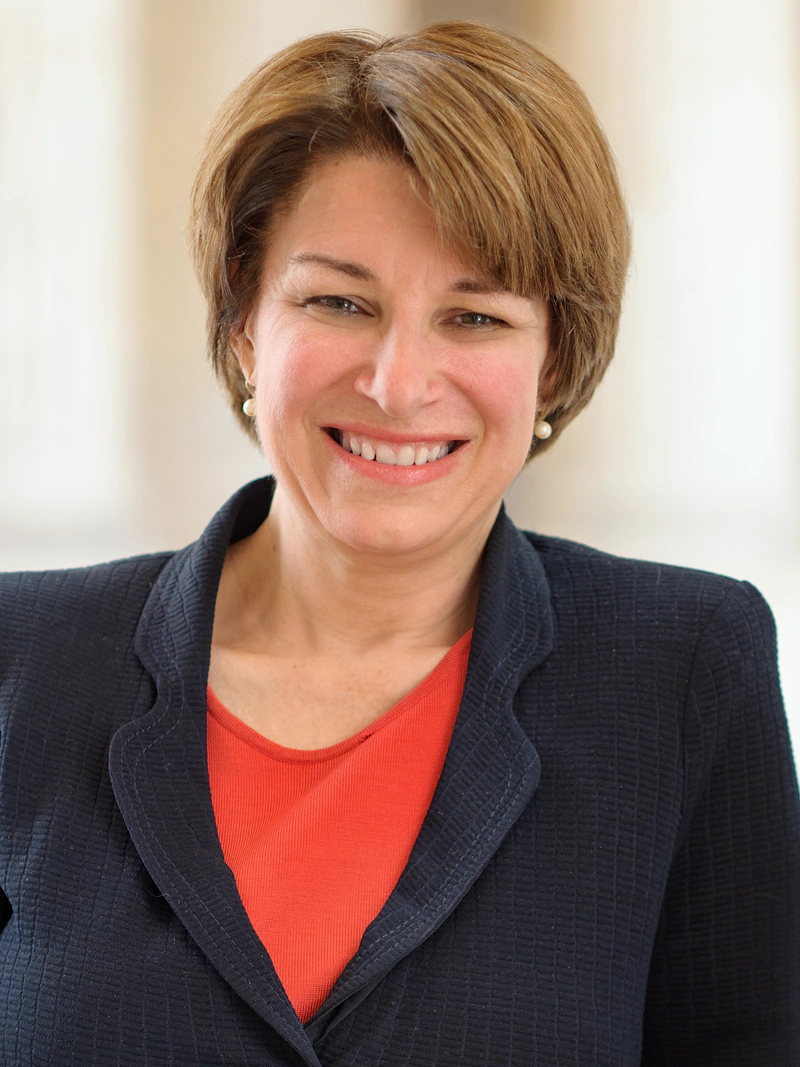
| 16 Quotes | |
| Born as | Amy Jean Klobuchar |
| Occup. | Congressman |
| From | USA |
| Spouse | John Bessler |
| Born | May 25, 1960 Plymouth, Minnesota, USA |
| Age | 65 years |
| Cite | |
Citation Formats
APA Style (7th ed.)
Amy klobuchar biography, facts and quotes. (2026, February 11). FixQuotes. https://fixquotes.com/authors/amy-klobuchar/
Chicago Style
"Amy Klobuchar biography, facts and quotes." FixQuotes. February 11, 2026. https://fixquotes.com/authors/amy-klobuchar/.
MLA Style (9th ed.)
"Amy Klobuchar biography, facts and quotes." FixQuotes, 11 Feb. 2026, https://fixquotes.com/authors/amy-klobuchar/. Accessed 22 Mar. 2026.
Early Life and Background
Amy Jean Klobuchar was born May 25, 1960, in Plymouth, Minnesota, and came of age in a state whose political culture prized clean government, practical reforms, and an almost civic-minded stubbornness. The daughter of Jim Klobuchar, a longtime Minneapolis Star Tribune columnist, and Rose (Heuberger) Klobuchar, a teacher, she grew up in a home where public life was not abstract - it was the daily work of explaining a city, a ballgame, a budget, and a neighbor's struggle with the same clarity. Minnesota in the 1960s and 1970s was also reshaping itself through suburban growth around Minneapolis-Saint Paul, and her upbringing tracked that shift: rooted in Midwestern institutions, but close to the pressure points of modern metropolitan life.Family upheaval marked her early interior landscape. Her parents divorced when she was a teenager, and Klobuchar has often described that period as a forcing ground for steadiness - an early training in keeping commitments when circumstances change. That combination of stability-seeking and competitiveness would later show in her public persona: controlled, prepared, and unusually attentive to how decisions land on ordinary routines. The northern political temper - moral seriousness paired with aversion to grandstanding - formed her instincts long before she held office.
Education and Formative Influences
Klobuchar attended Yale University, graduating cum laude in 1982, and then earned her J.D. from the University of Chicago Law School in 1985, a period when American law and politics were being re-litigated around crime, constitutional interpretation, and the reach of federal power. Her early legal work and volunteer experience with abused women and families, later reflected in her University of Chicago thesis project that became the book Uncovering the Dome (about the construction of U.S. Bank Stadium decades later), reinforced an enduring habit: treat institutions not as symbols, but as systems with levers, invoices, and human consequences.Career, Major Works, and Turning Points
After practicing law in Minnesota, Klobuchar entered public service as Hennepin County attorney (elected 1998; served 1999-2006), managing one of the largest prosecutor's offices in the Midwest with a reputation for competence and a focus on victims' services and community prosecution. In 2006 she won election to the U.S. Senate, becoming Minnesota's first elected female senator, and built a career as a legislative workhorse with a centrist-Democratic profile: consumer protection, antitrust enforcement, opioid and prescription-drug policy, election security, and pragmatic infrastructure. She chaired the Senate Judiciary Subcommittee on Antitrust, Competition Policy and Consumer Rights, pressed tech and consolidation issues, and became known for high bill-passage totals relative to peers. Her 2020 presidential run briefly elevated her as a Midwestern alternative inside a polarized party; her campaign ended after the South Carolina primary, and she endorsed Joe Biden, signaling her preference for coalition-building over factional purity.Philosophy, Style, and Themes
Klobuchar's political psychology is anchored in institutional loyalty and a conviction that democracy is not self-sustaining. She frames democratic continuity as the precondition for every other reform, a mindset sharpened by the post-2016 era of disinformation, election interference, and rising political violence. When she says, “Our democracy is a sacred trust”. , she is revealing a temperament that treats governance less as ideological theater and more as custodial duty - something inherited, maintained, and repaired. That language also maps onto her Senate focus on election infrastructure and rule-based competition in markets: to her, systems fail when norms erode and enforcement weakens.Her style is famously procedural: prepare, listen, bargain, repeat. The ethic is visible in her insistence on presence as a civic act - “There is no magic to politics. There's hard work. There's showing up”. It is both self-description and discipline: ambition tethered to stamina, ego constrained by checklists. Even her often-cited call for civic temperament - “You can disagree without being disagreeable”. - reads less like etiquette than like a theory of persuasion: political change requires keeping enough trust intact to assemble majorities, and majorities require relationships. The tension in her approach is that institutional faith can look like caution; the advantage is durability - an ability to keep working in the long middle of government where most outcomes are decided.
Legacy and Influence
Klobuchar's enduring influence rests on redefining what prominence can look like in a media-saturated age: not charisma-first, but committee-literate, legislatively minded, and explicitly protective of democratic processes. As a senator shaped by Minnesota pragmatism and by the institutional shocks of the 2010s and 2020s, she helped keep antitrust and competition policy central to Democratic governance debates, and she modeled a form of leadership that treats politics as accumulated credibility rather than a single performance. Whether remembered as a presidential contender or as a long-serving senator, her record argues that democratic resilience is built by people who keep showing up to do the unglamorous work of lawmaking.Our collection contains 16 quotes written by Amy, under the main topics: Motivational - Justice - Leadership - Freedom - Hope.
Source / external links