
Anatole France Biography Quotes 48 Report mistakes
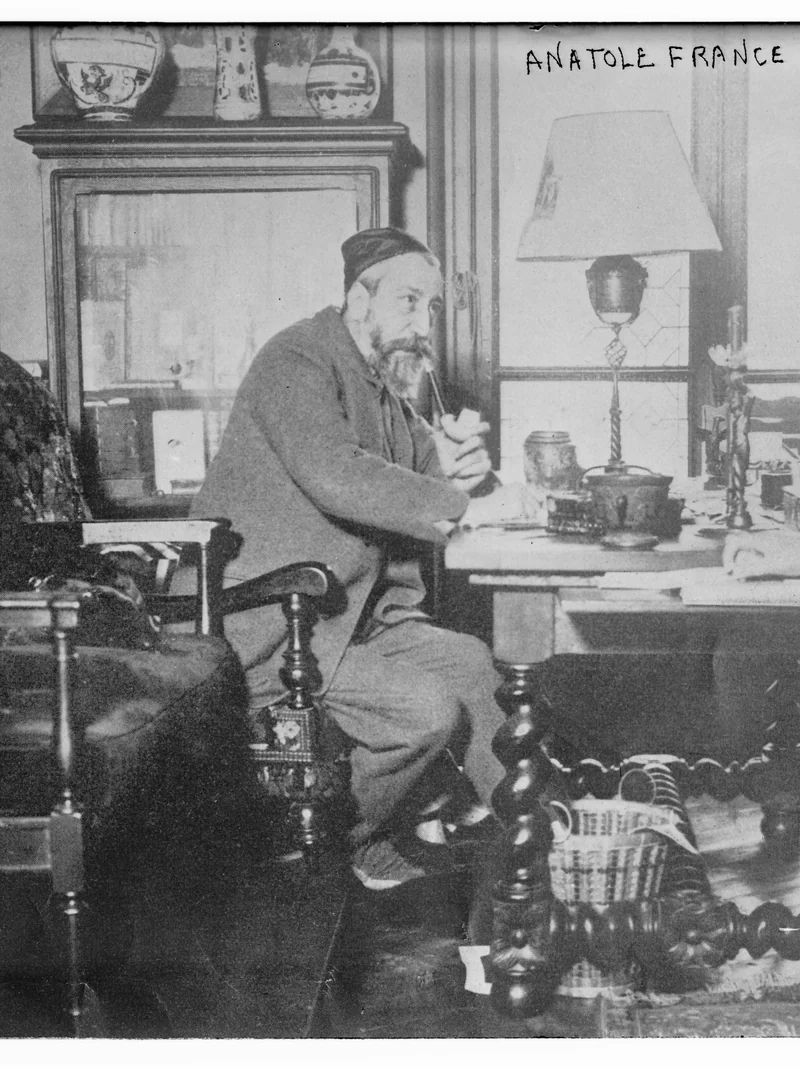
| 48 Quotes | |
| Occup. | Novelist |
| From | France |
| Born | April 16, 1844 |
| Died | October 12, 1924 |
| Aged | 80 years |
| Cite | |
Citation Formats
APA Style (7th ed.)
Anatole france biography, facts and quotes. (2026, February 1). FixQuotes. https://fixquotes.com/authors/anatole-france/
Chicago Style
"Anatole France biography, facts and quotes." FixQuotes. February 1, 2026. https://fixquotes.com/authors/anatole-france/.
MLA Style (9th ed.)
"Anatole France biography, facts and quotes." FixQuotes, 1 Feb. 2026, https://fixquotes.com/authors/anatole-france/. Accessed 25 Mar. 2026.
Early Life and Background
Anatole France was born Francois-Anatole Thibault on 1844-04-16 in Paris, in the narrow world of the Latin Quarter where old paper, old arguments, and old regimes still seemed to breathe. His father, Francois Noel Thibault, kept a bookshop that specialized in the Revolution and the classics, a trade that put the boy in daily contact with worn bindings and living talk - with priests, republicans, professors, and dilettantes all passing through the same doorway. From the start, he learned to read temperaments as closely as texts, and the habit of ironic observation that later became his signature was first a way of staying poised amid Parisian chatter.He grew up through the Second Republic's aftershocks and the consolidation of the Second Empire, then watched that political confidence collapse in 1870-1871 with defeat in the Franco-Prussian War and the Paris Commune. The experience fixed a lifelong sense that institutions were fragile and that public virtue was often theater. In private, his early life also trained him in a quiet stoicism: the child of a shopkeeper could enter the republic of letters, but only by discipline, connections, and the slow accumulation of authority.
Education and Formative Influences
France studied at the College Stanislas, a Catholic school whose formal rhetoric and moral instruction sharpened his skepticism as much as his prose. He absorbed Latin authors, especially the lucid irony of the satirists, and came to prefer the measured intelligence of the 18th century - Voltaire above all - to Romantic self-display. Early work as a publisher's reader and as a critic trained him to judge style like a craftsman, and the Parisian salon world taught him the social uses of literature: not only to move hearts, but to place ideas where power could not easily ignore them.Career, Major Works, and Turning Points
His first major success, The Crime of Sylvestre Bonnard (1881), presented the kind of hero he understood from inside - a kindly scholar whose decency is tested by the mess of real life - and it made France a central figure in Third Republic letters. He followed with novels that used the past as a mirror for the present: Thais (1890) and The Red Lily (1894) mixed sensuality, belief, and disillusion; the four-volume Contemporary History (1897-1901) anatomized bourgeois politics with surgical calm; and Penguin Island (1908) turned national myth into comic allegory. The decisive turning point was the Dreyfus Affair: France publicly defended Alfred Dreyfus and joined Emile Zola and other intellectuals against anti-Semitism and state secrecy, a choice that aligned his art with civic conscience and moved him toward a more explicit left-wing humanism. Elected to the French Academy in 1896, he received the Nobel Prize in Literature in 1921, then died in Paris on 1924-10-12, famous, contested, and still mischievously clear-eyed.Philosophy, Style, and Themes
France's inner life was marked by a tension between tenderness and disbelief. He distrusted mass opinion, not from aristocratic contempt but from a historian's sense of repetition and error - “If a million people say a foolish thing, it is still a foolish thing”. That sentence captures his psychology: a man trained in books and archives who refused to confuse consensus with truth. Yet he was not a cold rationalist; he wrote as someone who knew that ideas become humane only when touched by sympathy, and his gentlest characters often reveal a craving for innocence that the modern world has made hard to keep.His prose was celebrated for its classical poise - clean sentences, balanced clauses, a smile that can turn to a scalpel. The smile often cut toward social justice. In his most quoted formulation, “The law, in its majestic equality, forbids the rich as well as the poor to sleep under bridges, to beg in the streets, and to steal bread”. This is France at full strength: irony deployed not to evade commitment, but to expose how abstract principles can protect privilege. Still, he remained wary of systems that pretend to know too much about human motives; his fiction returns to partial understanding, mixed motives, and the small mercies individuals can still choose. Even his reveries about imagination - “To imagine is everything, to know is nothing at all”. - are less anti-intellectual than anti-dogmatic, a defense of the mind's freedom against official certainties.
Legacy and Influence
For decades France represented the cultivated conscience of the Third Republic: a novelist-critic who could translate scholarship into narrative, and politics into parable, without surrendering elegance. His reputation later dipped as modernism and harsher political passions made his urbanity seem insufficient, yet his best work endures as a template for the engaged ironist - the writer who can love civilization while diagnosing its hypocrisies. In the long view, his influence persists less in formal imitation than in permission: to be skeptical without nihilism, humane without sentimentality, and politically awake without sacrificing the pleasures of style.Our collection contains 48 quotes written by Anatole, under the main topics: Witty One-Liners - Motivational - Ethics & Morality - Truth - Wisdom.
Other people related to Anatole: Pierre Loti (Writer)
Anatole France Famous Works
- 1914 The Revolt of the Angels (Novel)
- 1912 The Gods Are Athirst (Novel)
- 1908 Penguin Island (Novel)
- 1894 The Red Lily (Novel)
- 1893 The Rotisserie of Queen Pédauque (Novel)
- 1890 Thaïs (Novel)
- 1881 The Crime of Sylvestre Bonnard (Novel)