
Anaxagoras Biography Quotes 5 Report mistakes
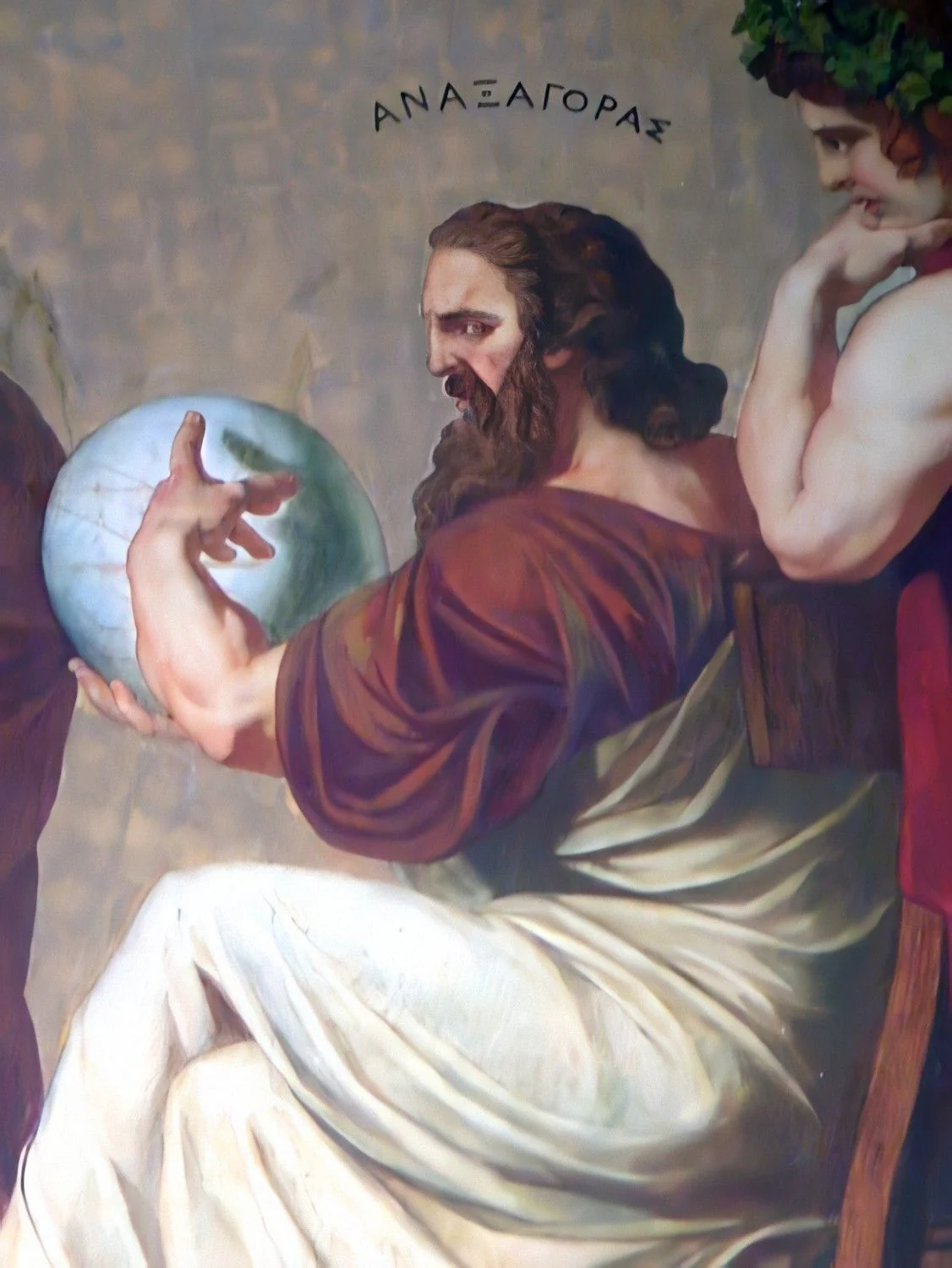
| 5 Quotes | |
| Occup. | Philosopher |
| From | Greece |
| Born | 500 BC Clazomenae, Ionia (now in modern-day Turkey) |
| Died | 428 BC Lampsacus, Ionia (now in modern-day Turkey) |
| Cite | |
Citation Formats
APA Style (7th ed.)
Anaxagoras biography, facts and quotes. (2026, February 11). FixQuotes. https://fixquotes.com/authors/anaxagoras/
Chicago Style
"Anaxagoras biography, facts and quotes." FixQuotes. February 11, 2026. https://fixquotes.com/authors/anaxagoras/.
MLA Style (9th ed.)
"Anaxagoras biography, facts and quotes." FixQuotes, 11 Feb. 2026, https://fixquotes.com/authors/anaxagoras/. Accessed 28 Mar. 2026.
Early Life and Background
Anaxagoras was born around 500 BCE in Clazomenae, an Ionian Greek city on the Anatolian coast, in a world where the old epic gods still framed public life but where seaborne trade and colonial contact had already made Ionia a laboratory for natural inquiry. Later tradition presents him as coming from a prosperous family, with enough means to step away from conventional civic ambition. Whatever the precise circumstances, his career makes sense only against the Ionian habit of asking what the world is made of, and how order can arise without recourse to mythic genealogy.Sometime in the early-mid 5th century BCE he left Ionia for Athens, the rising center of Greek political power and cultural experimentation. The move placed him at the hinge of eras: between Persian War aftermath and the coming Peloponnesian War, between aristocratic patronage and mass democratic politics. In Athens, intellectual life was increasingly public and contentious; the same city that rewarded originality in drama and rhetoric also policed impiety when ideas threatened civic cohesion.
Education and Formative Influences
No reliable record survives of his teachers, but his thought bears the imprint of earlier Ionian physics and the Eleatic demand for conceptual rigor: he inherits from Milesian speculation the search for material principles, and from Parmenides the pressure to explain change without allowing something to come from nothing. He also seems to have absorbed the practical astronomy of the Aegean and Near East, and he forged a distinctive synthesis: a cosmology at once mechanical in description and metaphysical in its insistence on an ordering intelligence.Career, Major Works, and Turning Points
In Athens Anaxagoras wrote a treatise generally known as On Nature, circulated in prose and later quarried for fragments by Aristotle, Simplicius, and other doxographers. He became associated with Pericles circle and influenced figures such as the tragedian Euripides; his rational explanations of celestial phenomena and his refusal to treat the sun and moon as divine made him vulnerable in a city where religion and politics intertwined. Sometime in the 430s BCE he was prosecuted for impiety (and perhaps for political reasons aimed at Pericles), imprisoned or threatened, and then left Athens; later accounts place his final years in Lampsacus on the Hellespont, where he died around 428 BCE and was honored locally. The exile was not merely biographical drama - it was a demonstration of the costs of explaining nature in public, in a democracy anxious about omens, war, and faction.Philosophy, Style, and Themes
Anaxagoras began from a blunt problem: if becoming and perishing are illusory, how can the world nonetheless display birth, growth, decay, and transformation? His answer was a radical pluralism. At the beginning, he held, "all things were together" - an indefinite mixture containing portions of every kind of stuff, infinitely divisible, with no smallest parts. Nothing truly comes into being or is destroyed; apparent change is the rearrangement and separation of ingredients already present, so that in every thing there is "a portion of everything". This doctrine both preserves the Eleatic ban on generation ex nihilo and accounts for empirical diversity through mixture and predominance.To make separation intelligible he introduced Nous, Mind, not as a mythic deity but as an autonomous, unmixed principle that initiates motion and organizes the cosmos. The psychological signature of his system is a confidence that explanation can pierce surface impression: “Appearances are a glimpse of the unseen”. That stance powered his naturalistic astronomy and his willingness to desacralize the heavens: “Everything has a natural explanation. The moon is not a god, but a great rock, and the sun a hot rock”. Yet his intellectual courage was matched by a bruised awareness of the citys volatility; the defiant tone later attributed to him in exile - “It is not I who have lost the Athenians, but the Athenians who have lost me”. - reads less like vanity than like a thinker asserting the independence of inquiry from popular verdicts. His prose, insofar as it can be reconstructed, was compressed and argumentative, aimed at reeducating perception: the world is not as it seems, and the task of reason is to specify the hidden structure that makes seeming possible.
Legacy and Influence
Anaxagoras reshaped Greek philosophy by making Mind a central explanatory term and by giving later thinkers a powerful model for reconciling permanence with change. Plato and Aristotle treated him as a pivotal predecessor - Aristotle admired the introduction of Nous while faulting its limited use, and Plato portrayed the promise of a rational cosmos that later systems would try to fulfill. His mixture theory fed into later debates on elements, qualities, and infinitesimal division; his celestial naturalism helped normalize the idea that the heavens obey the same kinds of causes as earthly bodies. Just as importantly, his Athenian trial became a recurring parable about the friction between free inquiry and civic religion, an enduring reminder that the history of ideas is also the history of the risks thinkers take when they insist that nature can be explained.Our collection contains 5 quotes written by Anaxagoras, under the main topics: Wisdom - Mortality - Reason & Logic - Peace.
Other people related to Anaxagoras: Parmedides (Philosopher)
Anaxagoras Famous Works
- -450 On Nature (Philosophical treatise)
Source / external links