
Andre Breton Biography Quotes 16 Report mistakes
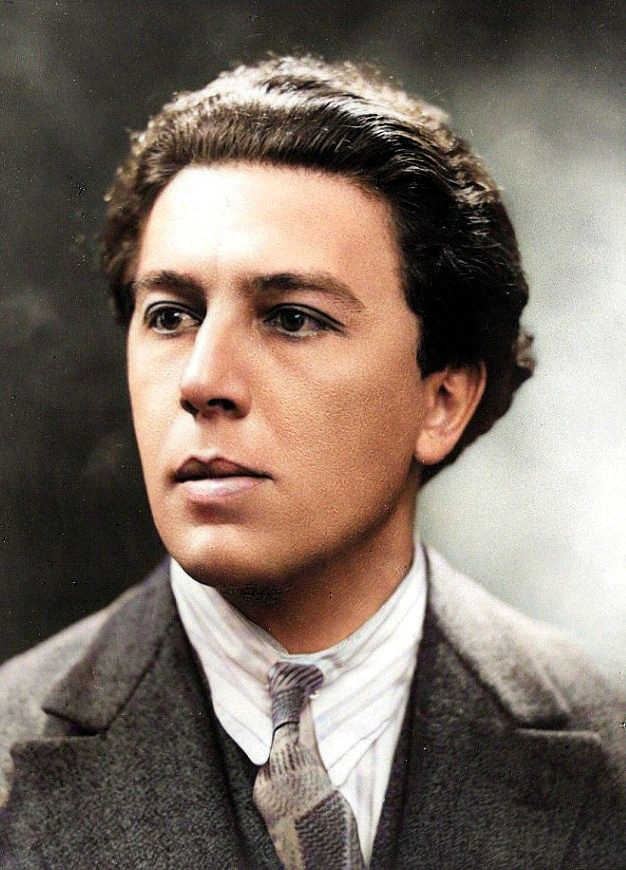
Attr: Henri Manuel
| 16 Quotes | |
| Born as | André Robert Breton |
| Known as | Father of Surrealism |
| Native name | André Breton |
| Occup. | Poet |
| From | France |
| Spouse | Elise Lamy |
| Born | February 18, 1896 Tinchebray, Orne, France |
| Died | September 28, 1966 Paris, France |
| Cause | Heart attack |
| Aged | 70 years |
| Cite | |
Citation Formats
APA Style (7th ed.)
Andre breton biography, facts and quotes. (2026, February 11). FixQuotes. https://fixquotes.com/authors/andre-breton/
Chicago Style
"Andre Breton biography, facts and quotes." FixQuotes. February 11, 2026. https://fixquotes.com/authors/andre-breton/.
MLA Style (9th ed.)
"Andre Breton biography, facts and quotes." FixQuotes, 11 Feb. 2026, https://fixquotes.com/authors/andre-breton/. Accessed 27 Mar. 2026.
Early Life and Background
Andre Breton was born on February 18, 1896, in Tinchebray, in rural Normandy, and grew up largely in nearby Saint-Brieuc and later Parisian surroundings shaped by the Third Republic's faith in progress and its anxieties about modernity. His father worked as a police clerk and later in insurance; his mother came from modest provincial stock. The family's social position was neither bohemian nor secure, and Breton learned early the discipline of respectable life even as he privately gravitated toward what could not be domesticated - reverie, forbidden reading, and a hunger for the marvelous within the everyday.That double pressure - bourgeois order outside, insurgent imagination within - became the psychological engine of his later leadership. He entered adulthood as Europe slid into mechanized catastrophe, and World War I radicalized him not through battlefield heroics but through the mind's exposure to trauma, delirium, and institutional control. Long before Surrealism had a name, Breton was already collecting evidence that the self was not a stable citizen but a contested territory.
Education and Formative Influences
Breton studied medicine in Paris, beginning in 1913, and his training in psychiatry and neurology proved decisive: he served during World War I in medical units and worked in psychiatric wards, encountering shell shock and the improvisations of early psychological treatment. In 1916 he met Jacques Vache, a nihilistic soldier whose disdain for received culture became for Breton an ethical shock; soon after he discovered Freud (often through secondary routes and imperfect access) and, in parallel, the poetic detonations of Rimbaud, Lautreamont, and Apollinaire. These influences fused the clinical and the lyrical: the mind as laboratory, language as the instrument that could expose what society demanded remain unseen.Career, Major Works, and Turning Points
After the war Breton moved through Dada circles with Tristan Tzara and Francis Picabia, then broke with Dada's purely negational impulse to found Surrealism as a disciplined adventure of the unconscious. He co-founded the journal Litterature, helped establish the Bureau of Surrealist Research, and in 1924 published the first Manifesto of Surrealism, defining automatism as a method and the marvelous as a goal; his novel Nadja (1928) made Paris a haunted map of chance encounters and erotic-metaphysical pursuit. A second manifesto (1930) hardened his polemical authority as he tried, with uneven results, to align Surrealism with revolutionary politics, joining the French Communist Party in 1927 and later being expelled amid disputes over artistic freedom. In exile during World War II he lived in the Americas, helped sustain Surrealism from New York, and returned to France after 1946 to defend the movement's continuity against both postwar conformity and the temptation to turn Surrealism into a museum style.Philosophy, Style, and Themes
Breton's inner life was organized around a single wager: that the mind contains a "certain point" where contradictions dissolve and a more total reality becomes accessible. “Everything tends to make us believe that there exists a certain point of the mind at which life and death, the real and the imagined, past and future, the communicable and the incommunicable, high and low, cease to be perceived as contradictions”. This was not abstract mysticism but a program for living - a refusal to accept the partitions imposed by bourgeois rationality, academic art, or political slogans. His fascination with dreams, coincidence, and sudden illumination was therefore existential: if the self is split, it can also be recomposed, not by moral improvement but by perceptual revolt.His style pursued that revolt through speed, montage, and unexpected couplings that mimic psychic eruption, yet he was also a rhetorician of manifestos, policing the movement's boundaries even as he proclaimed freedom. “No rules exist, and examples are simply life-savers answering the appeals of rules making vain attempts to exist”. The contradiction is revealing: Breton feared dilution more than rigidity, because Surrealism for him was not decoration but salvation from dead language and dead time. In Nadja and in his essays on love, he made eros the privileged pathway to the marvelous, an encounter that reconfigures identity rather than confirms it: “Love is when you meet someone who tells you something new about yourself”. Desire, in his work, is both romance and epistemology - a way of knowing what the self has repressed, and a way of refusing the world's coerced normality.
Legacy and Influence
Breton died in Paris on September 28, 1966, leaving behind not only poems, novels, and manifestos but a model of the artist as organizer of a collective imagination. His insistence that dream, chance, and desire are legitimate sources of knowledge shaped 20th-century poetry, visual art, cinema, and later countercultures, from automatic writing experiments to the iconography of the marvelous in photography and film. Just as enduring is the tension he embodied: visionary openness coupled to doctrinal severity. That friction - between liberation and leadership, private rapture and public program - helped keep Surrealism from becoming merely a style, and ensured that Breton remains a central figure for anyone who suspects that reality is larger than what is permitted to appear.Our collection contains 16 quotes written by Andre, under the main topics: Wisdom - Art - Writing - Freedom - Deep.
Other people related to Andre: Salvador Dali (Artist), Rene Magritte (Artist), Georges Bataille (Writer), Raymond Queneau (Poet), Man Ray (Photographer), Rene Daumal (Writer), Odysseas Elytis (Writer), Paul Eluard (Poet), Comte de Lautreamont (Poet), Yves Tanguy (Artist)
Andre Breton Famous Works
- 1953 Earthlight (Poetry Collection)
- 1947 Ode à Charles Fourier (Book)
- 1946 Young Cherry Trees Secured Against Hares (Poetry Collection)
- 1944 Arcane 17 (Book)
- 1937 L'Amour fou (Novel)
- 1928 Nadja (Novel)
- 1924 Manifesto of Surrealism (Book)
Source / external links