
Andrea Dworkin Biography Quotes 28 Report mistakes
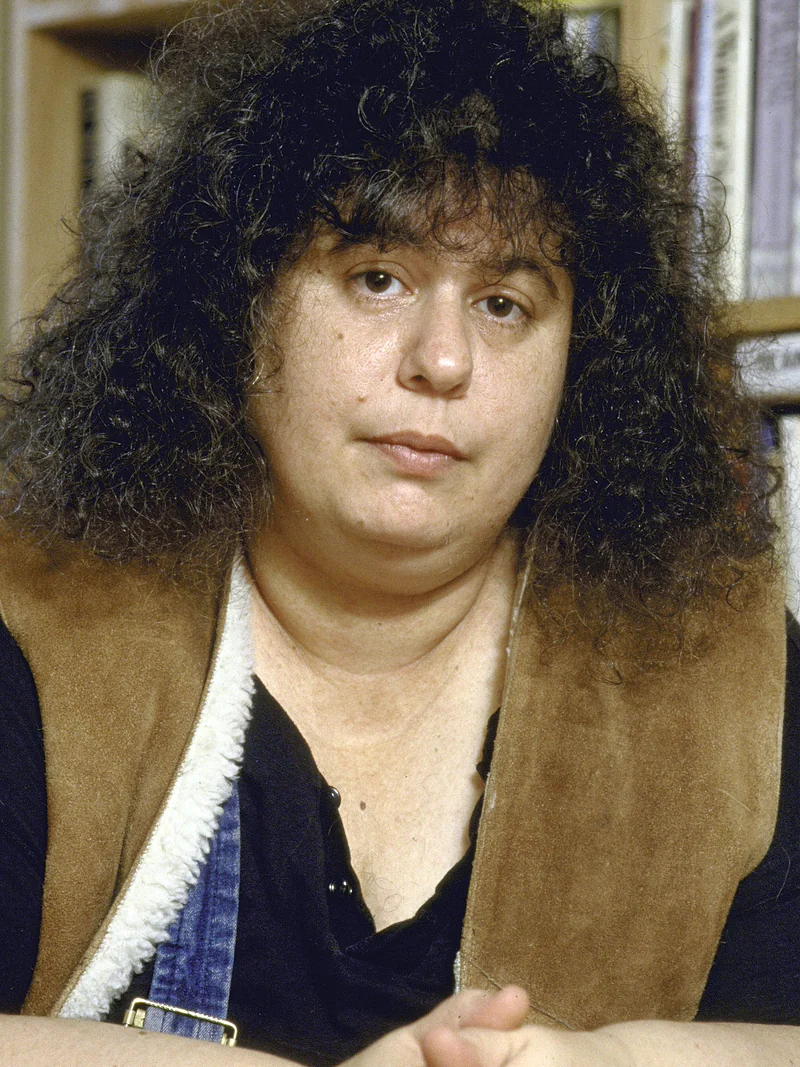
Attr: juliebindel.substack.com
| 28 Quotes | |
| Born as | Andrea Rita Dworkin |
| Occup. | Critic |
| From | USA |
| Born | September 26, 1946 Camden, New Jersey, USA |
| Died | April 9, 2005 Washington, DC, USA |
| Aged | 58 years |
| Cite | |
Citation Formats
APA Style (7th ed.)
Andrea dworkin biography, facts and quotes. (2026, February 11). FixQuotes. https://fixquotes.com/authors/andrea-dworkin/
Chicago Style
"Andrea Dworkin biography, facts and quotes." FixQuotes. February 11, 2026. https://fixquotes.com/authors/andrea-dworkin/.
MLA Style (9th ed.)
"Andrea Dworkin biography, facts and quotes." FixQuotes, 11 Feb. 2026, https://fixquotes.com/authors/andrea-dworkin/. Accessed 27 Mar. 2026.
Early Life and Background
Andrea Rita Dworkin was born on September 26, 1946, in Camden, New Jersey, into a Jewish family shaped by the aftershocks of the Holocaust and postwar American conformity. Her father, a schoolteacher and social worker, and her mother, a homemaker, raised her amid the frictions of working- and middle-class aspiration, Cold War discipline, and the gendered expectations that pressed hardest on ambitious girls. From the start she wrote as if language were a moral instrument, not decoration - a way to name what polite society required women to endure in silence.The formative trauma that Dworkin later placed near the root of her politics came early: as a young woman she was arrested at an antiwar protest and subjected, she reported, to a brutal internal examination in custody. The experience joined the era's public violence - Vietnam, police crackdowns, racist terror - to the private humiliations that feminism was beginning to describe as political. It also gave her a lifelong suspicion of institutions that claim neutrality while policing bodies: courts, medicine, and the family itself.
Education and Formative Influences
Dworkin attended Bennington College in Vermont during the 1960s, a period when the campus mixed avant-garde art with intense political argument; she left before completing a degree. She read widely in literature and radical theory while absorbing the counterculture's promises and betrayals - especially its sexual libertarianism, which often reproduced male power under a new banner. The emerging women's liberation movement, the writing of early radical feminists, and the reality of antiwar organizing furnished her with both a vocabulary and a target: the way domination hides inside what is called romance, freedom, or taste.Career, Major Works, and Turning Points
After time in the Netherlands and a marriage she later described as violent, Dworkin returned to the United States and became a central, polarizing voice of radical feminism in the 1970s-1990s. Her major books - Woman Hating (1974), Pornography: Men Possessing Women (1981), Right-Wing Women (1983), Intercourse (1987), and Life and Death (1997) - fused polemic, cultural criticism, and close reading, treating male supremacy as a political system with aesthetic, sexual, and legal instruments. A key turning point was her alliance with legal scholar Catharine A. MacKinnon to draft the Indianapolis anti-pornography civil-rights ordinance (1983-1984), which sought to define pornography as a practice that harms women and to give those harmed a civil remedy; it was repeatedly struck down on First Amendment grounds, cementing Dworkin's reputation as both visionary and censor in the public imagination. In later years she lectured widely, wrote memoiristic essays, and, despite chronic illness, persisted as a witness against what she saw as the normalization of sexual cruelty; she died on April 9, 2005, in Washington, D.C.Philosophy, Style, and Themes
Dworkin's inner life, as her prose reveals, was driven by a severe form of moral attention: she watched how domination becomes pleasurable and therefore durable. Her critique of pornography and "erotica" was not prudishness but a theory of social training - the way images teach people what to desire and whom to disregard. When she wrote, “Erotica is simply high-class pornography; better produced, better conceived, better executed, better packaged, designed for a better class of consumer”. , she was diagnosing refinement as camouflage, insisting that class and artistry can launder the same old hierarchy into sophistication. The point was psychological as much as political: a culture learns to call harm beautiful, and then defends beauty as innocent.Her style was incantatory, courtroom-sharp, and intimate with suffering; she argued like someone trying to prevent the next injury, not merely win a seminar. She could sound absolute because she was mapping a world where exceptions do not rescue the rule. “Feminism is hated because women are hated. Anti-feminism is a direct expression of misogyny; it is the political defense of women hating”. The sentence is less slogan than x-ray: it exposes the emotional investment that makes backlash feel righteous. Yet she also wrote to fortify courage against that backlash, framing feminism as an act of collective daring rather than individual self-improvement: “Women have been taught that, for us, the earth is flat, and that if we venture out, we will fall off the edge. Some of us have ventured out nevertheless, and so far we have not fallen off. It is my faith, my feminist faith, that we will not”. In that faith is the private Dworkin - frightened, furious, relentless - turning fear into a disciplined refusal to accept the boundaries assigned to women.
Legacy and Influence
Dworkin endures as one of the most quoted and contested feminist critics of the late 20th century, a writer who forced arguments about sex, consent, representation, and male violence out of the realm of euphemism and into public policy. Her opponents caricatured her as anti-sex; her readers found in her a language for experiences that had been treated as personal shame or inevitable "nature". The debates she ignited - about pornography's harms, about whether freedom of expression can coexist with sexual inequality, about the difference between desire and coercion in a patriarchal culture - now run through campus policy, survivor advocacy, internet platform governance, and renewed feminist organizing. If her work sometimes reads like prophecy, it is because she wrote about the social machinery that keeps reproducing itself; her lasting influence lies in making that machinery visible, and therefore, at least in principle, changeable.Our collection contains 28 quotes written by Andrea, under the main topics: Ethics & Morality - Freedom - Knowledge - Poetry - Equality.