
Andrew Carnegie Biography Quotes 31 Report mistakes
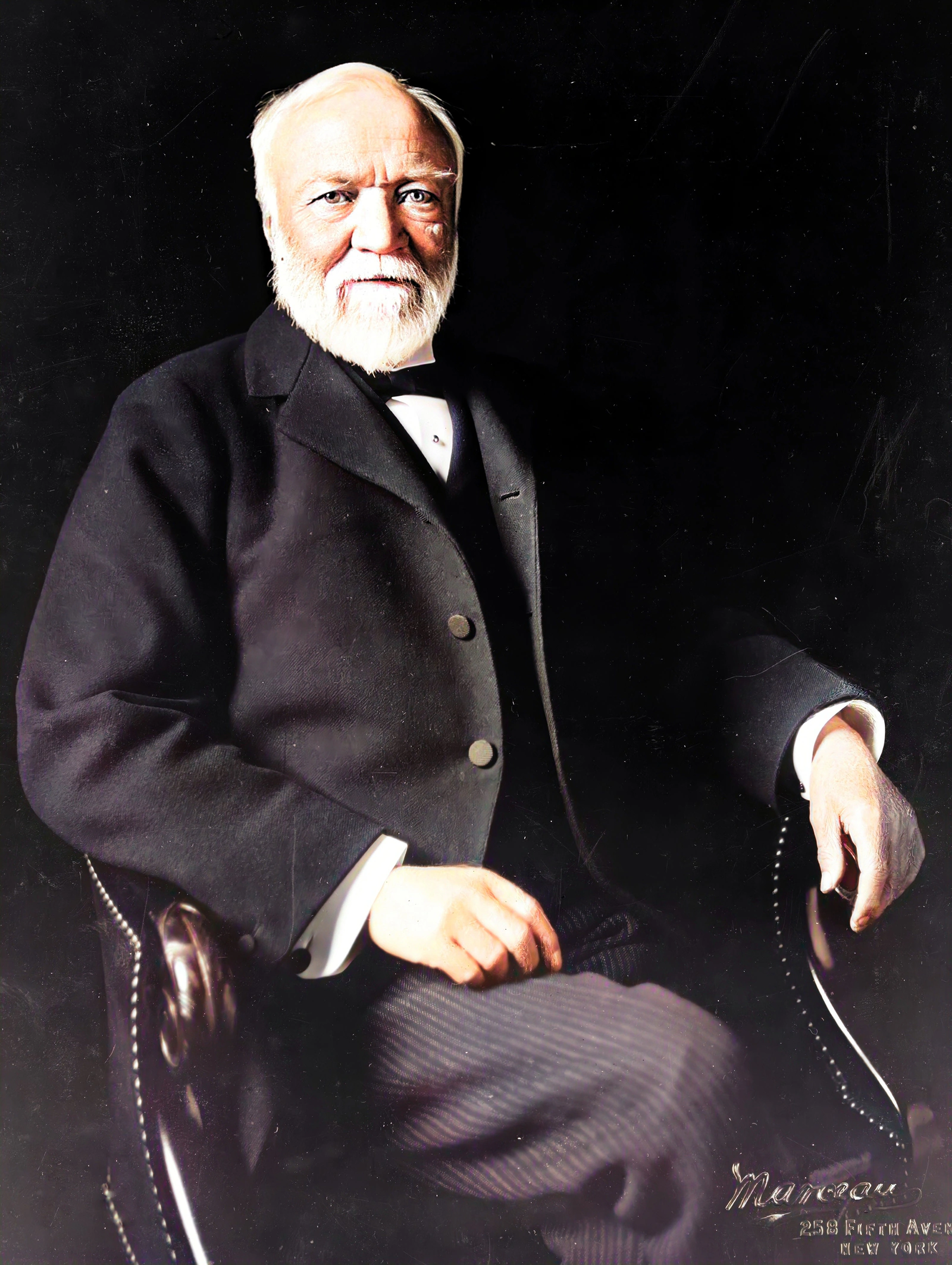
Attr: Theodore C. Marceau
| 31 Quotes | |
| Occup. | Businessman |
| From | USA |
| Born | November 25, 1835 Dunfermline, Scotland |
| Died | August 11, 1919 Lenox, Massachusetts, USA |
| Cause | Pneumonia |
| Aged | 83 years |
| Cite | |
Citation Formats
APA Style (7th ed.)
Andrew carnegie biography, facts and quotes. (2026, February 11). FixQuotes. https://fixquotes.com/authors/andrew-carnegie/
Chicago Style
"Andrew Carnegie biography, facts and quotes." FixQuotes. February 11, 2026. https://fixquotes.com/authors/andrew-carnegie/.
MLA Style (9th ed.)
"Andrew Carnegie biography, facts and quotes." FixQuotes, 11 Feb. 2026, https://fixquotes.com/authors/andrew-carnegie/. Accessed 25 Mar. 2026.
Early Life and Background
Andrew Carnegie was born on November 25, 1835, in Dunfermline, Fife, Scotland, into a handloom-weaver household already pressured by mechanization and falling wages. His father, William Carnegie, carried radical working-class ideals; his mother, Margaret Morrison Carnegie, carried the sharper instinct for survival and respectability. Carnegie later drew from both strains: the moral certainty of the reformer and the calculating discipline of the striver.In 1848 the family emigrated to the United States and settled in Allegheny City, Pennsylvania (now part of Pittsburgh), a region whose rivers and coal seams were becoming an industrial engine. The move was not romantic aspiration but necessity, and that origin story stayed close to him: modern capitalism as both rescue and upheaval. As a boy he worked first in a cotton mill and then as a messenger, absorbing the street-level facts of American urban growth - speed, noise, and opportunity braided together with precarious labor.
Education and Formative Influences
Carnegie had little formal schooling; his education came from voracious reading and from patrons who opened doors in a society that prized self-making. Colonel James Anderson, who lent books to working boys, became a lasting symbol for Carnegie of upward mobility through knowledge, later echoed in his own library program. By his teens he was a telegraph operator, learning not only the code but the habits of attention and initiative that corporate life rewarded. Just as important were the ideologies in the air: faith in progress, the American gospel of work, and a Victorian conviction that character could be engineered.Career, Major Works, and Turning Points
Carnegie rose quickly through the Pennsylvania Railroad under Thomas A. Scott, mastering logistics, costs, and the politics of expansion. During the Civil War he helped organize military rail transport and telegraph operations, a crucible that taught him how industry and the state could fuse in emergencies. He invested early in iron and then steel, building the Keystone Bridge Company and, most consequentially, Carnegie Steel, headquartered in Pittsburgh and integrated from ore to rail. His mills adopted the Bessemer process and later open-hearth improvements, driving down price and driving up scale. The violent 1892 Homestead Strike at the companys works - sparked by wage cuts and met with Pinkerton force - exposed the human cost of his system and haunted his public image, even as the business continued to dominate. In 1901 he sold Carnegie Steel to J.P. Morgan for about $480 million, forming U.S. Steel; he then shifted his identity from builder of an industrial empire to distributor of its proceeds, publishing essays such as "Wealth" (1889) and later "The Gospel of Wealth".Philosophy, Style, and Themes
Carnegies inner life was a negotiation between gratitude and control. He never forgot the immigrant family that needed America to survive, yet he came to believe that markets were a rough but ultimately improving mechanism. His statements on competition are revealing because they defend the system that made him while converting its brutality into a law of nature: “And while the law of competition may be sometimes hard for the individual, it is best for the race, because it ensures the survival of the fittest in every department”. That faith helped him endure moral dissonance - the ability to view strikes and layoffs as impersonal necessities rather than intimate tragedies.At the same time, he insisted that wealth carried psychological danger and ethical obligation. “Surplus wealth is a sacred trust which its possessor is bound to administer in his lifetime for the good of the community”. The phrasing is not casual; it is a self-imposed duty that also secures legacy and relieves guilt, converting profit into public purpose. Even his more worldly aphorisms show how he read society as a contest of timing and nerve: “The first man gets the oyster, the second man gets the shell”. In Carnegies mind, the successful capitalist was not merely lucky but mentally disciplined, strategically early, and willing to simplify life into a single line of advance.
Legacy and Influence
Carnegie died on August 11, 1919, at Shadowbrook in Lenox, Massachusetts, after giving away the bulk of his fortune through what became a distinctive American model of institutional philanthropy. He funded more than 2, 500 public libraries worldwide, endowed Carnegie Mellon University (originally Carnegie Technical Schools), created Carnegie Hall in New York, and established the Carnegie Endowment for International Peace and the Carnegie Institution for Science. His influence remains double-edged: a template for industrial scale and managerial efficiency, and a permanent case study in the tension between private power and public good. The modern language of philanthrocapitalism - wealth justified by downstream social investment - owes him both its architecture and its unresolved questions.Our collection contains 31 quotes written by Andrew, under the main topics: Motivational - Ethics & Morality - Truth - Leadership - Reason & Logic.
Other people related to Andrew: Napoleon Hill (Writer), Charles M. Schwab (Businessman), J. P. Morgan (Businessman), Charles Schwab (Businessman), John Bigelow (Lawyer)
Andrew Carnegie Famous Works
- 1908 Problems of To-day (Book)
- 1902 Empire of Business (Book)
- 1889 The Gospel of Wealth (Book)
- 1886 Triumphant Democracy (Book)
Source / external links