
Andrew Carnegie Biography Quotes 31 Report mistakes
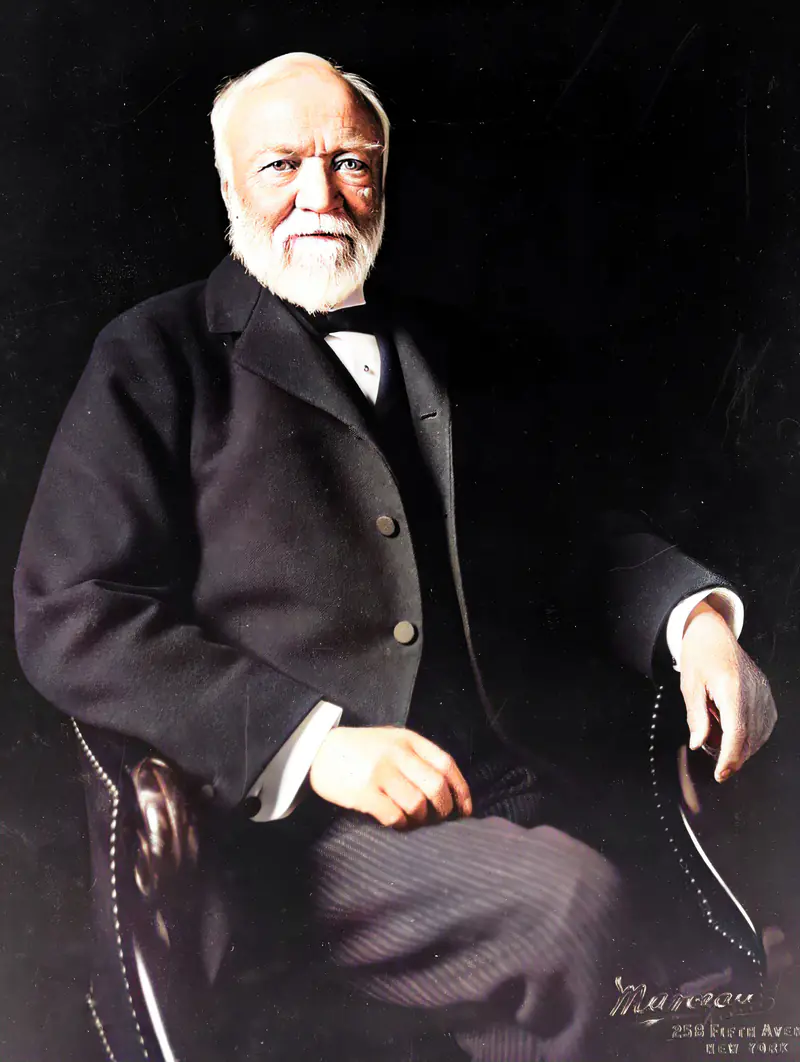
Attr: Theodore C. Marceau
| 31 Quotes | |
| Occup. | Businessman |
| From | USA |
| Born | November 25, 1835 Dunfermline, Scotland |
| Died | August 11, 1919 Lenox, Massachusetts, USA |
| Cause | Pneumonia |
| Aged | 83 years |
Andrew Carnegie was born in Dunfermline, Scotland, on November 25, 1835, to William Carnegie, a handloom weaver, and Margaret Morrison Carnegie. His childhood unfolded amid economic upheaval as mechanized looms displaced traditional crafts and employment in the weaving towns collapsed. The family lived modestly, and Margaret Carnegie became the decisive force who kept the household afloat when William struggled for work. In 1848, searching for opportunity, the Carnegies emigrated to the United States, settling in Allegheny City, Pennsylvania, across the river from Pittsburgh.
Apprenticeship in Telegraphy and Railroads
In industrializing western Pennsylvania, the teenage Carnegie took whatever work he could find. He began as a bobbin boy in a cotton mill, then became a telegraph messenger and operator. He distinguished himself by mastering the craft, learning to recognize signals by ear, a rare skill. Talent and drive brought him to the attention of Thomas A. Scott of the Pennsylvania Railroad, who hired him as a secretary and telegraph operator. Scott became an influential mentor, and Carnegie rose quickly, eventually becoming a superintendent of the Pittsburgh Division. During the Civil War, he helped coordinate telegraph and railroad logistics for the Union, learning how large systems, capital, and technology could be organized at scale.
From Iron Bridges to Steel
Leveraging savings and connections, Carnegie began investing in enterprises that supplied the railroad age. He backed sleeping cars and oil ventures and, crucially, founded the Keystone Bridge Company to replace wooden spans with stronger iron. After the war, he moved decisively into iron and then into steel, working with skilled associates such as Henry Phipps Jr., George Lauder, and engineer Alexander L. Holley to adopt and improve the Bessemer process. By the 1870s and 1880s, the Carnegie firms had become a vertically integrated system encompassing coke fields, ore deposits, rail transport, and mills at Braddock, Homestead, and elsewhere near Pittsburgh. The organization emphasized relentless cost control, technological innovation, and reinvestment of profits to expand capacity.
Management Style and Partnerships
Carnegie articulated a philosophy of delegating authority to capable lieutenants while keeping overall strategic control. He recruited ambitious managers, among them Henry Clay Frick to oversee coke and later to serve as chairman of the steel operations, and a young Charles M. Schwab, who rose from the shop floor to become an effective executive. Carnegie could be charming and loyal, but he was also exacting in negotiations, pushing suppliers and partners to the limit. His close colleague Henry Phipps Jr. managed finances with unusual discipline, while his cousin George Lauder contributed technical acumen. These partnerships helped the enterprise move with speed and confidence in a volatile industry.
The Homestead Strike and Its Aftermath
Growth brought conflict. In 1892, the Homestead Works became the site of one of the most consequential labor confrontations in American history. While Carnegie was in Scotland, his chairman Henry Clay Frick locked out the Amalgamated Association of Iron and Steel Workers after a wage dispute, leading to a violent clash between armed Pinkerton agents and locked-out workers. The attempted assassination of Frick by the anarchist Alexander Berkman further inflamed tensions. Although Carnegie had long expressed sympathy for education and self-improvement among workers, the events at Homestead stained his reputation. Many critics argued that his system, with its exacting costs and drive for efficiency, left too little space for union power. The episode created a lasting rift between Carnegie and Frick and complicated the moral claims of an industrialist who also preached benevolence.
Sale to United States Steel
By the late 1890s, Carnegie Steel was the dominant American producer. In 1901, financier J. P. Morgan consolidated Carnegie Steel with other firms to form United States Steel. Carnegie agreed to sell, and the transaction made him one of the wealthiest individuals in the world. Charles M. Schwab became the first president of the new company. The sale marked a turning point: Carnegie, still in his mid-sixties, withdrew from business life to devote himself to philanthropy and public causes.
The Gospel of Wealth
Carnegie had articulated his philanthropic creed in an 1889 essay, Wealth, often called The Gospel of Wealth. He argued that the accumulation of great fortunes could be socially beneficial if the wealthy became trustees for the community, deploying their surplus capital to create ladders of opportunity. He condemned indiscriminate charity that sustained dependency and urged targeted endowments for libraries, universities, cultural institutions, and scientific research. His aphorism, The man who dies thus rich dies disgraced, became a mantra for his final decades.
Libraries, Education, and Culture
The most visible fruits of this creed were the thousands of Carnegie libraries built across the United States, the British Isles, and other countries. Working closely with his longtime secretary James Bertram, he developed guidelines that required municipalities to provide sites, maintenance, and free access in exchange for building grants. He funded the Carnegie Institute in Pittsburgh, today connected to the Carnegie Museums, and in New York, he endowed Carnegie Hall, which opened in 1891 and became a premier venue for music and public lectures.
He created the Carnegie Institute of Technology in Pittsburgh, which later merged to form Carnegie Mellon University. He endowed the Carnegie Institution of Washington for scientific research and the Carnegie Foundation for the Advancement of Teaching, which established a pioneering pension system for college professors. He also supported historically Black institutions, notably aiding Booker T. Washington and Tuskegee Institute, reflecting his belief in education as the primary engine of advancement.
Peace, Policy, and Public Life
In his later years, Carnegie championed international arbitration and disarmament. He funded the Carnegie Endowment for International Peace and provided major support for the Peace Palace at The Hague, designed as a home for international law. He aligned himself with other prominent voices, including diplomat Andrew Dickson White and, at times, President Theodore Roosevelt, even when their views on military preparedness diverged. At home, Carnegie joined the American Anti-Imperialist League alongside figures such as Mark Twain, opposing U.S. annexation of the Philippines after the Spanish-American War. He wrote letters and essays urging policy makers to resolve disputes through law rather than force, seeing peace as the ultimate economy.
Personal Life
Carnegie married Louise Whitfield in 1887. Their marriage was a lasting partnership; Louise often advised on charitable gifts and maintained the household that anchored his increasingly public life. They had one daughter, Margaret, whose upbringing intertwined with the family commitment to civic endeavors. Though Carnegie relished society and travel, he also valued quiet retreats, spending time in Scotland at Skibo Castle and in the Berkshires when in the United States. Friendships with thinkers such as Herbert Spencer reinforced his belief that social progress depended on individual initiative guided by civic conscience.
Final Years and Death
Carnegie spent the 1900s and 1910s systematically transferring his wealth to the institutions he had created. He remained attentive to implementation details, corresponding with boards and trustees to ensure that endowments followed clear standards. The outbreak of World War I tested his optimism about peaceful arbitration; he continued to fund relief and postwar efforts while grieving the scale of destruction. He died on August 11, 1919, in Lenox, Massachusetts, after a brief illness. He was buried in Sleepy Hollow Cemetery in New York.
Legacy and Assessment
Andrew Carnegie left a complex legacy. As a businessman, he was an architect of American steel and a master of vertical integration, cost control, and technological adaptation. Associates such as Henry Phipps Jr., Charles M. Schwab, George Lauder, and Henry Clay Frick helped build and run an enterprise that supplied rails, beams, and armor plate for a growing nation. As a public figure, he advocated self-improvement and social investment, and he endowed durable institutions that still shape science, education, music, law, and international relations. Yet the memory of Homestead, and the harshness felt by many workers in the mills, tempered celebration of his achievements.
Carnegie believed that capital, rightly directed, could dissolve the contradictions of industrial society by expanding opportunity. Whether or not one fully accepts that claim, the network of Carnegie libraries, the research and teaching foundations he endowed, and the peace initiatives he supported testify to an ambition that extended beyond personal fortune. Through the careers of allies and rivals alike, from Thomas A. Scott and J. P. Morgan to Booker T. Washington and Mark Twain, his life intersected with the energies and controversies of the age. He remains emblematic of both the extraordinary possibilities and the enduring tensions of the American industrial era.
Our collection contains 31 quotes who is written by Andrew, under the main topics: Motivational - Ethics & Morality - Truth - Leadership - Work Ethic.
Other people realated to Andrew: Dale Carnegie (Writer), Napoleon Hill (Writer), Orison Swett Marden (Writer), Donna Tartt (Novelist), Bertha von Suttner (Novelist), Henry S. Haskins (Businessman)
Andrew Carnegie Famous Works
- 1908 Problems of To-day (Book)
- 1902 Empire of Business (Book)
- 1889 The Gospel of Wealth (Book)
- 1886 Triumphant Democracy (Book)
Source / external links