
Ann Coulter Biography Quotes 38 Report mistakes
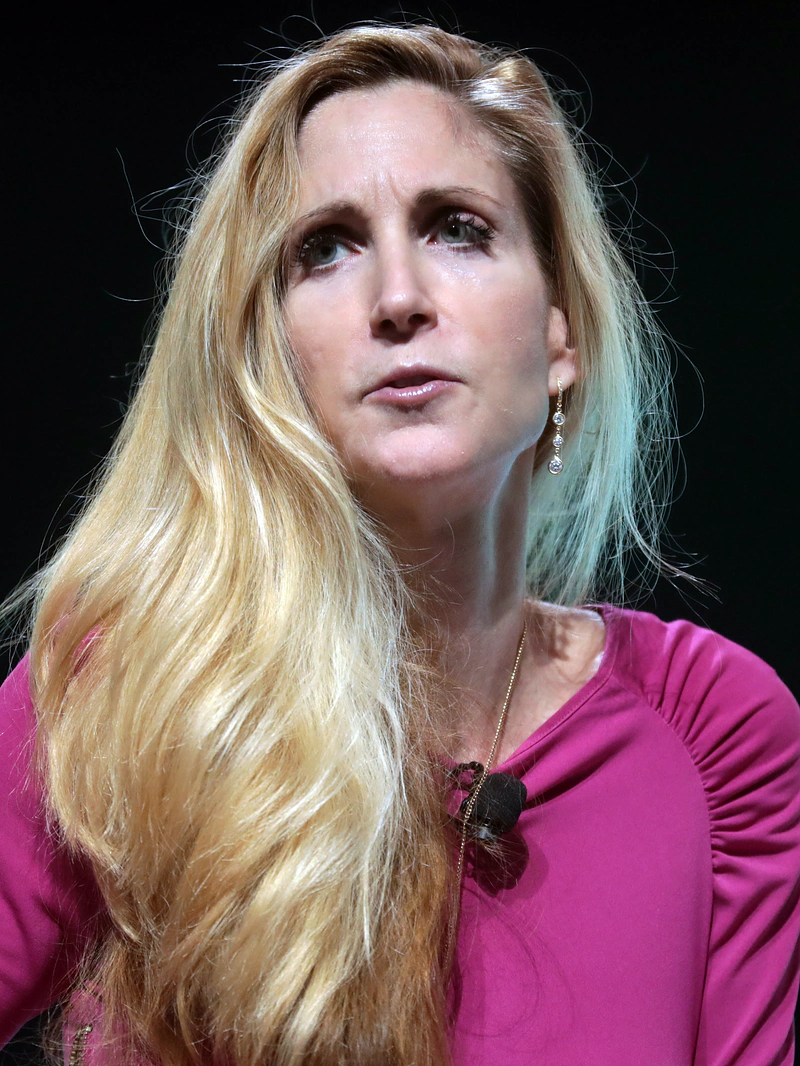
| 38 Quotes | |
| Born as | Ann Hart Coulter |
| Occup. | Journalist |
| From | USA |
| Born | December 8, 1961 New York City, New York, USA |
| Age | 64 years |
| Cite | |
Citation Formats
APA Style (7th ed.)
Ann coulter biography, facts and quotes. (2026, February 11). FixQuotes. https://fixquotes.com/authors/ann-coulter/
Chicago Style
"Ann Coulter biography, facts and quotes." FixQuotes. February 11, 2026. https://fixquotes.com/authors/ann-coulter/.
MLA Style (9th ed.)
"Ann Coulter biography, facts and quotes." FixQuotes, 11 Feb. 2026, https://fixquotes.com/authors/ann-coulter/. Accessed 5 Mar. 2026.
Early Life and Background
Ann Hart Coulter was born on December 8, 1961, in New York City, and grew up largely in Connecticut in a comfortable, achievement-oriented household that prized argument, reading, and the rituals of middle-class American stability. Her father, John Vincent Coulter, was an attorney, and her mother, Nell Martin Coulter, managed the home; the family was Catholic by background and politically conservative in instinct, with the post-1960s backlash forming the ambient weather of her childhood. She came of age as the country digested Watergate, stagflation, the Iran hostage crisis, and then the Reagan-era restoration narrative - events that taught ambitious young conservatives to treat politics as a high-stakes story about order, morale, and national power.That sense of politics as a moral drama mattered to her inner life. Coulter has often described herself, implicitly and explicitly, as someone whose mind is sharpened by conflict and whose identity is reinforced by refusing the soothing consensus of elite opinion. Even before she became a public figure, the outlines of her persona were visible: the appetite for provocation, the pleasure in puncturing what she sees as pieties, and a disciplined confidence that comes from believing your side is not merely correct but culturally outnumbered - a stance that can create both comedic freedom and a kind of siege mentality.
Education and Formative Influences
Coulter attended Cornell University, graduating in 1984, then earned a JD from the University of Michigan Law School in 1988, institutions where she encountered the confident liberalism of elite academia and learned to treat it as an adversary to be cross-examined. The law-school training left traces in her later work: a prosecutor's structure, a brief-writer's selective citation, and a habit of framing disputes as questions of evidence and motive rather than temperament. Her formative influences were less a single mentor than an era: the rise of the New Right, the growth of cable news, and the emerging conservative counter-public that trained polemicists to speak in headlines.Career, Major Works, and Turning Points
After law school she clerked and worked in law, including in Washington, before moving decisively into political media as a columnist, commentator, and author whose brand fused courtroom-style indictment with stand-up cadence. Her breakthrough came with high-visibility appearances on television and a run of best-selling books that made her a durable presence in conservative publishing: High Crimes and Misdemeanors (1998) argued the Clinton years normalized corruption; Slander (2002) targeted mainstream media narratives; Treason (2003) escalated her critique of liberal dissent after 9/11; Godless (2006) framed secular liberalism as quasi-religious; and later works like Adios, America (2015) brought immigration and national identity to the center of her project, even as they complicated her relationship with party leadership and, eventually, with segments of the Trump coalition she initially courted but also criticized when she judged promises unmet. Turning points in her career often followed national shocks - impeachment, 9/11, the Iraq War, Obama-era polarization - moments when audiences wanted not nuance but moral certainty and verbal ferocity.Philosophy, Style, and Themes
Coulter's worldview is anchored in a combative, restorationist conservatism: history is a contest between order and decay, and politics is the arena where sentimentality becomes policy and policy becomes fate. She returns obsessively to perceived asymmetries - in media framing, in cultural permission structures, and in the standards applied to Republicans versus Democrats - and her success depends on translating those grievances into crisp, repeatable lines. Her humor is not ornamental; it is a weapon that signals dominance, invites the audience into shared contempt, and hardens boundaries between "us" and "them". That boundary-making also reveals psychology: the satisfaction of transgression, the distrust of empathy as a cover for power, and the conviction that ridicule can accomplish what technocratic argument cannot.Her themes are easiest to see where her rhetoric compresses moral judgment into shock. The post-9/11 hardline mood appears in her most notorious formulation, “We should invade their countries, kill their leaders and convert them to Christianity. We weren't punctilious about locating and punishing only Hitler and his top officers. We carpet-bombed German cities; we killed civilians. That's war. And this is war”. Read as psychology, the extremity is partly theatrical, but it also betrays an attraction to clarity through force - a preference for decisive punishment over procedural restraint, and for civilizational framing over policing metaphors. Her domestic target is liberalism as a style of mind, and she often caricatures it as evasive or illogical: “Liberal soccer moms are precisely as likely to receive anthrax in the mail as to develop a capacity for linear thinking”. That sentence is less about anthrax than about her core method - to portray opponents not merely as wrong but as cognitively unserious. Finally, she uses Democrats as a foil for stagnation and complaint: “The Democrats have no actual policy proposals of their own unless constant carping counts as a policy”. The impulse underneath is diagnostic: she wants politics to be an arena of consequences, and she treats the language of compassion without enforcement as a kind of fraud.
Legacy and Influence
Coulter's legacy is inseparable from the modern conservative mediascape she helped shape: the bestselling political broadside, the viral insult as argument, and the personality-driven ecosystem where a writer can function like a permanent opposition party. She influenced a generation of right-leaning commentators who learned that attention is power and that moral certainty sells, even as critics argue her tactics deepened polarization and normalized dehumanizing rhetoric. Yet her staying power also reflects a real historical function: she voiced, with unusual candor and cruelty, the resentments and anxieties of an America that felt condescended to by institutions. Whether admired as a fearless truth-teller or condemned as an accelerant of culture war, she remains a defining biographical case study in how late-20th and early-21st century journalism blurred into entertainment, and how polemic became both a career and a political instrument.Our collection contains 38 quotes written by Ann, under the main topics: Witty One-Liners - Sarcastic - Freedom - Reason & Logic - Equality.
Other people related to Ann: James Wolcott (Critic)
Ann Coulter Famous Works
- 2018 Resistance Is Futile!: How the Trump-Hating Left Lost Its Collective Mind (Non-fiction)
- 2016 In Trump We Trust: E Pluribus Awesome! (Non-fiction)
- 2015 Adios, America: The Left's Plan to Turn Our Country into a Third World Hellhole (Non-fiction)
- 2012 Mugged: Racial Demagoguery from the Seventies to Obama (Non-fiction)
- 2011 Demonic: How the Liberal Mob Is Endangering America (Non-fiction)
- 2009 Guilty: Liberal "Victims" and Their Assault on America (Non-fiction)
- 2007 If Democrats Had Any Brains, They'd Be Republicans (Non-fiction)
- 2006 Godless: The Church of Liberalism (Non-fiction)
- 2004 How to Talk to a Liberal (If You Must): The World According to Ann Coulter (Non-fiction)
- 2003 Treason: Liberal Treachery from the Cold War to the War on Terrorism (Non-fiction)
- 2002 Slander: Liberal Lies About the American Right (Non-fiction)
- 1998 High Crimes and Misdemeanors: The Case Against Bill Clinton (Non-fiction)
Source / external links