
Ansel Adams Biography Quotes 32 Report mistakes
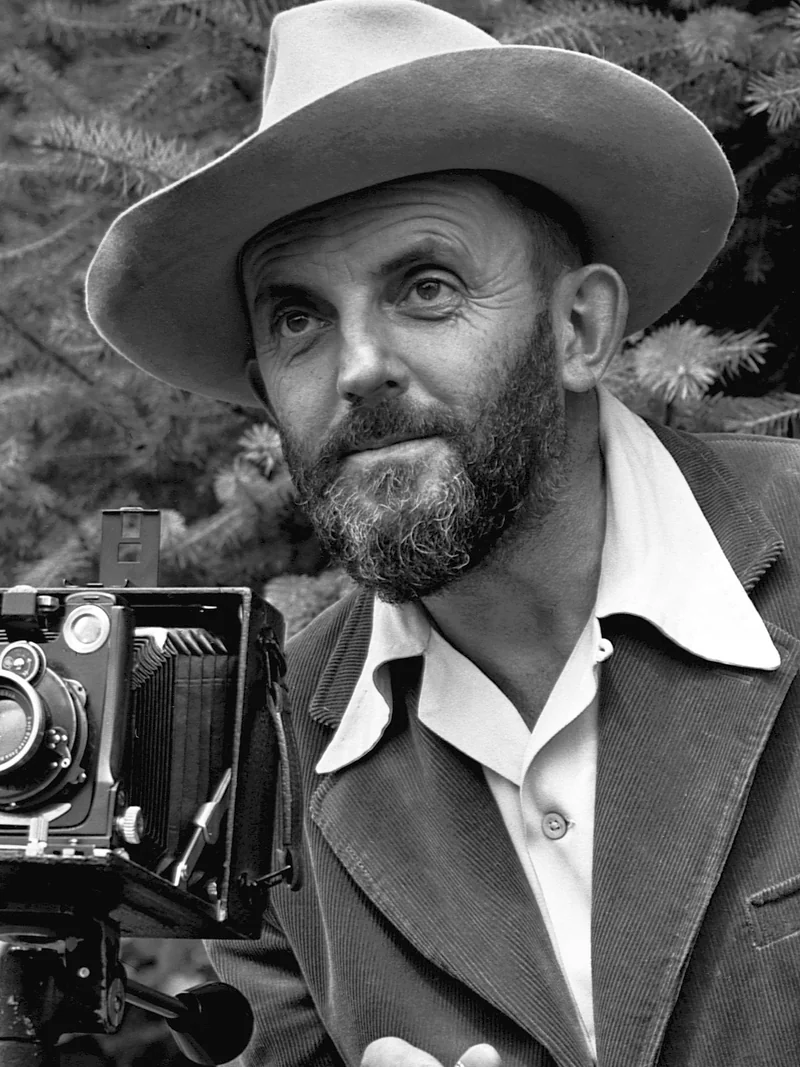
| 32 Quotes | |
| Born as | Ansel Easton Adams |
| Occup. | Photographer |
| From | USA |
| Born | February 20, 1902 San Francisco, California, USA |
| Died | April 22, 1984 Monterey, California, USA |
| Aged | 82 years |
| Cite | |
Citation Formats
APA Style (7th ed.)
Ansel adams biography, facts and quotes. (2026, February 3). FixQuotes. https://fixquotes.com/authors/ansel-adams/
Chicago Style
"Ansel Adams biography, facts and quotes." FixQuotes. February 3, 2026. https://fixquotes.com/authors/ansel-adams/.
MLA Style (9th ed.)
"Ansel Adams biography, facts and quotes." FixQuotes, 3 Feb. 2026, https://fixquotes.com/authors/ansel-adams/. Accessed 5 Mar. 2026.
Early Life and Background
Ansel Easton Adams was born on February 20, 1902, in San Francisco, California, into a family of means whose fortunes and stability were tested early. The 1906 earthquake and fire marked his childhood with both physical jolt and psychic imprint; he later attributed a nasal injury to the quake, a small but lasting reminder of how abruptly the world could tilt. Often restless and solitary, he struggled in conventional classrooms and found steadier ground in long walks, books, and the clarifying order of nature.The Adams household carried a mix of civic respectability and stubborn independence. His father, Charles Hitchcock Adams, encouraged intellectual curiosity and outdoor life, while the wider culture around the boy was rapidly modernizing - automobiles, new skyscrapers, and the growing national romance with the American West. For a sensitive child who felt misfit in crowds, the granite and weather of Northern California offered a counter-society: impersonal, exacting, and somehow consoling.
Education and Formative Influences
Largely educated through private tutoring and self-directed study, Adams first imagined a future in music. In 1916, a family trip to Yosemite National Park changed the axis of his ambition when he was given a Kodak Brownie and began photographing the valley. He returned repeatedly, absorbing John Muir's preservationist spirit and the Sierra Club's culture of strenuous fellowship, and he trained his eye by studying light on rock the way a pianist studies phrasing. By the early 1920s he was both a serious pianist and an increasingly disciplined photographer, learning craft through darkroom practice, close looking, and the mentorship and criticism available within Yosemite's small artistic community.Career, Major Works, and Turning Points
Adams chose photography over concert performance in the late 1920s, a decision clarified by the success of early Yosemite images and by his marriage in 1928 to Virginia Best, whose family ran Best's Studio in Yosemite Valley. In 1932 he co-founded Group f/64 with Edward Weston, Imogen Cunningham, Willard Van Dyke and others, arguing for sharp-focus "straight" photography suited to the West's hard-edged forms. His 1930s and 1940s work - including "Monolith, the Face of Half Dome" (1927), "Rose and Driftwood" (1932), "Clearing Winter Storm" (c. 1944), and the widely reproduced "Moonrise, Hernandez, New Mexico" (1941) - fused technical control with mythic atmosphere. Parallel to his art ran public service: leadership within the Sierra Club, advocacy for national parks, and a wartime documentary project at Manzanar that produced "Born Free and Equal" (1944), insisting on dignity amid incarceration. In 1941-42 he helped formulate the Zone System with Fred Archer, and across subsequent decades he shaped institutions as well as prints: advising museums, teaching workshops, and writing influential manuals that standardized high-level photographic practice.Philosophy, Style, and Themes
Adams' inner life revolved around a paradox: a romantic devotion to wilderness and a nearly industrial insistence on method. He treated the camera less as a diary than as an instrument whose discipline could honor emotion without sentimentality. The Zone System was not merely a technical recipe but a psychological contract - a way to turn intuition into repeatable decisions about exposure and development, so that feeling could survive the darkroom. His images are famous for luminous skies and sculptural tonal range, yet the point was never surface glamour; it was the conviction that clarity, rigor, and reverence could coexist.That conviction appears in the way he described photographic authorship: “The negative is the equivalent of the composer's score, and the print the performance”. In that metaphor lies both humility and control - humility before the world he could not manufacture, control over how experience would be translated for others. He also insisted that meaning is co-authored: “There are always two people in every picture: the photographer and the viewer”. This is Adams acknowledging that even his most "objective" landscapes were arguments about value, asking viewers to complete the moral act of attention. The ethic hardened into activism when preservation met politics; his frustration is unvarnished in, “It is horrifying that we have to fight our own government to save the environment”. The line exposes his era as well as his temperament: a man of institutions who nonetheless feared institutional amnesia, and who used beauty not as escape but as leverage.
Legacy and Influence
Adams died on April 22, 1984, leaving a body of work that helped define the visual identity of the American West and elevated photography's standing in museums, universities, and publishing. His technical teaching trained generations of practitioners; his prints became benchmarks for tonal mastery; and his activism helped shape the cultural legitimacy of conservation at a time when wilderness needed political defenders as much as poets. Yet his most enduring influence may be psychological: he modeled how craft can serve conscience, how an artist can be both exacting and awed, and how a single frame - patiently made - can argue for the dignity of the world it depicts.Our collection contains 32 quotes written by Ansel, under the main topics: Wisdom - Truth - Art - Nature - Deep.
Other people related to Ansel: Mary Austin (Writer), Wynn Bullock (Photographer)
Ansel Adams Famous Works
- 1985 Examples: The Making of 40 Photographs (Book)
- 1980 Making a Photograph (Book)
- 1963 The Print (Book)
- 1960 This Is the American Earth (Book)
- 1950 The Negative (Book)
- 1944 Born Free and Equal: The Story of Loyal Japanese Americans (Book)
- 1942 The Tetons and the Snake River (Photograph)
- 1941 Moonrise, Hernandez, New Mexico (Photograph)
- 1937 The Camera (Book)
- 1934 Our National Parks (Book)
- 1927 Parmelian Prints of the High Sierras (Collection)
- 1927 Monolith, the Face of Half Dome (Photograph)