
Antonie van Leeuwenhoek Biography Quotes 2 Report mistakes
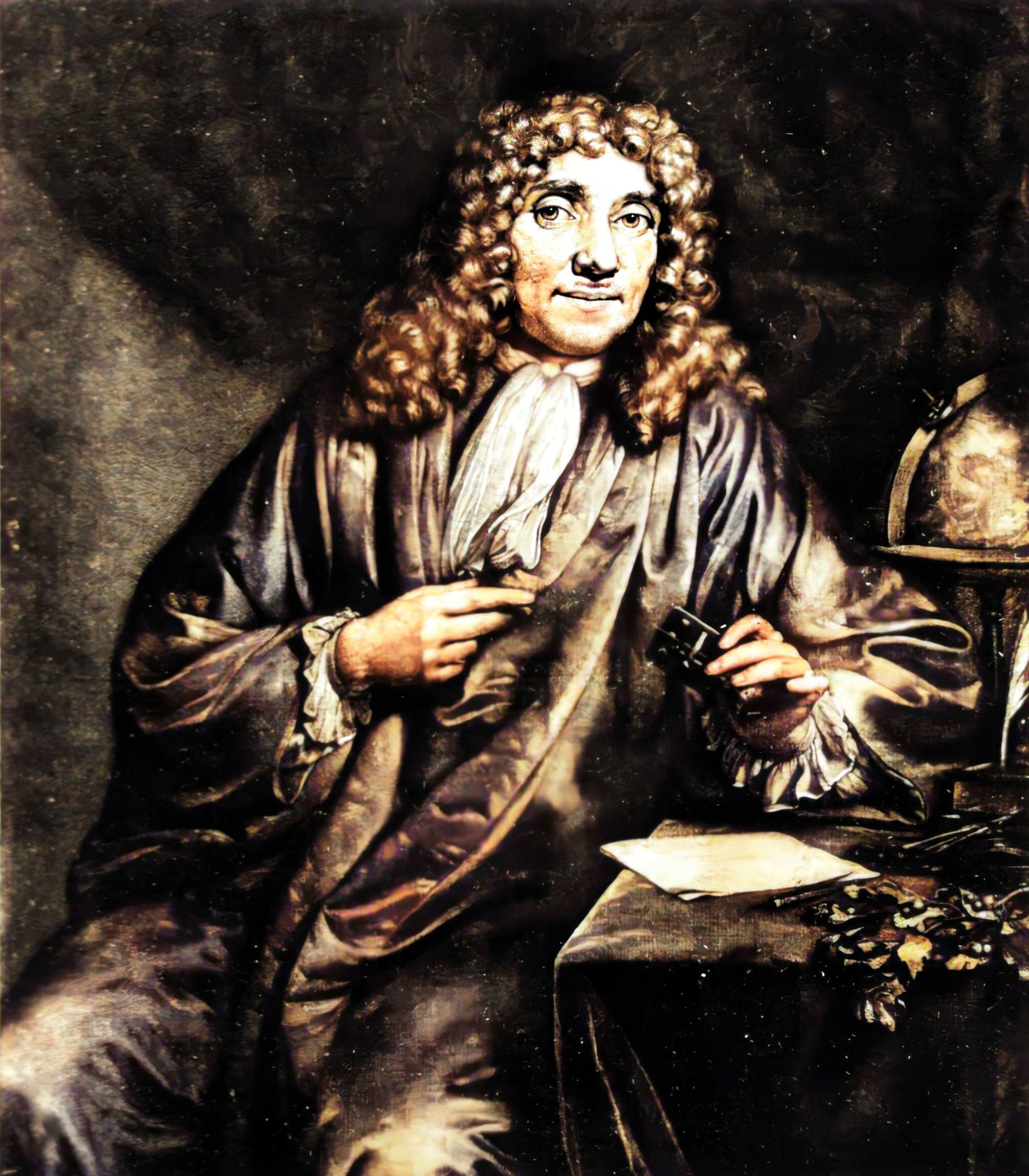
Attr: Jan Verkolje (1650—1693), Public domain
| 2 Quotes | |
| Born as | Antonie Philips van Leeuwenhoek |
| Occup. | Scientist |
| From | Netherland |
| Spouse | Barbara de Mey |
| Born | October 24, 1632 Delft, South Holland, Netherlands |
| Died | August 26, 1723 Delft, South Holland, Netherlands |
| Aged | 90 years |
| Cite | |
Citation Formats
APA Style (7th ed.)
Antonie van leeuwenhoek biography, facts and quotes. (2026, February 11). FixQuotes. https://fixquotes.com/authors/antonie-van-leeuwenhoek/
Chicago Style
"Antonie van Leeuwenhoek biography, facts and quotes." FixQuotes. February 11, 2026. https://fixquotes.com/authors/antonie-van-leeuwenhoek/.
MLA Style (9th ed.)
"Antonie van Leeuwenhoek biography, facts and quotes." FixQuotes, 11 Feb. 2026, https://fixquotes.com/authors/antonie-van-leeuwenhoek/. Accessed 5 Mar. 2026.
Early Life and Background
Antonie Philips van Leeuwenhoek was born on 24 October 1632 in Delft, in the Dutch Republic, a mercantile city of canals, guilds, and workshops. His father, Philips Thoniszoon, was a basket maker who died when Antonie was young; his mother, Margaretha Bel van den Berch, came from a brewer's family. The texture of his childhood was practical and urban rather than scholarly: craft labor, bookkeeping, and the disciplined rhythms of a household that expected usefulness. In a republic energized by trade and a new confidence in observation - the same climate that fed Dutch painting, navigation, and instrument-making - Leeuwenhoek absorbed an ethic of looking closely at the material world.He married Barbara de Mey in 1654 and settled into a life that, outwardly, resembled thousands of respectable burghers. He worked as a draper and later became chamberlain of the Delft sheriffs court, posts that provided a modest income and access to a network of civic officials, physicians, and learned visitors. Tragedy shaped his interior life: most of his children died in infancy, with only one daughter, Maria, surviving to adulthood; Barbara died in 1666, and his second wife, Cornelia Swalmius, died in 1694. The combination of domestic loss, steady employment, and solitary habits helped create a man who poured intensity into patient, private inquiry.
Education and Formative Influences
Leeuwenhoek had little formal schooling and no university training, and he wrote in Dutch rather than the Latin of the Republic of Letters. As a young man he spent time in Amsterdam in the 1640s, likely apprenticed in the cloth trade, where he would have encountered magnifying glasses used to inspect thread and weave. His formative influences were therefore artisanal and optical: the practical need to judge quality, the availability of lenses from spectacle makers, and the broader intellectual shift associated with Francis Bacon and Robert Hooke toward experiments and testimony. Hooke's Micrographia (1665), with its spectacular engravings and insistence that instruments could extend the senses, helped set the stage for Leeuwenhoek's own, more radical decision: not to rely on complex compound microscopes, but to perfect tiny single lenses and trust what they revealed.Career, Major Works, and Turning Points
From the 1660s onward, in rooms above his Delft life, Leeuwenhoek built hundreds of simple microscopes: a minute, high-curvature lens mounted between metal plates, with screws to position a specimen and adjust focus. With these he mapped a new scale of nature. In 1674 he described microorganisms from pond water; in 1676 he reported "little animals" that modern readers recognize as protozoa and bacteria. Over decades he sent a flood of letters to the Royal Society in London, beginning in the early 1670s and extending into the 1720s, detailing red blood cells (1674), spermatozoa (1677), the structure of muscle and nerves, yeast and fermentation, and the intricate anatomy of insects and plants. Skepticism met him at first - the claims were too strange, the lenses too personal - but confirmations by visitors and by Society-appointed witnesses turned him into an international authority, elected a Fellow of the Royal Society in 1680. His turning point was not a single publication but a sustained practice: relentless observation, meticulous reporting, and a stubborn refusal to yield his instruments to easy replication, ensuring both mystique and controversy.Philosophy, Style, and Themes
Leeuwenhoek's inner life reads through his habits: solitary labor, repeated trials, and an almost moral attachment to attention. He approached nature as a workshop of minute mechanisms, best understood by direct seeing rather than inherited theory. His temperament was disciplined and forward-leaning, less speculative than accumulative; he kept returning to the lens, as if thinking itself required the body to stay at the bench. “A man has always to be busy with his thoughts if anything is to be accomplished”. In him, curiosity was not leisure but duty, and the minute became a lifelong arena where patience could defeat ignorance.His style in correspondence was concrete, procedural, and surprisingly intimate: he narrated how he prepared samples, what he saw across time, and what he suspected might mislead him. That insistence on a written record was also psychological self-control - an attempt to bind wonder to accountability, and to turn private sight into public knowledge. “Whenever I found out anything remarkable, I have thought it my duty to put down my discovery on paper, so that all ingenious people might be informed thereof”. The theme that repeats across his observations is scale as revelation: the familiar world of blood, saliva, cloth fibers, and pond scum becomes strange, crowded, and dynamic when the eye is extended. He did not set out to found microbiology; he set out to be faithful to what the lens disclosed, and his faithfulness created a new domain of facts.
Legacy and Influence
Leeuwenhoek died in Delft on 26 August 1723, leaving behind not a treatise but a mountain of testimony - letters that helped institutionalize microscopy as a serious scientific practice and expanded the empirical imagination of Europe. By revealing bacteria, protozoa, sperm cells, and the circulation-visible components of blood, he altered how life could be conceived, preparing the ground for later cell theory and, much later, germ theory. His influence also lies in a model of the scientific self: an uncredentialed artisan-civic official who, in the Republic's tolerant and commercially connected culture, could speak to the highest learned bodies through disciplined observation. The modern laboratory is built not only on grand instruments and theories, but also on his stubborn principle that the smallest facts, carefully seen and carefully reported, can reorder the largest explanations.Our collection contains 2 quotes written by Antonie, under the main topics: Wisdom - Knowledge.
Antonie van Leeuwenhoek Famous Works
- 1688 Brief on the circulation of the blood in small vessels (Letter)
- 1677 Letter on the protozoa (Letter)
Source / external links