
Aristotle Onassis Biography Quotes 9 Report mistakes
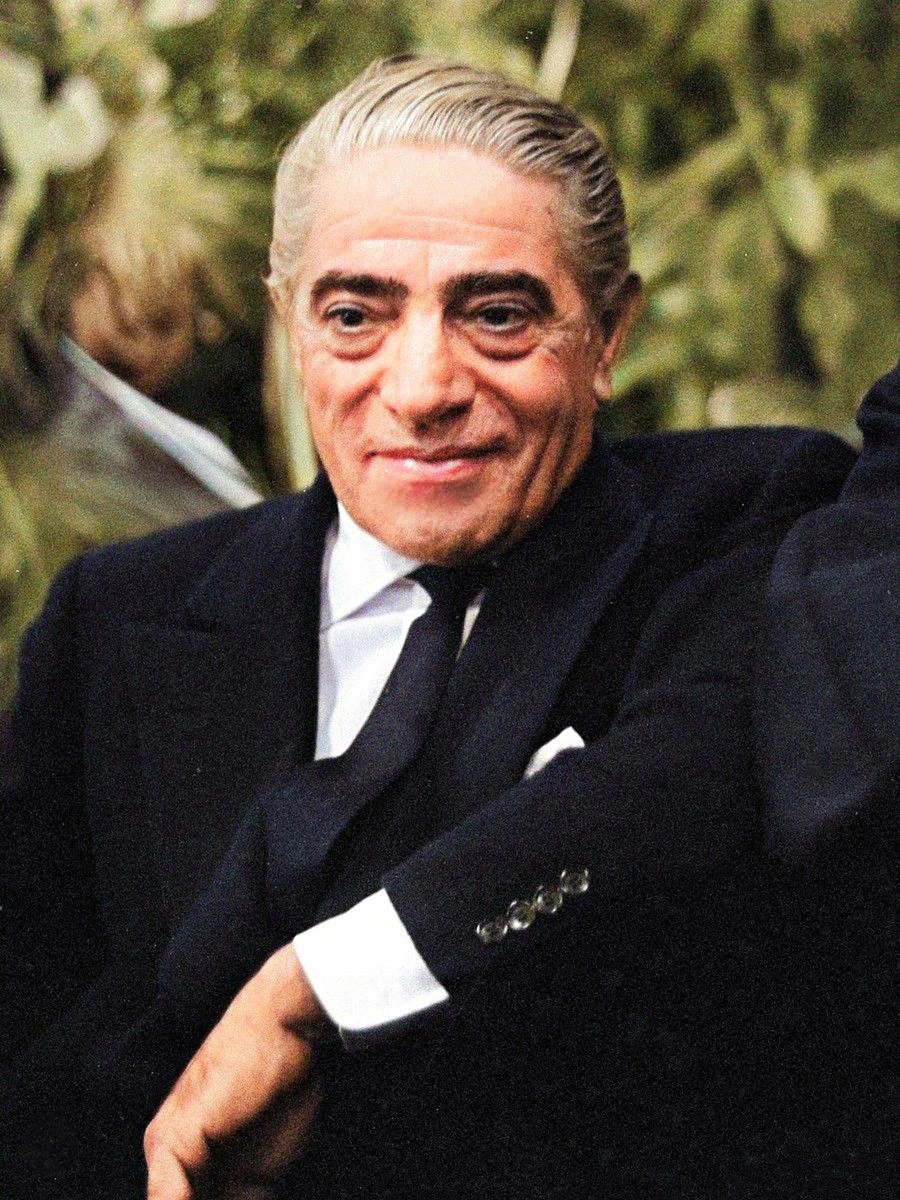
| 9 Quotes | |
| Born as | Aristotle Socrates Onassis |
| Native name | Αριστοτέλης Ωνάσης |
| Occup. | Businessman |
| From | Greece |
| Spouse | Jacqueline Kennedy Onassis |
| Born | January 15, 1906 Karataş, İzmir, Ottoman Empire (now Turkey) |
| Died | March 15, 1975 Neuilly-sur-Seine, France |
| Cause | Myocardial infarction |
| Aged | 69 years |
| Cite | |
Citation Formats
APA Style (7th ed.)
Aristotle onassis biography, facts and quotes. (2026, February 11). FixQuotes. https://fixquotes.com/authors/aristotle-onassis/
Chicago Style
"Aristotle Onassis biography, facts and quotes." FixQuotes. February 11, 2026. https://fixquotes.com/authors/aristotle-onassis/.
MLA Style (9th ed.)
"Aristotle Onassis biography, facts and quotes." FixQuotes, 11 Feb. 2026, https://fixquotes.com/authors/aristotle-onassis/. Accessed 26 Mar. 2026.
Early Life and Background
Aristotle Socrates Onassis was born on 1906-01-15 in Smyrna (Izmir), then an Ottoman port city where Greek, Turkish, Armenian, and Levantine commerce interlocked along the Aegean. His father, Socrates Onassis, worked in tobacco trading and related shipping, and the household belonged to a confident Greek merchant class that measured status by deals closed, ships chartered, and family names kept solvent. From childhood he absorbed the talk of manifests, freight rates, and the psychology of bargaining in a city built on transaction.The decisive rupture came with the Greco-Turkish War and the catastrophe of 1922. Smyrna burned, the Greek population fled, and Onassis watched a world of ledgers and storefronts become ash and exile. That trauma - sudden dispossession, the lesson that property and safety are contingent - followed him into adulthood as both fear and fuel. In the early 1920s he left for Argentina with little capital and a large appetite for control, determined to rebuild not only wealth but the sense of inevitability that history had stripped away.
Education and Formative Influences
Onassis did not take the classic path of university training; his education was practical, multilingual, and accelerated by displacement. In Buenos Aires he learned the grammar of immigrant survival: networking through Greek diaspora circles, reading markets, leveraging credit, and presenting himself as inevitable even when he was not. He worked around tobacco and trade, cultivated connections in shipping and banking, and refined a talent for turning uncertainty into advantage - a temperament shaped as much by the volatility of interwar capitalism as by the memory of Smyrna.Career, Major Works, and Turning Points
From a foothold in Argentina, Onassis moved into maritime commerce and then into the modern oil-and-tanker economy that surged after World War II. He expanded aggressively in the late 1940s and 1950s, building a fleet of large tankers and negotiating contracts that tied private shipping to state power and corporate energy needs; the tanker became his instrument, scalable and global. He also pursued prestige assets - notably the purchase of the island of Skorpios in 1963 - and used marriage and celebrity to reinforce brand, marrying Athina "Tina" Livanos in 1946 and later Jacqueline Kennedy in 1968. Yet the same decade that made him a world symbol of wealth also delivered his most private blow: the death of his son Alexander in a 1973 plane crash. Onassis declined sharply thereafter and died on 1975-03-15 in Neuilly-sur-Seine, France, leaving a business empire and a family story marked by glamour and grief.Philosophy, Style, and Themes
Onassis approached business as a contest of information, timing, and nerve rather than a moral ledger. He believed advantage came from asymmetry: “The secret of business is to know something that nobody else knows”. This was not merely a tactic but a worldview born of upheaval - when institutions fail, the person who sees first survives first. His deals often depended on reading political weather, betting on the direction of oil, and understanding how fear and ambition move boards of directors as surely as waves move a hull.His interpersonal style was similarly unsentimental and competitive: “I have no friends and no enemies - only competitors”. The line is revealing not only of his ruthlessness but of his emotional economy, a preference for relationships that could be priced, leveraged, or outlasted. Yet he was not a simple miser; he understood money as theater and attraction, saying, “If women didn't exist, all the money in the world would have no meaning”. In that sentence the inner life peeks through: wealth as a language of desire and status, an attempt to master admiration when history had once made him powerless. His world was built on ships, but also on attention.
Legacy and Influence
Onassis remains a defining figure of 20th-century shipping: a self-made magnate who exploited the postwar oil boom, the globalization of maritime flags and finance, and the permeability between private enterprise and geopolitics. He helped popularize the modern archetype of the tycoon as celebrity, turning yachts, islands, and marriages into extensions of corporate strategy. His philanthropic afterlife, especially through the Alexander S. Onassis Foundation, sits beside a darker legacy of hard-edged competition that still shapes how shipping fortunes are made and mythologized. More than a rich man, he became a parable of the century that produced him - displaced by war, enlarged by energy, and finally undone by the one risk no negotiation can hedge: loss.Our collection contains 9 quotes written by Aristotle, under the main topics: Witty One-Liners - Motivational - Resilience - Vision & Strategy - Romantic.
Other people related to Aristotle: Jackie Kennedy (First Lady), Caroline Kennedy (Celebrity)
Source / external links