
Arthur C. Clarke Biography Quotes 28 Report mistakes
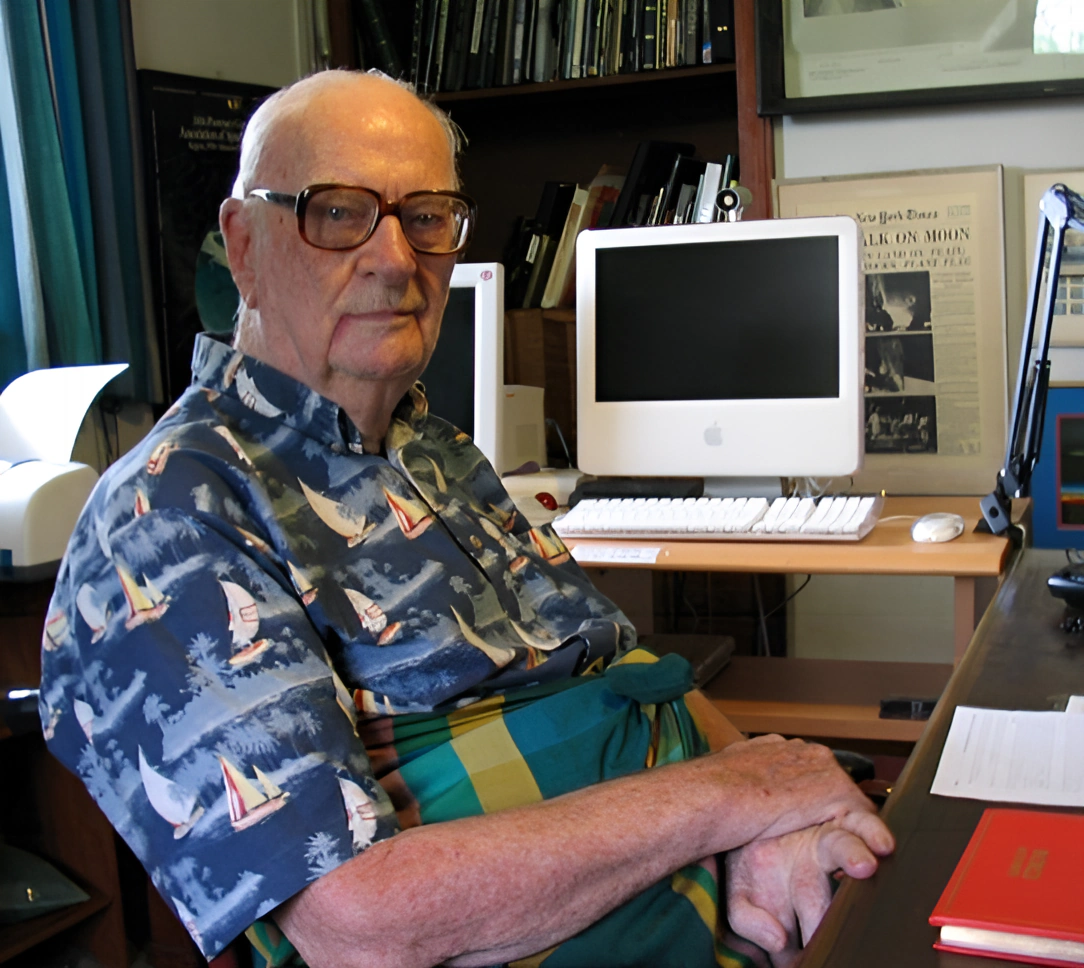
| 28 Quotes | |
| Born as | Arthur Charles Clarke |
| Occup. | Writer |
| From | United Kingdom |
| Born | December 16, 1917 Minehead, Somerset, England |
| Died | March 19, 2008 Colombo, Sri Lanka |
| Cause | Respiratory complications |
| Aged | 90 years |
| Cite | |
Citation Formats
APA Style (7th ed.)
Arthur c. clarke biography, facts and quotes. (2026, February 11). FixQuotes. https://fixquotes.com/authors/arthur-c-clarke/
Chicago Style
"Arthur C. Clarke biography, facts and quotes." FixQuotes. February 11, 2026. https://fixquotes.com/authors/arthur-c-clarke/.
MLA Style (9th ed.)
"Arthur C. Clarke biography, facts and quotes." FixQuotes, 11 Feb. 2026, https://fixquotes.com/authors/arthur-c-clarke/. Accessed 27 Mar. 2026.
Early Life and Background
Arthur Charles Clarke was born on December 16, 1917, in Minehead, Somerset, on the edge of Exmoor - a landscape of big skies and sea horizons that later felt like a natural preface to his cosmic imagination. His father, a farmer and World War I veteran, and his mother, of quieter steadiness, raised him in a household shaped by rural routines, interwar austerity, and the lingering aftertaste of mechanized conflict. Clarke later described his earliest wonder as practical as it was dreamy: stargazing, model building, and avid reading became ways to escape local limits without rejecting them.Britain between the wars offered him both constraint and stimulus: class boundaries, limited money, and a public culture increasingly fascinated by radio, aviation, and the promise of scientific modernity. From boyhood he devoured pulp science fiction and popular astronomy, but he also absorbed the cautious empiricism of a society that prized understatement. The tension between romantic yearning and engineering discipline - between the cathedral and the laboratory - would define his inner life: he wanted transcendence, but on verifiable terms.
Education and Formative Influences
Clarke attended Huish's Grammar School in Taunton, then moved to London in the mid-1930s, working as a civil servant while educating himself in the reading rooms of the city. Early memberships in the British Interplanetary Society were decisive: amid enthusiasts and engineers, he found a community that treated spaceflight not as fantasy but as an approaching project, and he began writing both fiction and clear, persuasive nonfiction. World War II accelerated his technical formation: he served in the Royal Air Force as a radar specialist and instructor, an experience that taught him systems thinking, the psychology of machines under stress, and the moral ambiguity of applied science.Career, Major Works, and Turning Points
After the war Clarke turned his wartime electronics literacy into an unusually hybrid career - novelist, essayist, forecaster. In 1945 he published "Extra-Terrestrial Relays", a short technical paper proposing geostationary communications satellites, later nicknamed the "Clarke orbit", which helped make global broadcasting conceptually inevitable. His fiction matured through "Childhood's End" (1953), "The City and the Stars" (1956), and "A Fall of Moondust" (1961), works that paired hard engineering with metaphysical unease. The central turning point came with his collaboration with Stanley Kubrick on "2001: A Space Odyssey" (film 1968; novel 1968): the project amplified his reach, fixed his name to a new iconography of space, and sharpened his belief that humanity's next evolutionary step would be cognitive and moral as much as technological. In 1956 he settled in Sri Lanka (then Ceylon), drawn by the ocean, diving, and distance from British literary politics; from there he wrote later novels such as "Rendezvous with Rama" (1973) and, with collaborators, the sequels and other series, while becoming a familiar public explainer of the Space Age.Philosophy, Style, and Themes
Clarke's style married lucid exposition to a cool, reverent sense of scale. He rarely wrote like a mystic, yet he pursued mystical effects by rational means - the shiver that comes when the universe feels intelligible and yet immeasurably larger than the mind. His famous axiom, “Any sufficiently advanced technology is indistinguishable from magic”. , was not a surrender to superstition but a warning about perception: wonder is a human response to complexity, and the ethical question is who controls the enchantment. In his best work, the "magical" moment is immediately followed by a demand for explanation, humility, and competent stewardship.Psychologically, Clarke was a disciplined skeptic with a romantic's appetite for the sublime. He distrusted claims that closed inquiry, insisting that frontiers exist to be crossed: “The only way to discover the limits of the possible is to go beyond them into the impossible”. This is the engine behind the monolith in "2001", the serene alien artifact of "Rama", and the transcendent overlords of "Childhood's End" - external provocations that force human beings to outgrow comforting stories about their centrality. He was also a trenchant secular moralist, wary of institutions that claimed ownership of conscience: “The greatest tragedy in mankind's entire history may be the hijacking of morality by religion”. That line clarifies a recurring Clarke motif: morality should expand with knowledge, not retreat into taboo, and cosmic perspective should make cruelty harder, not easier.
Legacy and Influence
Clarke died on March 19, 2008, in Colombo, leaving a legacy that spans literature, technology, and public imagination. As a writer he helped define hard science fiction's modern voice - intellectually accessible, awed by beauty, alert to unintended consequences - and his best novels remain templates for "sense of wonder" that does not abandon rigor. As a futurist he did not merely predict; he provided usable concepts, and the satellite relay idea alone altered everyday life. His deeper influence is cultural: he made space feel like a human neighborhood and insisted that the future is not a genre but a responsibility, one that demands skepticism, curiosity, and the courage to be wrong on the way to being less wrong.Our collection contains 28 quotes written by Arthur, under the main topics: Witty One-Liners - Motivational - Ethics & Morality - Deep - Learning.
Other people related to Arthur: Willy Ley (Writer), Mike Oldfield (Musician)
Arthur C. Clarke Famous Works
- 1997 3001: The Final Odyssey (Novel)
- 1987 2061: Odyssey Three (Novel)
- 1986 The Songs of Distant Earth (Novel)
- 1979 The Fountains of Paradise (Novel)
- 1973 Rendezvous with Rama (Novel)
- 1968 2001: A Space Odyssey (Novel)
- 1953 Childhood's End (Novel)
Source / external links