
Arthur Conan Doyle Biography Quotes 34 Report mistakes
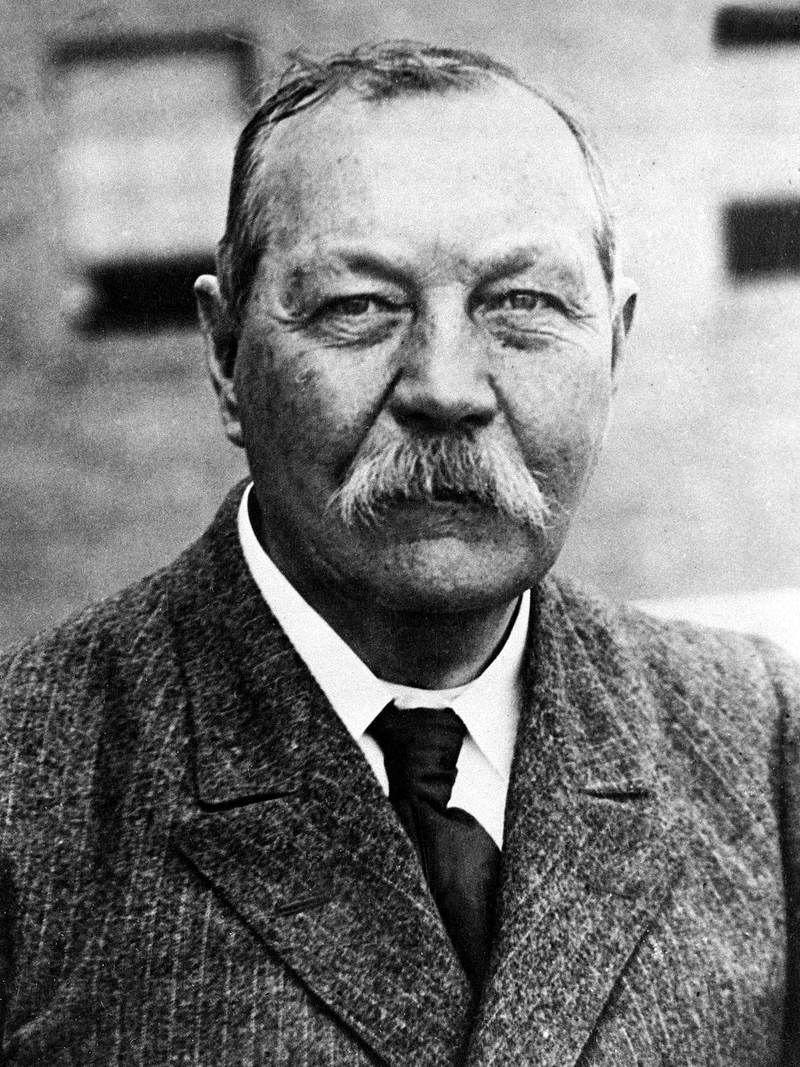
| 34 Quotes | |
| Born as | Arthur Ignatius Conan Doyle |
| Occup. | Writer |
| From | United Kingdom |
| Born | May 22, 1859 Edinburgh, Scotland, UK |
| Died | July 7, 1930 Crowborough, Sussex, England, UK |
| Aged | 71 years |
| Cite | |
Citation Formats
APA Style (7th ed.)
Arthur conan doyle biography, facts and quotes. (2026, February 11). FixQuotes. https://fixquotes.com/authors/arthur-conan-doyle/
Chicago Style
"Arthur Conan Doyle biography, facts and quotes." FixQuotes. February 11, 2026. https://fixquotes.com/authors/arthur-conan-doyle/.
MLA Style (9th ed.)
"Arthur Conan Doyle biography, facts and quotes." FixQuotes, 11 Feb. 2026, https://fixquotes.com/authors/arthur-conan-doyle/. Accessed 22 Mar. 2026.
Early Life and Background
Arthur Ignatius Conan Doyle was born on 1859-05-22 in Edinburgh, Scotland, into a family where imagination and instability lived side by side. His father, Charles Altamont Doyle, a civil servant with artistic gifts, slid into alcoholism and recurrent institutionalization; the household that Arthur, his mother Mary Foley Doyle, and the children inhabited was often precarious, emotionally and financially. Mary, spirited, Catholic, and steeped in stories of chivalry and historical romance, became his anchor and first great influence, teaching him that narrative could impose pattern on chaos.Victorian Britain rewarded discipline while breeding doubt: empire and industry expanded even as science unsettled inherited certainties. Doyle grew up watching respectability strain under private pain, a contradiction he would later dramatize through respectable facades concealing violence, greed, or obsession. From early on he developed two durable impulses - to diagnose and to console - the budding doctor who wanted facts, and the born storyteller who wanted meaning.
Education and Formative Influences
Educated first by Jesuits at Stonyhurst College and later at Stella Matutina in Feldkirch, Austria, Doyle absorbed rigorous training in rhetoric, logic, and moral debate, along with the outsider feeling of a Scottish Catholic in a largely Protestant public sphere. He entered the University of Edinburgh Medical School in 1876, where the surgeon and teacher Joseph Bell demonstrated razor-sharp observation and inference, a living model for Sherlock Holmes. Doyle also encountered the era's intellectual crosscurrents: Darwinian science, new forensic thinking, and mass periodical culture that could turn a short story into a livelihood.Career, Major Works, and Turning Points
After sea voyages as a ship's surgeon to the Arctic whaler Hope (1880) and later to West Africa (1881), Doyle qualified as a physician and tried to build practices in Southsea and then London, writing in the dead hours between patients. In 1887 he introduced Holmes and Dr. Watson in A Study in Scarlet, refining the character in The Sign of Four (1890) and making him a phenomenon through The Strand Magazine beginning in 1891. Restless to be taken seriously, he wrote historical fiction (Micah Clarke, 1889; The White Company, 1891), adventure (The Lost World, 1912), and plays, while public life pulled him toward causes and controversy: he defended British conduct in the South African War with The War in South Africa: Its Cause and Conduct (1902), was knighted the same year, and later used his fame to argue miscarriages of justice (notably the George Edalji and Oscar Slater cases). A decisive late turning point was grief - multiple wartime and family losses - which accelerated his public commitment to Spiritualism, even as it strained friendships and baffled admirers who preferred his cool rational detective.Philosophy, Style, and Themes
Doyle's art rests on a Victorian faith that the world is readable if one is disciplined enough to look, then humble enough to test. Holmes is not merely clever; he is an ethic of method. “It is a capital mistake to theorize before one has data”. That sentence is Doyle's self-portrait as a medical writer: trained to gather symptoms, suspicious of premature certainty, and acutely aware that minds comfort themselves with stories when evidence is thin. The companion idea - that speech clarifies thought - underlies the Holmes-Watson duet, where explanation is both performance and verification: “Nothing clears up a case so much as stating it to another person”. In practice Doyle built narratives like case histories, advancing by observation, hypothesis, and correction, then ending with a retrospective chain that makes contingency look inevitable.Yet Doyle also dramatized the costs of reason when it becomes pride. His best stories stage the tension between the measurable and the mysterious, between the gaslit street and the dark moor, between London's modernity and older violences that modernity fails to erase. Holmes's famous maxim, “Once you eliminate the impossible, whatever remains, no matter how improbable, must be the truth”. , reads as triumphant logic - but Doyle's life complicates it. The man who could invent the century's emblem of skepticism also yearned for proof of survival after death, and in his Spiritualist years he pursued "improbable" truths with the same stubbornness he once reserved for fingerprints and footprints. His style mirrors that divided temperament: brisk, visual, propulsive, with a reporter's eye for detail and a romantic's appetite for wonder, whether the wonder is criminal ingenuity, imperial adventure, or the unseen.
Legacy and Influence
Doyle died on 1930-07-07 in Crowborough, Sussex, leaving a body of work far wider than Holmes but permanently reorganized by Holmes's shadow. He helped standardize the modern detective story - the consulting detective, the loyal narrator, the fair-play clue, the final explanatory monologue - and fed later forensics, police procedure fiction, and the broader cultural ideal of the analytic mind. At the same time his public campaigns for justice modeled a writer using celebrity as civic pressure, while his Spiritualism stands as a cautionary and humanizing footnote: a creator of rational myth who could not live by reason alone. The endurance of Holmes across adaptations, languages, and technologies testifies to Doyle's central achievement - turning observation into drama, and doubt into a form of hope.Our collection contains 34 quotes written by Arthur, under the main topics: Witty One-Liners - Ethics & Morality - Truth - Wisdom - Friendship.
Other people related to Arthur: Wilkie Collins (Novelist), Will Thomas (Novelist), Joseph McCabe (Writer), Arthur Machen (Author), Hesketh Pearson (Actor)
Arthur Conan Doyle Famous Works
- 1927 The Case-Book of Sherlock Holmes (Collection)
- 1926 The Land of Mist (Novel)
- 1922 The Coming of the Fairies (Non-fiction)
- 1917 His Last Bow (Collection)
- 1915 The Valley of Fear (Novel)
- 1913 The Poison Belt (Novel)
- 1912 The Lost World (Novel)
- 1909 The Crime of the Congo (Non-fiction)
- 1905 The Return of Sherlock Holmes (Collection)
- 1902 The Hound of the Baskervilles (Novel)
- 1900 The Great Boer War (Non-fiction)
- 1897 Uncle Bernac (Novel)
- 1896 Rodney Stone (Novel)
- 1896 The Exploits of Brigadier Gerard (Collection)
- 1894 The Memoirs of Sherlock Holmes (Collection)
- 1892 The Adventures of Sherlock Holmes (Collection)
- 1891 The White Company (Novel)
- 1890 The Sign of the Four (Novel)
- 1889 Micah Clarke (Novel)
- 1887 A Study in Scarlet (Novel)