
Arthur Rimbaud Biography Quotes 14 Report mistakes
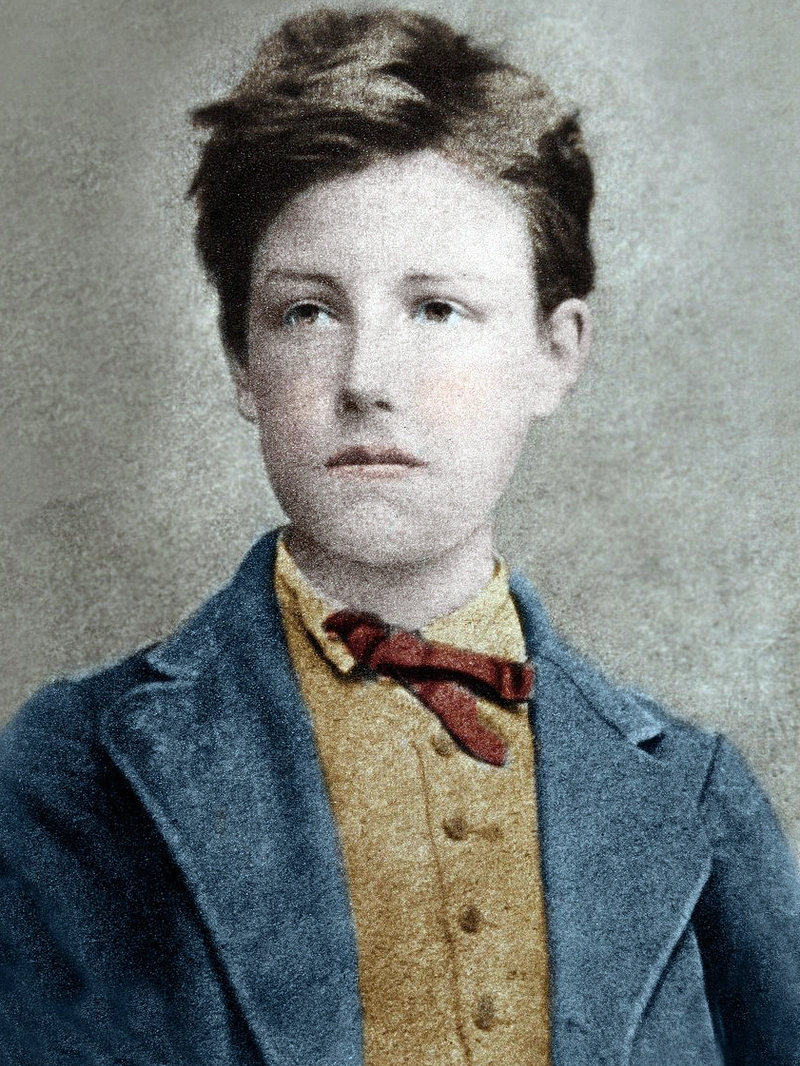
| 14 Quotes | |
| Born as | Jean Nicolas Arthur Rimbaud |
| Occup. | Poet |
| From | France |
| Born | October 20, 1854 Charleville, Ardennes, France |
| Died | November 10, 1891 Marseille, France |
| Cause | cancer |
| Aged | 37 years |
| Cite | |
Citation Formats
APA Style (7th ed.)
Arthur rimbaud biography, facts and quotes. (2026, February 14). FixQuotes. https://fixquotes.com/authors/arthur-rimbaud/
Chicago Style
"Arthur Rimbaud biography, facts and quotes." FixQuotes. February 14, 2026. https://fixquotes.com/authors/arthur-rimbaud/.
MLA Style (9th ed.)
"Arthur Rimbaud biography, facts and quotes." FixQuotes, 14 Feb. 2026, https://fixquotes.com/authors/arthur-rimbaud/. Accessed 25 Mar. 2026.
Early Life and Background
Jean Nicolas Arthur Rimbaud was born on 1854-10-20 in Charleville, in the Ardennes of northeastern France, a provincial garrison town shadowed by the borderlands and, later, by the Franco-Prussian War. His father, an army captain often absent, effectively vanished from family life in the early 1860s; his mother, Vitalie Cuif, ran the household with strict Catholic discipline and an accountant's vigilance. The household atmosphere - ordered, watchful, emotionally tight - bred in the boy both ferocious self-reliance and a craving to explode boundaries.Rimbaud was precocious, prize-winning, and difficult. He mastered Latin verse at school, devoured modern poetry in secret, and learned early that brilliance could be both passport and weapon in a small town. In 1870-1871, war and political upheaval shook the region: Charleville saw Prussian occupation; Paris lurched from siege to the Commune. Rimbaud's repeated runaways from home and school were not only adolescent defiance but a direct collision between a mind hungry for experience and an era when France itself seemed to tear up its old maps.
Education and Formative Influences
At the College de Charleville, teachers like Georges Izambard encouraged his literary ambition, while Rimbaud absorbed Hugo, Banville, the Parnassians, and the new freedoms of Baudelaire. By sixteen he could mimic established forms flawlessly and then sabotage them from within, sending audacious poems to Paris and to Paul Verlaine. His famous "Letter of the Seer" (1871) - part manifesto, part self-experiment - argued for a systematic derangement of the senses, turning education into a laboratory for perception, identity, and moral risk.Career, Major Works, and Turning Points
Rimbaud's true career lasted scarcely four years yet altered modern poetry. In 1871 he reached Paris and soon entered Verlaine's orbit; their volatile relationship, fueled by admiration, alcohol, and mutual provocation, became a scandal and a crucible. Rimbaud wrote the incandescent early lyrics ("Le Bateau ivre"), then the jagged, city-haunted prose poems of Illuminations (composed 1872-1874, published later), and finally A Season in Hell (Une saison en enfer, 1873), the only book he oversaw in print, paid for himself in Brussels. In July 1873, amid rupture, Verlaine shot him in the wrist; Verlaine's imprisonment and Rimbaud's own disgust with the cycle of dependence and performance hardened into a turning point. After restless travel through Europe, Rimbaud renounced literature, worked as a clerk, soldier-for-hire, and trader, and eventually based himself in Aden and Harar, dealing in coffee, hides, and logistical schemes across the Horn of Africa. In 1891 he returned to France gravely ill; his right leg was amputated, likely from bone cancer, and he died in Marseille on 1891-11-10, aged thirty-seven.Philosophy, Style, and Themes
Rimbaud's inner life is best read as a battle between appetite for the absolute and contempt for the self that seeks it. The adolescent prodigy treated identity as a medium to be melted down: “I is another”. That sentence is not a paradox for its own sake but a psychological method - to estrange the ego, to force the poet into being a receiver, a conduit, even a crime scene where voices, sensations, and social languages collide. His work turns biography into experiment: the poet as runaway, seer, and imposter, testing how far consciousness can be pushed before it cracks or clears.Stylistically, he accelerated French verse toward modernity: sudden montage, slang against liturgy, hallucinatory color-sound correspondences, and a syntax that behaves like weather. In A Season in Hell, confession becomes anti-confession, a mind prosecuting itself while refusing redemption; the famous fatigue is not mere sadness but the burnout of hyper-perception: “But, truly, I have wept too much! The Dawns are heartbreaking. Every moon is atrocious and every sun bitter”. Even his later silence reads as a continuation of the same logic: the will to stop performing "poetry" as a role and to seek a harsher, exterior truth. The self-accusation “Idle youth, enslaved to everything; by being too sensitive I have wasted my life”. captures his fear that sensitivity can become another chain - a narcotic of insight that substitutes for action, love, or durable ethical choice.
Legacy and Influence
Rimbaud left a small body of work that became a vast engine for the 20th century. Symbolists took his break with decorative music and turned it into doctrine; Surrealists claimed his derangement as precedent; modernists across languages learned from his speed, his urban visions, and his refusal to separate lyric beauty from moral abrasion. Just as influential was the life-pattern: the child genius who detonates the form and then disappears into labor and distance, converting literary fame into a myth of freedom. In that myth, Rimbaud remains a test case for what art can cost - and for how a few years of writing can permanently rewire the possibilities of poetic speech.Our collection contains 14 quotes written by Arthur, under the main topics: Ethics & Morality - Deep - Meaning of Life - Parenting - Poetry.
Other people related to Arthur: Paul Claudel (Dramatist), Paul Celan (Poet), John Ashbery (Poet), Arthur Symons (Poet), Hart Crane (Poet)
Frequently Asked Questions
- Arthur Rimbaud movie: A well-known film about his life and relationship with Paul Verlaine is "Total Eclipse" (1995).
- Arthur Rimbaud books: Notable works include "A Season in Hell" (1873) and "Illuminations" (published posthumously in 1886).
- Arthur Rimbaud wife: He never married and did not have a wife.
- Arthur Rimbaud bsd: Jean Nicolas Arthur Rimbaud was born October 20, 1854, in Charleville, Ardennes, France, and he died November 10, 1891, in Marseille, France.
- How old was Arthur Rimbaud? He became 37 years old
Arthur Rimbaud Famous Works
- 1886 Illuminations (Collection)
- 1873 A Season in Hell (Poetry)
- 1871 Letter of the Seer (Essay)
- 1871 Vowels (Poetry)
- 1871 The Drunken Boat (Poetry)
- 1870 Poems (early) (Collection)
- 1870 Ophelia (Poetry)
- 1870 Sensation (Poetry)
- 1870 The Sleeper in the Valley (Poetry)
- 1870 My Bohemia (Poetry)
Source / external links