
Arundhati Roy Biography Quotes 12 Report mistakes
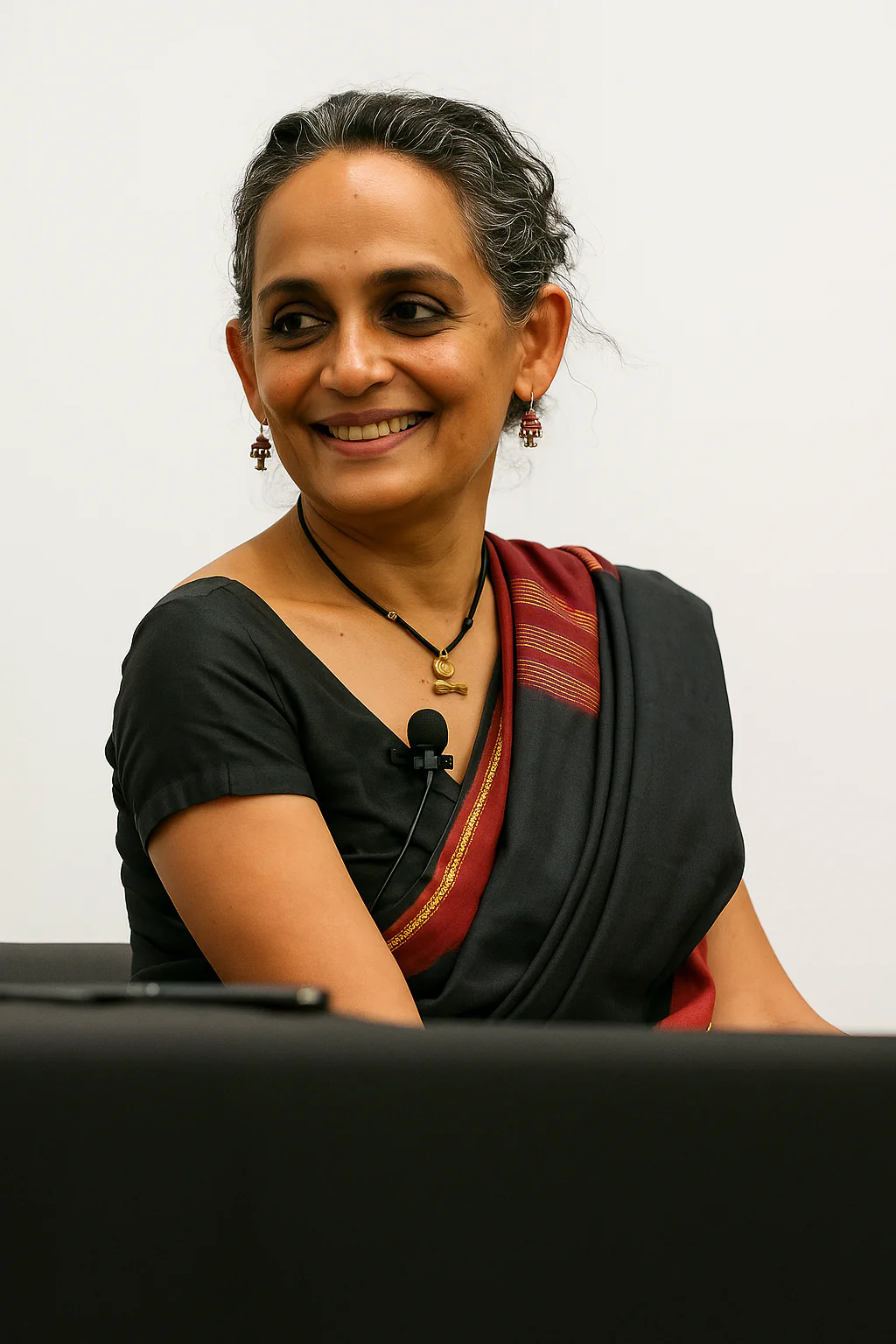
| 12 Quotes | |
| Born as | Suzanna Arundhati Roy |
| Occup. | Novelist |
| From | India |
| Born | November 24, 1961 Shillong, Assam, India |
| Age | 64 years |
| Cite | |
Citation Formats
APA Style (7th ed.)
Arundhati roy biography, facts and quotes. (2026, February 11). FixQuotes. https://fixquotes.com/authors/arundhati-roy/
Chicago Style
"Arundhati Roy biography, facts and quotes." FixQuotes. February 11, 2026. https://fixquotes.com/authors/arundhati-roy/.
MLA Style (9th ed.)
"Arundhati Roy biography, facts and quotes." FixQuotes, 11 Feb. 2026, https://fixquotes.com/authors/arundhati-roy/. Accessed 5 Mar. 2026.
Early Life and Background
Suzanna Arundhati Roy was born on November 24, 1961, in Shillong, then in Assam (today in Meghalaya), India, into a family whose fractures would later supply her fiction with both intimacy and bite. Her mother, Mary Roy, a Syrian Christian from Kerala, became a noted activist for womens inheritance rights; her father, Rajib Roy, a Bengali Hindu tea planter, struggled with alcoholism. The marriage broke down early, and Roy grew up largely in Aymanam, near Kottayam in Kerala, a landscape of backwaters, monsoon rot, and social surveillance that she would later turn into a moral geography.The texture of her childhood was shaped by being an outsider several times over: between regions, languages, and religious identities, and within a matrilineal household that still bore the weight of patriarchal expectation. Roy absorbed how class and caste could coexist with liberal self-description, how family affection could coexist with control, and how public respectability often masked private damage. These early contradictions became her lifelong subject: not simply injustice in the abstract, but the way it lives inside homes, schools, courts, and everyday speech.
Education and Formative Influences
Roy studied architecture at the School of Planning and Architecture in New Delhi, training her eye for structure, space, and the politics of design. Delhi in the 1980s also exposed her to the churn of late Cold War politics, the rise of television India, and a capital where power was both bureaucratic and theatrical. She moved through artistic and activist circles, worked in jobs tied to culture and development, and learned how institutions translate lofty ideals into paperwork and exclusion - a skepticism that would later harden into her public voice.Career, Major Works, and Turning Points
Roy entered public life through writing for film and television, including the screenplay for Shekhar Kapurs film Bandit Queen (1994), later distancing herself from the finished work while gaining a reputation for uncompromising argument. Her global breakthrough was the novel The God of Small Things (1997), which won the Booker Prize and made her, overnight, both a literary celebrity and a political target. After that success, she largely redirected her energy toward essays and activism: criticizing Indias nuclear tests in The End of Imagination (1998), arguing against big dams in The Greater Common Good (1999) and Power Politics (2001), and taking on U.S. militarism after 9/11. She returned to long fiction with The Ministry of Utmost Happiness (2017), a polyphonic novel spanning Delhi, Kashmir, and the margins of the nation-state, and later expanded her essay work with collections such as My Seditious Heart (2019) and Azadi: Freedom. Fascism. Fiction. (2020).Philosophy, Style, and Themes
Roy writes like an architect of feeling: she builds scenes from sensory detail, then reveals the load-bearing beams of history inside them. In her novels, private lives are never purely private; they are arranged by caste, gender, property law, and the unspoken violence of respectability. Her sentences move between lyric tenderness and prosecutorial clarity, making beauty and accusation share the same breath. Even when her politics is explicit, her deeper preoccupation is psychological: how ordinary people learn to live with the unbearable, and what it costs the soul to normalize cruelty.That psychology surfaces in her own language of vigilance and refusal. “You have come to a stage where you almost have to work on yourself. You know, on finding some tranquility with which to respond to these things, because I realize that the biggest risk that many of us run is beginning to get inured to the horrors”. Her essays return to the machinery that produces horror - the state, the prison, the market - and the narratives that sanitize it. “Torture has been privatized now, so you have obviously the whole scandal in America about the abuse of prisoners and the fact that, army people might be made to pay a price, but who are the privatized torturers accountable too?” Yet she is not a nihilist; her hope is muscular, grounded in dissent, in languages of solidarity that outlive governments. “Another world is not only possible, she is on her way. On a quiet day, I can hear her breathing”. Taken together, these lines map Roys inner discipline: to stay porous to suffering without becoming numb, and to defend imagination as a political resource.
Legacy and Influence
Roy endures as a rare figure who has been both a canonical novelist and a globally recognized dissident, refusing the separation of art from public responsibility. The God of Small Things reshaped the possibilities for Indian English fiction with its charged intimacy and its indictment of caste and family power; her essays, meanwhile, helped define a post-1990s vocabulary of resistance to neoliberal development, religious nationalism, and the security state in India and beyond. Admired and contested in equal measure, she has influenced a generation of writers, activists, and readers who see literature not as escape but as a way of naming what polite society trains itself not to see.Our collection contains 12 quotes written by Arundhati, under the main topics: Justice - Writing - Freedom - New Beginnings - Human Rights.
Frequently Asked Questions
- Arundhati Roy New book: Latest novel: The Ministry of Utmost Happiness (2017); latest essay collection: Azadi (2020).
- Arundhati Roy daughter: She has no daughter (no children).
- Arundhati Roy famous works: The God of Small Things (1997 Booker Prize); The Ministry of Utmost Happiness; essays like Azadi and Capitalism: A Ghost Story.
- Arundhati Roy husband: Married to filmmaker Pradip Krishen (previously married to architect Gerard da Cunha).
- Arundhati Roy books: The God of Small Things; The Ministry of Utmost Happiness; Azadi; My Seditious Heart; The Algebra of Infinite Justice; Field Notes on Democracy; Capitalism: A Ghost Story.
- Arundhati Roy movies: Screenwriter of In Which Annie Gives It Those Ones (1989) and Electric Moon (1992); subject of the documentary DAM/AGE (2002).
- How old is Arundhati Roy? She is 64 years old
Arundhati Roy Famous Works
- 2019 My Seditious Heart (Collection)
- 2017 The Ministry of Utmost Happiness (Novel)
- 1997 The God of Small Things (Novel)
Source / external links