
Arundhati Roy Biography Quotes 12 Report mistakes
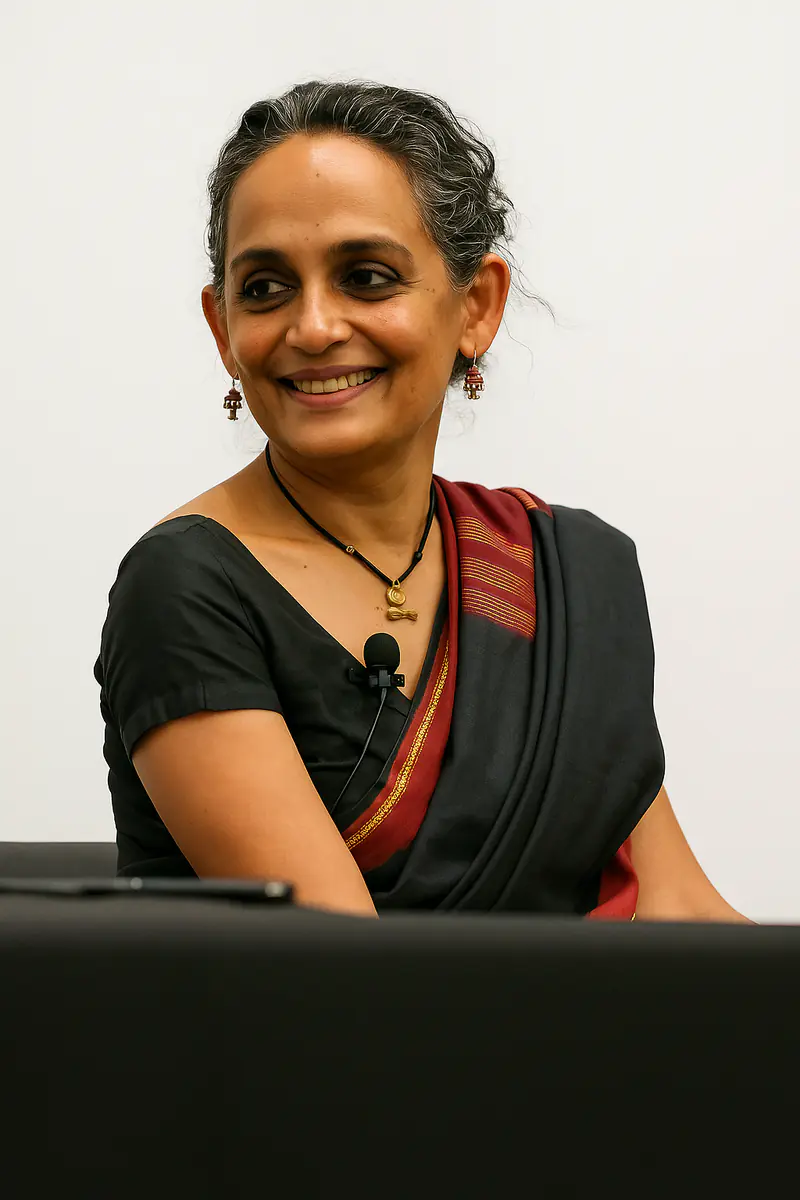
| 12 Quotes | |
| Born as | Suzanna Arundhati Roy |
| Occup. | Novelist |
| From | India |
| Born | November 24, 1961 Shillong, Assam, India |
| Age | 64 years |
Suzanna Arundhati Roy was born on 24 November 1961 in Shillong, then part of Assam in India. Her mother, Mary Roy, was a teacher and a pioneering women's rights advocate from Kerala whose legal battle helped secure equal inheritance rights for Syrian Christian women in the state. Her father was a Bengali tea plantation manager. After her parents separated, Roy moved with her mother and brother to Kottayam in Kerala, spending formative years in and around Aymanam, a landscape and social world that would later infuse her fiction. Educated at schools her mother helped establish, including what became Pallikoodam, she left Kerala for Delhi as a teenager to study architecture at the School of Planning and Architecture. In Delhi she supported herself in a variety of jobs, an experience that sharpened her sense of the city's inequalities and cultural dynamism.
Early Career in Film and Television
Roy's first public prominence came through cinema and television. She acted in Massey Sahib (1985), directed by filmmaker Pradip Krishen. With Krishen she collaborated on writing for screen, most notably In Which Annie Gives It Those Ones (1989), a satirical television film about architecture students, for which she won the National Film Award for Best Screenplay. She also wrote the screenplay for Electric Moon (1992), an acerbic take on postcolonial tourism. These projects placed her amid New Delhi's community of independent filmmakers, actors, and writers, including colleagues and collaborators who moved between art, activism, and media. Roy and Krishen later married and eventually separated, but the creative milieu they shared shaped her voice and sharpened her gift for dialogue, observational detail, and irony.
The God of Small Things
Roy turned decisively toward literature with her debut novel, The God of Small Things (1997), set largely in Kerala and echoing the textures of Aymanam. The book interlaces family history with caste, class, and the residues of colonialism, crafting a structure that moves nonlinearly through memory. It became an international sensation and won the Booker Prize, making Roy one of the most visible Indian novelists of her generation. The novel's success also put her in conversation, sometimes contentiously, with writers and critics in India and abroad about form, politics, and the boundaries between private experience and public life. Readers often linked the book's setting and characters to Roy's own childhood environment, though she consistently emphasized its status as fiction.
Public Intellectual and Activist
After her novel's success, Roy devoted substantial energy to essay writing and activism. She wrote powerfully against India's 1998 nuclear tests in The End of Imagination, and became a prominent critic of large dam projects, aligning with the Narmada Bachao Andolan and figures such as Medha Patkar in The Greater Common Good and The Cost of Living. Her essays during and after the early 2000s, collected in volumes like The Algebra of Infinite Justice and later Field Notes on Democracy, criticized corporate globalization, militarization, and the erosion of civil liberties. She wrote about Kashmir, the aftermath of communal violence, and the expansion of internal security operations against Adivasi communities in central India, traveling to forest regions and publishing Walking with the Comrades. Roy's work drew support from human rights advocates and sharp rebuttals from officials and commentators who regarded her as polarizing; the debate around her became a proxy for larger arguments about development, nationalism, and dissent.
Legal Challenges and Public Controversies
Roy's activism led to legal scrutiny. In 2002, in connection with statements related to the Narmada dam litigation, India's Supreme Court found her in criminal contempt, imposing a symbolic one-day prison sentence and a fine. She remained unapologetic, framing the episode as part of a wider contest over free expression and the rights of displaced communities. She continued to face complaints and investigations at different moments as she wrote on Kashmir and other sensitive topics, arguing that vigorous public debate is fundamental to a democratic society.
Later Fiction and Nonfiction
For two decades after her debut, Roy concentrated on essays, among them War Talk, An Ordinary Person's Guide to Empire, Broken Republic, and Capitalism: A Ghost Story, before publishing her second novel, The Ministry of Utmost Happiness (2017). Ranging from the streets of Delhi to Kashmir, and featuring a diverse cast including the transgender character Anjum, the novel braided intimate lives with state violence and environmental ruin. It was longlisted for major prizes and renewed discussion about the relationship between Roy's fiction and her politics. She also produced expansive collections of nonfiction, including My Seditious Heart (2019), a two-decade anthology, and Azadi (2020), whose essays, among them her widely cited reflection on COVID-19 as "a portal", connected public health, inequality, and political freedom.
Awards and Recognition
Roy's writing has been recognized across genres. The God of Small Things won the Booker Prize and was translated into many languages. In addition to her early National Film Award, she received international honors for her political essays, including awards from literary and civil society organizations that noted her fusion of literary craft and public courage. In 2015 she announced that she would return her National Film Award in solidarity with writers and artists protesting rising intolerance, placing herself again at the center of national debate.
Personal Life and Influences
Roy's personal and intellectual formation reflects multiple worlds: her mother Mary Roy's example as a principled educator and litigant; the layered cultures of Kerala and Delhi; friendships and collaborations with filmmakers like Pradip Krishen; and dialogues with activists, lawyers, and journalists working on displacement, caste, and civil liberties. Her extended engagement with the ideas of B. R. Ambedkar, especially in The Doctor and the Saint, placed her in sustained conversation with Dalit scholars and social movements about caste and democracy. She has made her home in Delhi for many years, even as her reporting and activism have taken her to displacement camps, courtrooms, universities, and remote forest villages.
Legacy and Influence
Arundhati Roy's significance rests on a rare combination of literary achievement and dissenting public voice. As a novelist she expanded the textures of English-language fiction from the subcontinent, using lyrical prose and inventive structure to inhabit memory, love, and social taboo. As an essayist she pressed arguments about power with moral urgency, insisting on the costs borne by the poor, by minorities, and by the environment. The debates she provoked, over development, nationalism, and the limits of speech, have made her both a touchstone and a lightning rod. Through it all, her work has kept faith with the idea that language can unsettle official narratives, and that storytelling, across novels, reportage, and essays, can help imagine more just futures.
Our collection contains 12 quotes who is written by Arundhati, under the main topics: Justice - Writing - Freedom - New Beginnings - Human Rights.
Other people realated to Arundhati: Amy Goodman (Journalist)
Frequently Asked Questions
- Arundhati Roy New book: Latest novel: The Ministry of Utmost Happiness (2017); latest essay collection: Azadi (2020).
- Arundhati Roy daughter: She has no daughter (no children).
- Arundhati Roy famous works: The God of Small Things (1997 Booker Prize); The Ministry of Utmost Happiness; essays like Azadi and Capitalism: A Ghost Story.
- Arundhati Roy husband: Married to filmmaker Pradip Krishen (previously married to architect Gerard da Cunha).
- Arundhati Roy books: The God of Small Things; The Ministry of Utmost Happiness; Azadi; My Seditious Heart; The Algebra of Infinite Justice; Field Notes on Democracy; Capitalism: A Ghost Story.
- Arundhati Roy movies: Screenwriter of In Which Annie Gives It Those Ones (1989) and Electric Moon (1992); subject of the documentary DAM/AGE (2002).
- How old is Arundhati Roy? She is 64 years old
Arundhati Roy Famous Works
- 2019 My Seditious Heart (Collection)
- 2017 The Ministry of Utmost Happiness (Novel)
- 1997 The God of Small Things (Novel)
Source / external links