
Augusto Pinochet Biography Quotes 5 Report mistakes
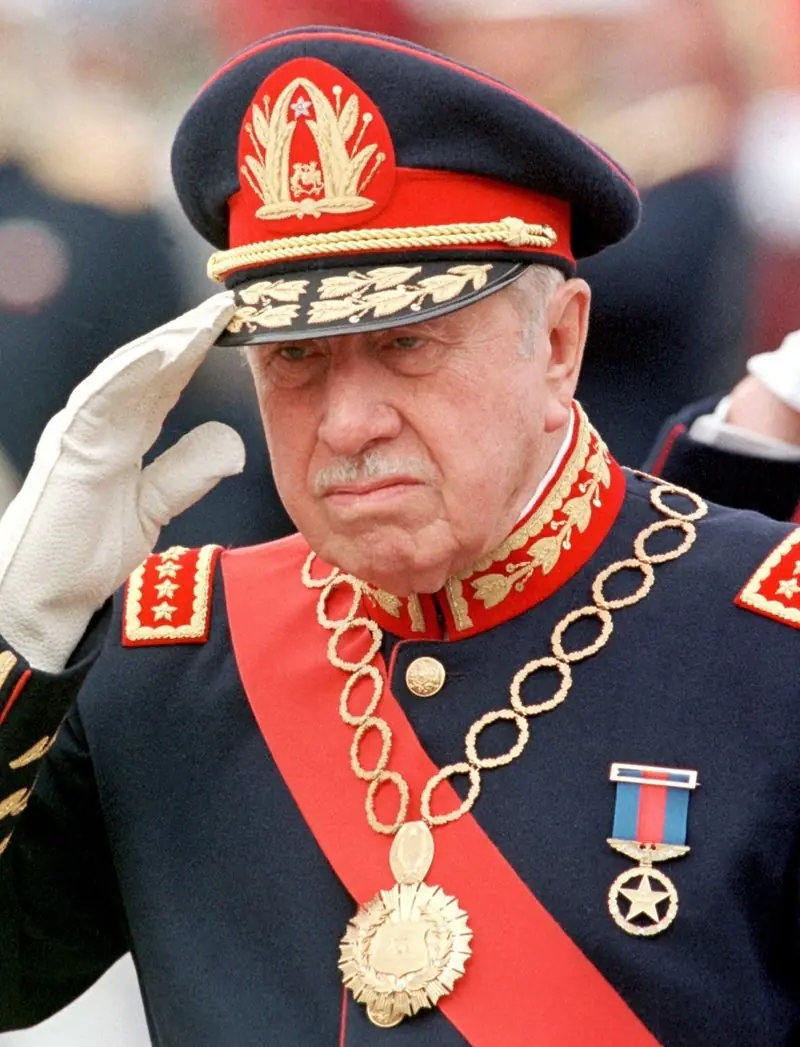
| 5 Quotes | |
| Born as | Augusto José Ramón Pinochet Ugarte |
| Occup. | Soldier |
| From | Chile |
| Born | November 25, 1915 Valparaíso, Chile |
| Died | December 10, 2006 Santiago, Chile |
| Aged | 91 years |
Augusto Jose Ramon Pinochet Ugarte was born on November 25, 1915, in Valparaiso, Chile, a port city shaped by maritime trade, migration, and a strong tradition of public order. He grew up in a lower-middle-class Catholic milieu that valued hierarchy and respectability, a social atmosphere that would later mesh easily with military institutional culture. Chile in his youth was marked by political volatility, labor conflict, and the lingering aftershocks of the Great Depression, conditions that encouraged many conservatives to see stability as an overriding civic virtue.
Pinochet married Lucia Hiriart in 1943, a partnership that became central to his private identity and public mythology. The family circle offered a sense of mission and moral certainty that he later projected onto the state itself. Those who worked near him often described an inward, guarded temperament: disciplined in routine, wary of rivals, and intensely attentive to loyalty - traits that hardened as Chilean politics polarized in the 1960s and early 1970s.
Education and Formative Influences
Pinochet entered the Escuela Militar in Santiago in 1933 and graduated into an army that viewed itself as guardian of the republic, heir to the Prussian-influenced professionalism adopted by Chile in earlier decades. He served in various garrisons, taught at military schools, and studied geopolitics and security doctrine as anti-communism became a defining lens of the Cold War. His time in internal-security postings and staff roles reinforced a belief that ideological conflict was existential and that the state could not survive without centralized command, intelligence, and disciplined coercion.
Career, Major Works, and Turning Points
Rising through the ranks, Pinochet became a general and in August 1973 was appointed commander-in-chief of the army by President Salvador Allende amid strikes, unrest, and escalating confrontation between the Popular Unity government and its opponents. On September 11, 1973, he joined the armed forces in overthrowing Allende and soon emerged as head of the ruling junta, consolidating personal authority as "Supreme Chief of the Nation" and then president. His regime combined sweeping repression - including DINA and later CNI intelligence services, disappearances, torture, exile, and Operation Condor coordination - with a radical market overhaul guided by technocrats known as the "Chicago Boys". The 1980 constitution institutionalized a controlled transition and military prerogatives; after losing the 1988 plebiscite, he handed the presidency to Patricio Aylwin in 1990 but remained army commander until 1998 and then a senator-for-life, seeking legal and symbolic immunity as cases mounted over human rights abuses and corruption.
Philosophy, Style, and Themes
Pinochet framed himself less as a politician than as an instrument of national salvation, blending military corporatism, Catholic providential language, and Cold War anti-Marxism. He insisted his violence was remedial rather than constitutive, asserting that "Everything I did, all my actions, all of the problems I had I dedicate to God and to Chile, because I kept Chile from becoming Communist". The psychological appeal of that formulation is its transfer of agency: the self becomes a servant of higher imperatives, turning moral choice into duty and collapsing plural politics into a single, righteous command. When confronted with atrocity, he often moved from regret to absolution-by-transcendence: "I regret and suffer those losses, but it's God's will. He will pardon me if I committed excesses, but I don't think I did". That sentence reveals a habitual narrowing of responsibility - suffering is acknowledged, but culpability is dissolved in divine permission and self-exonerating doubt.
His personal style was austere, suspicious, and managerial, favoring secrecy, chain of command, and the grammar of emergency. In public ritual he cultivated the soldier-as-nation archetype, a man whose legitimacy derived from uniformed service rather than consent, and whose gratitude flowed upward to the patria rather than outward to citizens. "During 65 years, I have walked the path of duty and discipline... And today, looking back at that long path of service, my soldier's heart stirs and murmurs from deep within: Thank you. Thank you, my homeland". The theme is not intimacy with the populace but communion with an abstract homeland, a relationship that can justify exceptional measures and silence dissent as disloyalty. In this worldview, order is moral, conflict is pathology, and opposition becomes an internal enemy - a framework that made negotiated politics feel like weakness and repression feel like hygiene.
Legacy and Influence
Pinochet died on December 10, 2006, in Santiago, without a final criminal conviction, but his life permanently reordered Chilean memory and institutions. He left a paradoxical inheritance: macroeconomic modernization and global integration alongside deep inequality, trauma, and a long struggle for truth and justice embodied by the Rettig and Valech commissions and decades of court cases. Internationally, his 1998 arrest in London on a Spanish warrant helped redefine the reach of universal jurisdiction for crimes against humanity, signaling that former heads of state could be pursued beyond borders. In Chile, "pinochetismo" endures as both political identity and moral warning, ensuring that debates over security, constitutional legitimacy, and the limits of state power remain inseparable from the lives damaged - and the civic trust broken - under his rule.
Our collection contains 5 quotes who is written by Augusto, under the main topics: Witty One-Liners - Freedom - Military & Soldier - War - God.
Other people realated to Augusto: Jorge Luis Borges (Poet), Henry A. Kissinger (Statesman), Fernando Flores (Politician)
Source / external links