
Aung San Suu Kyi Biography Quotes 8 Report mistakes
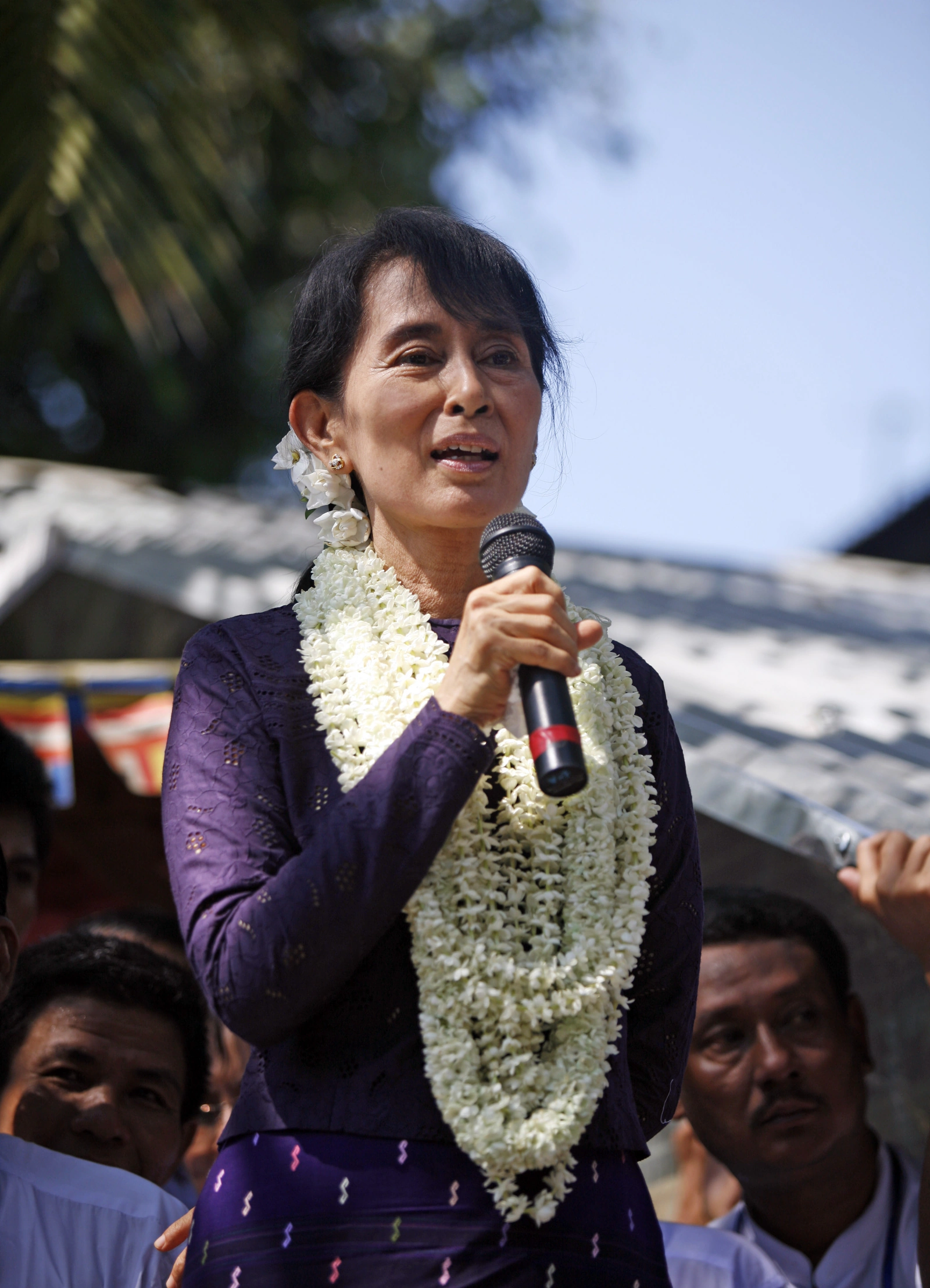
| 8 Quotes | |
| Occup. | Activist |
| From | Myanmar |
| Born | June 19, 1945 |
| Age | 80 years |
| Cite | |
Citation Formats
APA Style (7th ed.)
Aung san suu kyi biography, facts and quotes. (2026, February 24). FixQuotes. https://fixquotes.com/authors/aung-san-suu-kyi/
Chicago Style
"Aung San Suu Kyi biography, facts and quotes." FixQuotes. February 24, 2026. https://fixquotes.com/authors/aung-san-suu-kyi/.
MLA Style (9th ed.)
"Aung San Suu Kyi biography, facts and quotes." FixQuotes, 24 Feb. 2026, https://fixquotes.com/authors/aung-san-suu-kyi/. Accessed 5 Mar. 2026.
Early Life and Background
Aung San Suu Kyi was born on 1945-06-19 in Rangoon (Yangon), Burma, into a household where politics was not an abstraction but a family inheritance. Her father, Gen. Aung San, led the wartime struggle that cleared a path to Burmese independence and was assassinated in 1947 when she was a child, leaving a national martyrdom that shaped her private identity. Her mother, Khin Kyi, became a prominent public figure and later a diplomat, giving Suu Kyi early proximity to statecraft, ceremony, and the sharp divides between power and the governed.
Burma then moved through post-independence turbulence into Gen. Ne Win's 1962 coup and the long military-dominated order that followed. Suu Kyi grew up with the paradox of being both protected by the aura of her father's name and exposed to the burdens it imposed: expectation, surveillance, and the sense that personal choices might be read as political acts. The country she left as a young woman increasingly sealed itself off, while her family story kept pulling her back toward its unfinished revolution.
Education and Formative Influences
She studied in India during her mother's posting, absorbing the example of constitutional politics and the memory of nonviolent mass movements, then continued her education at St Hugh's College, Oxford, reading philosophy, politics, and economics. In the late 1960s she worked at the United Nations in New York, gaining a technocratic view of development and international norms. Marriage to the British scholar Michael Aris and years raising two sons in the United Kingdom placed her at a distance from Burma's daily repression, yet also gave her comparative vantage: a life lived between systems, where democratic procedure was ordinary rather than heroic.
Career, Major Works, and Turning Points
In 1988, as Burma convulsed in nationwide protests against military rule, Suu Kyi returned to Rangoon to care for her ailing mother and was rapidly propelled into leadership. She co-founded the National League for Democracy (NLD), addressed vast crowds, and became the regime's most potent civilian challenger, helped by the symbolic force of her lineage and the discipline of her message. The NLD won the 1990 election in a landslide, but the military refused to honor the result; she spent much of 1989-2010 under house arrest, separated from her family and barred from travel, while her writings and speeches circulated abroad. Awarded the Nobel Peace Prize in 1991, she became a global icon of principled resistance, then re-entered formal politics after partial liberalization, leading the NLD to a decisive victory in 2015 and serving as de facto civilian leader from 2016. Her tenure, however, collided with constitutional limits, military power, and international outrage over the 2017 Rohingya crisis; after the 2021 coup she was again detained and sentenced in a series of cases widely viewed as politicized.
Philosophy, Style, and Themes
Suu Kyi's political psychology fused moral absolutism with strategic patience. She framed democracy not as a Western accessory but as protection for ordinary lives, insisting that “Human beings the world over need freedom and security that they may be able to realize their full potential”. That pairing of freedom and security revealed her central tension: she wanted liberation without social fracture, and she repeatedly sought to discipline popular anger into a politics that could endure repression without becoming its mirror image.
Her essays and addresses also diagnose how authority defends itself by redefining virtue as obedience. “It is often in the name of cultural integrity as well as social stability and national security that democratic reforms based on human rights are resisted by authoritarian governments”. This was less a slogan than a map of the regime's rhetoric, and it shaped her style: calm, didactic, steeped in Buddhist-inflected restraint, and aimed at delegitimizing violence by refusing its emotional tempo. Yet she also rejected the notion that politics was inherently corrupt, arguing publicly, “I think I should be active politically. Because I look upon myself as a politician. That's not a dirty work, you know. Some people think that there are something wrong with politicians. Of course, something wrong with some politicians”. Behind the plain language lay a self-portrait: duty embraced without romanticizing the arena, and a belief that ethical conduct must be practiced inside institutions, not only against them.
Legacy and Influence
Suu Kyi's legacy is inseparable from Burma/Myanmar's unresolved struggle between electoral legitimacy and military supremacy. To admirers, her years of detention and refusal to compromise in the 1990s exemplified nonviolent courage and helped keep Burma's democratic aspiration alive; to critics, her years in power exposed a narrowing empathy and a willingness to subordinate human-rights advocacy to nationalist politics and state survival. Globally she altered how the late 20th century imagined dissidence - as endurance rather than insurgency - and her rise and fall became a cautionary biography of icon-making: a single figure can embody a people's hope, yet cannot escape the brutal structures, ethnic fractures, and moral tests that define a country's history.
Our collection contains 8 quotes written by Aung, under the main topics: Leadership - Freedom - Equality - Change - Peace.
Other people related to Aung: Luc Besson (Director)
Source / external links