
Ayrton Senna Biography Quotes 27 Report mistakes
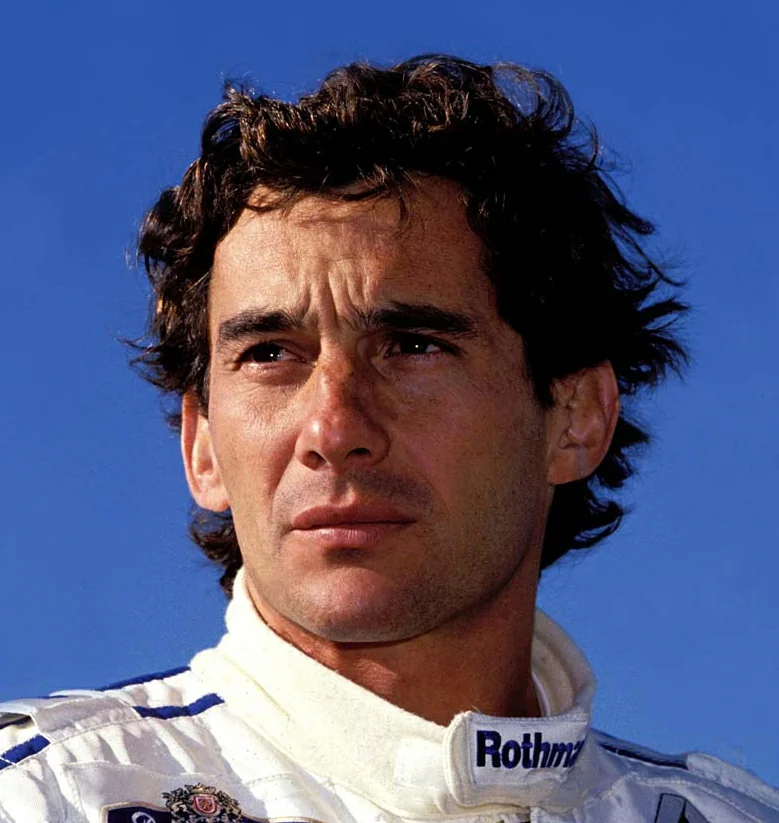
| 27 Quotes | |
| Occup. | Celebrity |
| From | Brazil |
| Born | March 21, 1960 São Paulo, Brazil |
| Died | May 1, 1994 Bologna, Italy |
| Aged | 34 years |
| Cite | |
Citation Formats
APA Style (7th ed.)
Ayrton senna biography, facts and quotes. (2026, February 11). FixQuotes. https://fixquotes.com/authors/ayrton-senna/
Chicago Style
"Ayrton Senna biography, facts and quotes." FixQuotes. February 11, 2026. https://fixquotes.com/authors/ayrton-senna/.
MLA Style (9th ed.)
"Ayrton Senna biography, facts and quotes." FixQuotes, 11 Feb. 2026, https://fixquotes.com/authors/ayrton-senna/. Accessed 27 Mar. 2026.
Early Life and Background
Ayrton Senna da Silva was born on March 21, 1960, in Sao Paulo, Brazil, into a middle-class family that combined ambition with structure. His father, Milton da Silva, encouraged mechanical curiosity early; the boy who struggled with coordination and anxiety in school found calm in motion, especially when engines gave him a set of rules and immediate feedback. Brazil in the 1960s and 1970s was modernizing under authoritarian rule, and Senna grew up amid sharp contrasts - aspiration and constraint, spectacle and inequality - that later shaped his private insistence that success had obligations.Karting became his first language of selfhood. At Interlagos and later in regional circuits, he developed the traits that would define him: ferocious concentration, moral seriousness, and a sense that performance was a form of personal truth. The family name "da Silva" was common; the decision to race as "Senna" signaled a desire to be singular, not merely successful, and to craft an identity that could carry beyond the paddock.
Education and Formative Influences
Senna briefly studied business administration in Sao Paulo before committing fully to racing, a choice that was less rebellion than recognition of vocation. He absorbed the European ladder system as a cultural education: the discipline of British single-seaters, the politics of sponsorship, the loneliness of living far from home, and the spiritual self-talk that helped him convert fear into precision. His Catholic faith and intense self-scrutiny became twin anchors; he treated racing not as entertainment but as a test of character under speed.Career, Major Works, and Turning Points
After dominating junior categories in England, Senna entered Formula One in 1984 with Toleman, announcing himself in the rain at Monaco with a near-upset that hinted at a rare wet-weather genius. He moved to Lotus in 1985, collecting pole positions and wins that showcased one-lap brilliance, then reached his peak at McLaren (1988-1993), winning three World Drivers' Championships (1988, 1990, 1991) and forging a defining rivalry with Alain Prost that mixed psychology, politics, and contrasting ideas of fairness. Turning points included the controversial 1989 and 1990 Suzuka collisions, his 1991 home triumph at Interlagos while stuck in a single gear, and the bleak 1994 start with Williams as active-suspension rules changed and the car proved nervous. On May 1, 1994, he died after a crash at Tamburello during the San Marino Grand Prix at Imola, a loss that forced the sport into a new era of safety reform.Philosophy, Style, and Themes
Senna drove as if the cockpit were a confessional: the lap demanded total honesty, and any compromise felt like a lie. He framed competition in stark terms, not because he enjoyed conflict, but because he feared dilution of purpose: “You must take the compromise to win, or else nothing. That means: you race or you do not”. This absolutism could look like arrogance; inwardly it was closer to asceticism - an attempt to quiet doubt by making the goal non-negotiable.His greatest performances suggest an altered relationship with time, especially in qualifying and in the rain, where he described crossing from calculation into trance: “And suddenly I realised that I was no longer driving the car consciously. I was driving it by a kind of instinct, only I was in a different dimension”. That "different dimension" was not mysticism for show; it was his name for flow under mortal risk, the moment when fear, faith, and technique fused into clarity. Yet the same intensity made second place feel intolerable, as if survival without triumph were a kind of erasure: “Being second is to be the first of the ones who lose”. The psychology behind the line was revealing - he measured himself against an ideal, not a field, and treated excellence as a moral debt to his own potential and to the people who projected hope onto his victories.
Legacy and Influence
Senna became Brazil's most enduring modern sporting icon, a figure whose charisma was inseparable from vulnerability: openly reflective, privately lonely, publicly incandescent. Through the Ayrton Senna Institute, founded by his family after his death, his name became linked not only to speed but to education and social investment, extending his sense of responsibility into civic life. In Formula One, his death accelerated systemic safety changes - circuit redesigns, car structures, medical response, and a culture less willing to romanticize lethal risk. For drivers who followed, he remains a benchmark of raw pace and rain mastery, but also a cautionary myth: a man who chased purity at the limit, and in doing so reshaped how the sport understands greatness, danger, and duty.Our collection contains 27 quotes written by Ayrton, under the main topics: Witty One-Liners - Motivational - Mortality - Victory - Sports.
Other people related to Ayrton: Nigel Mansell (Athlete), Michael Andretti (Athlete)
Source / external links