
B. F. Skinner Biography Quotes 28 Report mistakes
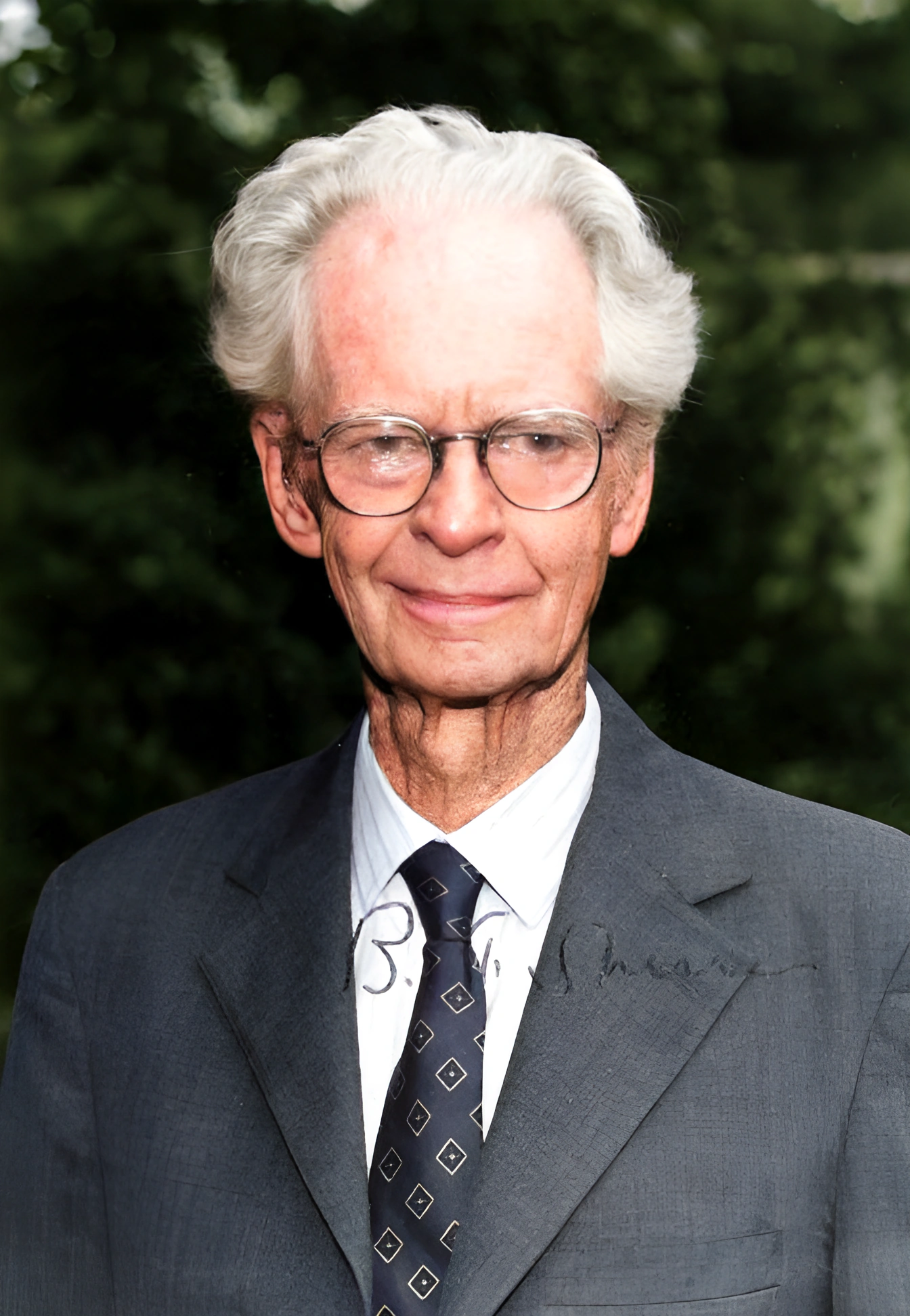
| 28 Quotes | |
| Born as | Burrhus Frederic Skinner |
| Occup. | Psychologist |
| From | USA |
| Spouse | Yvonne Blue |
| Born | March 20, 1904 Susquehanna, Pennsylvania, United States |
| Died | August 18, 1990 Massachusetts, United States |
| Cause | Leukemia |
| Aged | 86 years |
| Cite | |
Citation Formats
APA Style (7th ed.)
B. f. skinner biography, facts and quotes. (2026, February 11). FixQuotes. https://fixquotes.com/authors/b-f-skinner/
Chicago Style
"B. F. Skinner biography, facts and quotes." FixQuotes. February 11, 2026. https://fixquotes.com/authors/b-f-skinner/.
MLA Style (9th ed.)
"B. F. Skinner biography, facts and quotes." FixQuotes, 11 Feb. 2026, https://fixquotes.com/authors/b-f-skinner/. Accessed 27 Mar. 2026.
Early Life and Background
Burrhus Frederic Skinner was born on March 20, 1904, in Susquehanna, Pennsylvania, a small railroad town where routines, tools, and practical outcomes were visible in everyday life. His father, William Skinner, was a lawyer; his mother, Grace Burrhus Skinner, was religious and morally exacting. The household blended ambition with restraint, and Skinner later wrote about the pressures of approval and disapproval - early lessons in how social consequences can govern conduct long before anyone gives them a scientific name.As a boy he built gadgets, contraptions, and small mechanical systems, delighting in designs that reliably produced effects. That early tinkering mattered: it trained his attention on observable relations between action and outcome, and it gave him a craftsman's confidence that behavior, like a mechanism, could be studied by controlling conditions. The cultural backdrop of his youth - Progressive Era faith in expertise followed by the disillusionments of World War I - helped make the promise of a rigorous science of behavior feel not only possible but necessary.
Education and Formative Influences
Skinner attended Hamilton College in Clinton, New York, graduating in 1926 with a degree in English literature and an initial ambition to become a writer. A difficult post-college period in Scranton, marked by stalled creativity and a growing dissatisfaction with introspection, pushed him toward psychology. He entered Harvard University for graduate study, absorbing the emerging American experimental tradition while reacting against mentalistic explanations; he was influenced by the behaviorism of John B. Watson and, more technically, by Ivan Pavlov's conditioning work and the methodological rigor of physiologists. At Harvard he began shaping his own program: focus on measurable behavior, engineer the environment, and let data - not self-report - arbitrate theories of mind.Career, Major Works, and Turning Points
In the 1930s Skinner built the operant conditioning chamber (the "Skinner box") and developed cumulative records that made patterns of responding visible over time, culminating in The Behavior of Organisms (1938). After positions at the University of Minnesota and Indiana University, he returned to Harvard in 1948, where his laboratory became a center for experimental analysis of behavior. World War II steered him briefly toward applied work, including the controversial "Project Pigeon" to guide missiles; later he broadened his public reach with Walden Two (1948), a utopian novel about a behaviorally engineered community, and Science and Human Behavior (1953), which argued that social problems yield to a technology of behavior. In the 1960s and 1970s his influence peaked and his controversies sharpened - especially after Beyond Freedom and Dignity (1971) challenged popular ideas of autonomous will - yet he remained prolific, lecturing and publishing into his final years, including the reflective About Behaviorism (1974).Philosophy, Style, and Themes
Skinner's core claim was austere: to explain behavior, look to histories of reinforcement and current contingencies rather than inner entities treated as causes. He insisted that “Behavior is shaped and maintained by its consequences”. In his hands, that was not a slogan but a research program that tied learning to schedules of reinforcement, extinction, discrimination, and stimulus control. His style favored operational definitions and engineered demonstrations over speculation; even when addressing art, religion, politics, or therapy, he returned to the same architecture of explanation: what conditions precede action, what follows it, and how those outcomes alter the future.Psychologically, Skinner combined a reformer's impatience with suffering and a technician's belief that better tools beat better intentions. He wrote as someone wary of moralistic blame, arguing that responsibility talk often masks ignorance of causes; in that spirit he maintained, “It is a mistake to suppose that the whole issue is how to free man. The issue is to improve the way in which he is controlled”. He pushed the implications into education and parenting, where the provocative confidence of behavior shaping - “Give me a child and I'll shape him into anything”. - captured both his ambition and his critics' fear. Yet his deeper motivation was not coercion for its own sake but the replacement of punishment and force with humane design: arrange environments so that desirable behavior is reinforced, avoid traps that reward short-term harm, and build institutions that make decency easier than cruelty.
Legacy and Influence
Skinner died on August 18, 1990, in Cambridge, Massachusetts, after decades as the most visible American behaviorist. His legacy endures in the experimental analysis of behavior, in applied behavior analysis (ABA) methods used in developmental disability services and classroom management, and in behaviorally informed design in organizations, public health, and digital products - for good or ill, depending on ethics. He also left a permanent argument on the table: whether a science that sidelines inner causes impoverishes our picture of the person or, instead, offers the clearest route to compassion by replacing condemnation with understanding. In an era still divided between mentalistic comfort and measurable change, Skinner remains the figure who most relentlessly insisted that what we call "self" is not ignored by behavioral science, but explained through the patterns of control we learn to notice - and, if we dare, to redesign.Our collection contains 28 quotes written by F. Skinner, under the main topics: Never Give Up - Love - Freedom - Learning - Parenting.
Other people related to F. Skinner: Morton Hunt (Writer)
Source / external links