
Babe Ruth Biography Quotes 27 Report mistakes
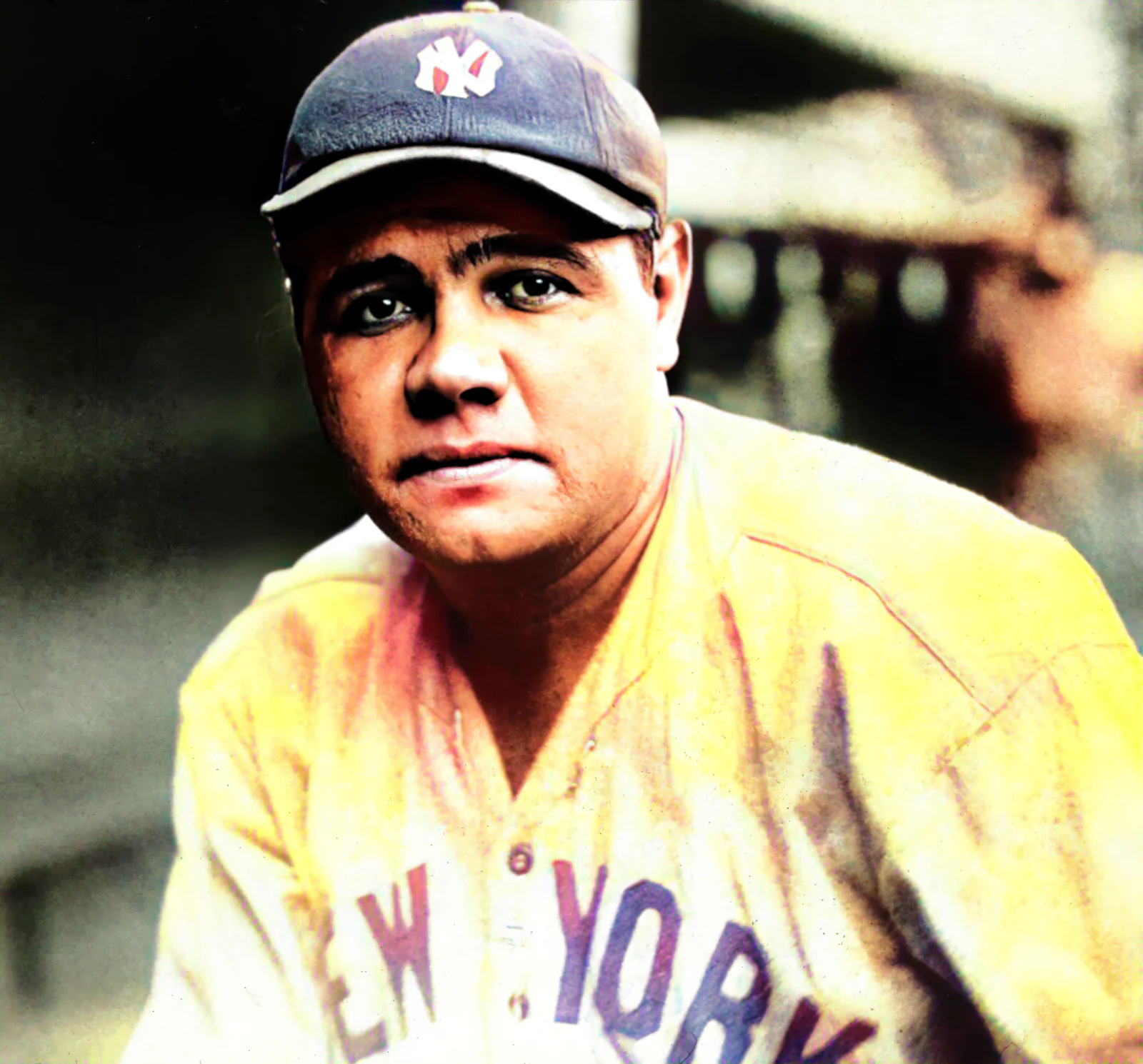
| 27 Quotes | |
| Born as | George Herman Ruth Jr. |
| Occup. | Athlete |
| From | USA |
| Born | February 6, 1895 Baltimore, Maryland, USA |
| Died | August 16, 1948 New York City, New York, USA |
| Cause | Cancer |
| Aged | 53 years |
| Cite | |
Citation Formats
APA Style (7th ed.)
Babe ruth biography, facts and quotes. (2026, February 1). FixQuotes. https://fixquotes.com/authors/babe-ruth/
Chicago Style
"Babe Ruth biography, facts and quotes." FixQuotes. February 1, 2026. https://fixquotes.com/authors/babe-ruth/.
MLA Style (9th ed.)
"Babe Ruth biography, facts and quotes." FixQuotes, 1 Feb. 2026, https://fixquotes.com/authors/babe-ruth/. Accessed 5 Mar. 2026.
Early Life and Background
George Herman Ruth Jr. was born on February 6, 1895, in Baltimore, Maryland, a port city thick with immigrant labor, taverns, and street commerce. His parents, George Sr. and Katherine, ran a saloon, and the boy who would be called "Babe" grew up amid adult talk, cash drawers, and the rough permissions of turn-of-the-century working-class life. He was one of eight children, but only a few survived infancy - a family fact that shadowed the era as much as any headline about the Spanish-American War or the coming churn of industrial America.Ruth was, by most accounts, too big, too loud, and too unattended for the narrow spaces of school and neighborhood discipline. Petty trouble and constant motion pushed his parents toward a hard solution in 1902: he was sent to St. Mary's Industrial School for Boys, a Catholic reformatory in Baltimore. The move both contained his worst impulses and placed him inside a structured world where authority, routine, and an unexpected kind of affection could shape him.
Education and Formative Influences
St. Mary's became Ruth's real education. Under the care of the Xaverian Brothers, he learned basic trades and the social grammar of rules, but his deepest schooling came on the diamond. Brother Matthias Boutlier recognized the left-handed boy's uncommon coordination and taught him to field, throw, and hit with intention, not just force. In a time before modern farm systems, the institution functioned as Ruth's incubator - not merely polishing a skill, but giving him a route away from the street and toward a vocation that could absorb his appetite for risk.Career, Major Works, and Turning Points
Ruth signed with the Baltimore Orioles (then a minor league club) in 1914 and was quickly sold to the Boston Red Sox, debuting that same year. Initially a dominant left-handed pitcher, he helped Boston win World Series titles in 1915, 1916, and 1918, before his hitting became too explosive to keep in the rotation. The sport's dead-ball conventions began to crack around him; his home runs turned games into events and stadiums into theaters. In 1919 he hit 29 home runs, then was sold to the New York Yankees in early 1920 - a transaction that shifted baseball's center of gravity. With the Yankees he became the emblem of the live-ball era, setting single-season records (notably 54 in 1920 and 60 in 1927) and anchoring pennant runs and World Series victories (1923, 1927, 1928, 1932). Off the field, fame amplified his appetites and consequences: a highly publicized marriage to Helen Woodford, later to Claire Hodgson, bouts of poor conditioning, a 1925 illness that nearly derailed him, and periodic clashes with management all marked turning points in a career built on both power and volatility. He finished with 714 home runs and a mythic aura that outlasted his playing days, which ended in 1935 after a brief, unhappy stint with the Boston Braves.Philosophy, Style, and Themes
Ruth's style was architectural: he redrew what baseball permitted a hitter to attempt. Where earlier stars often prized placement and speed, he pursued leverage, lift, and damage, accepting strikeouts as rent paid for supremacy. His bravado was not merely showmanship but a psychological tool - a way to make pressure audible, to make opponents imagine catastrophe before it arrived. “Never let the fear of striking out get in your way”. That line reads like self-coaching from a man who knew his gifts came with public failure built in, and who chose to swing anyway.Yet Ruth also understood the discipline of time, especially as age and injuries accumulated. The same man who could boast about refusing "dinky singles" also insisted that reputation could not bat for you. “Yesterday's home runs don't win today's games”. The tension between indulgence and accountability ran through his inner life: he craved adoration and excess, but he also feared wasting the one escape route he had been handed. “If it wasn't for baseball, I'd be in either the penitentiary or the cemetery”. In that confession is the core of his psychology - baseball as salvation and as a stage, a place where a restless boy from Baltimore could turn impulse into craft and craft into legend.
Legacy and Influence
Ruth died on August 16, 1948, in New York City, after a public battle with cancer that drew crowds to Yankee Stadium and to the streets outside the hospital - a testament to how completely he had fused with the national pastime. His influence is both statistical and cultural: he helped normalize the home run as baseball's central spectacle, accelerated the Yankees' transformation into a dynasty brand, and set a template for American sports celebrity that mixed intimacy, scandal, and mass appeal. Later sluggers chased his numbers, but even more chased his symbolic position: the player who made a game feel modern, loud, and emotionally legible to millions, while carrying inside him the memory of what he might have been without it.Our collection contains 27 quotes written by Babe, under the main topics: Witty One-Liners - Motivational - Funny - Wisdom - Never Give Up.
Other people related to Babe: Mickey Mantle (Athlete), Roger Maris (Athlete), Hank Aaron (Athlete), Grantland Rice (Journalist), Bill Klem (Athlete), Carl Hubbell (Athlete), Smokey Joe Wood (Athlete), Tris Speaker (Athlete), Bob Considine (Journalist), Barry Bonds (Athlete)
Source / external links