
Ban Ki-moon Biography Quotes 11 Report mistakes
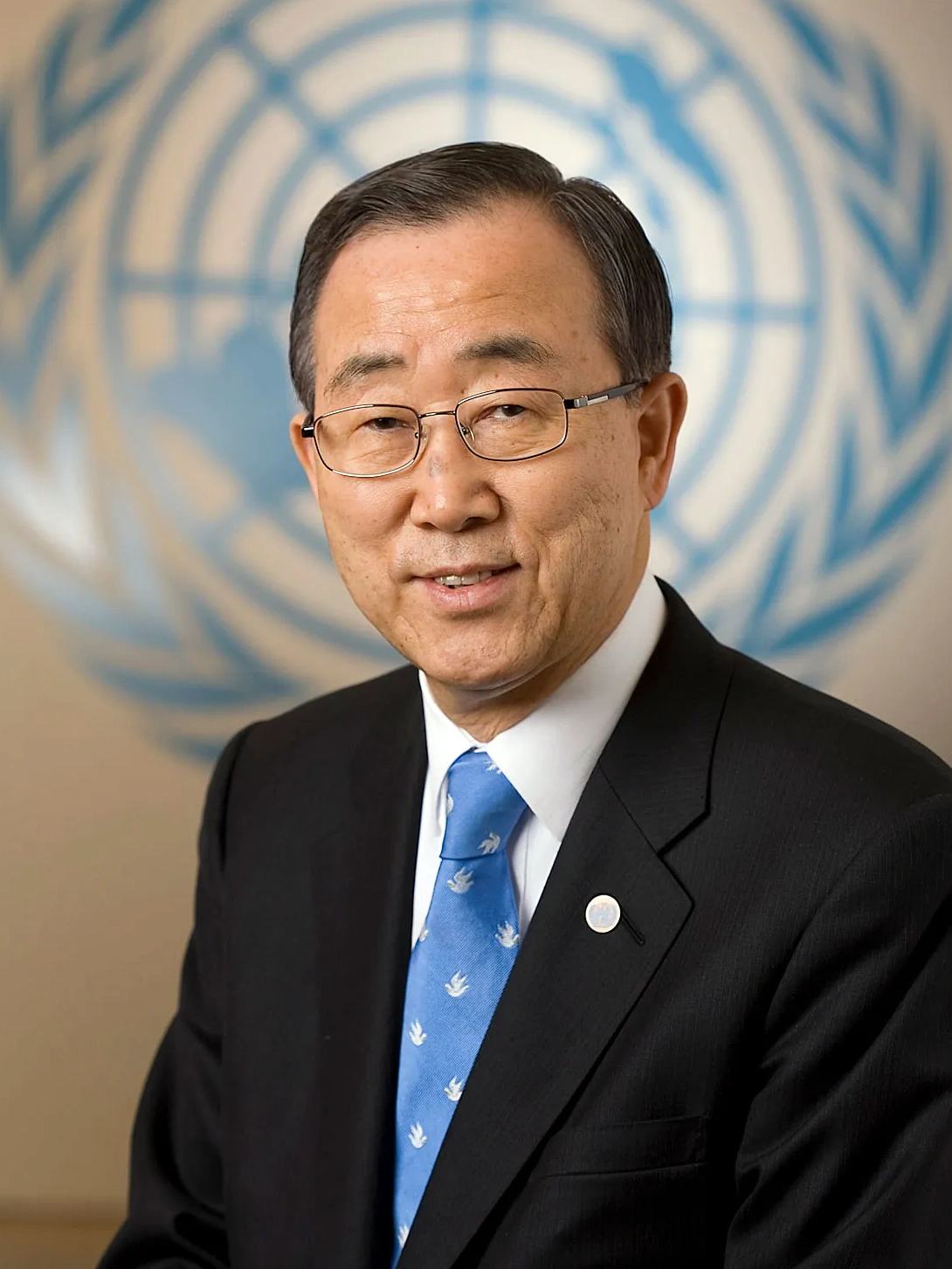
Attr: Britannica
| 11 Quotes | |
| Native name | 반기문 |
| Occup. | Diplomat |
| From | Korea |
| Spouse | Yoo Soon-taek (1971) |
| Born | June 13, 1944 Eumseong County, North Chungcheong, Korea |
| Age | 81 years |
| Cite | |
Citation Formats
APA Style (7th ed.)
Ban ki-moon biography, facts and quotes. (2026, March 8). FixQuotes. https://fixquotes.com/authors/ban-ki-moon/
Chicago Style
"Ban Ki-moon biography, facts and quotes." FixQuotes. March 8, 2026. https://fixquotes.com/authors/ban-ki-moon/.
MLA Style (9th ed.)
"Ban Ki-moon biography, facts and quotes." FixQuotes, 8 Mar. 2026, https://fixquotes.com/authors/ban-ki-moon/. Accessed 29 Mar. 2026.
Early Life and Background
Ban Ki-moon was born on June 13, 1944, in Eumseong County, North Chungcheong, during the last year of Japanese colonial rule in Korea. His childhood unfolded amid national rupture: liberation in 1945, partition, and then the Korean War, which pushed millions into displacement and scarcity. His family experienced the insecurity typical of provincial Korea in the 1950s, when hunger, damaged infrastructure, and political instability were ordinary facts of life. That setting mattered. Ban's later internationalism did not arise from abstraction but from early contact with national vulnerability - a boyhood shaped by the memory of foreign occupation, civil war, and dependence on global aid.He has often described himself as a product of South Korea's improbable ascent from devastation to industrial and diplomatic prominence. In a society remade by discipline, schooling, and state-led development, Ban came to represent a generation that linked personal advancement to national recovery. He was not a charismatic populist or theatrical public figure; from early on, he projected reserve, diligence, and self-command. Those traits, sometimes dismissed by critics as colorless, were in fact integral to his method. He emerged from a culture in which public service, hierarchy, and collective obligation carried unusual weight, and his temperament fit the long labor of diplomacy better than the quick rewards of ideological display.
Education and Formative Influences
Ban attended local schools before studying international relations at Seoul National University, graduating in 1970, and later completed a master's degree in public administration at Harvard University's Kennedy School in 1985. One famous formative episode came while he was still a student, when he won an English-language competition and traveled to the United States, where he met President John F. Kennedy. That encounter became part of his personal mythology: the provincial Korean student glimpsing the wider world and the power of international politics. More durable than any single anecdote, however, was the intellectual formation he received in Cold War South Korea - anti-communist, developmental, intensely education-centered, and newly outward-looking. He entered adulthood when the Republic of Korea was moving from survival to modernization, and he absorbed the era's faith in technocratic competence, alliance-building, and institutionally managed progress.Career, Major Works, and Turning Points
Ban joined South Korea's foreign ministry in 1970 and built a steady career through postings in New Delhi, Washington, Vienna, and at the United Nations, gaining a reputation as a meticulous negotiator and reliable administrator. He worked on issues central to Seoul's diplomacy: relations with the United States, the North Korean nuclear question, and South Korea's broader insertion into multilateral institutions. He served as national security adviser, presidential foreign policy aide, and eventually foreign minister from 2004 to 2006 under President Roh Moo-hyun. In 2006 he was chosen as the eighth secretary-general of the United Nations, taking office in January 2007. His decade in that role was defined by persistent crisis management rather than one grand settlement: climate diplomacy leading to the Paris Agreement framework, advocacy for the Millennium Development Goals and then the 2030 Agenda, institutional support for the Sustainable Development Goals, response efforts around Haiti, South Sudan, Syria, and Ebola, and campaigns for women's rights and youth engagement. His tenure also exposed the limits of the office. He faced criticism for caution during the Syrian catastrophe, for operating through bureaucratic consensus, and for the structural weakness of a secretary-general confronting Security Council deadlock. Yet his central achievement lay in holding together a universal forum through an era of fragmentation while pushing climate change and sustainable development from peripheral concerns to the center of global governance.Philosophy, Style, and Themes
Ban's public philosophy fused Korean developmental memory with UN universalism. He believed institutions matter because history can collapse quickly when institutions fail; that belief was not rhetorical but biographical. His speeches repeatedly returned to education, youth, poverty, and climate because he saw them as linked rather than separate causes. “Education is hope and dignity. Education is growth and empowerment. Education is the basic building block of every society and a pathway out of poverty”. That insistence reveals a mind formed by national reconstruction: education was not merely a moral good but the mechanism by which a war-scarred society remade itself. He was equally drawn to generational language - “I firmly believe that young people are a powerful force for social progress. People say you are leaders of tomorrow. I say you are leaders of today”. The line captures both his optimism and his managerial instinct: mobilize constituencies, translate ideals into programs, and broaden responsibility beyond statesmen.His style was sober, procedural, and accumulative. He rarely sought the unforgettable phrase for its own sake, but when he did, it was to compress urgency into collective duty. “We are the first generation that can put an end to poverty and we are the last generation that can put an end to climate change”. That sentence is revealing. It frames history as a narrowing window, morality as timetable, and politics as implementation. Ban's psychology was that of a disciplined broker who trusted persistence more than drama. Even his moral appeals carried the cadence of coordination rather than prophecy. Critics heard blandness; supporters heard seriousness. In either case, his language reflected a man convinced that the world's gravest problems would not yield to brilliance alone, but to patient, organized, multinational effort.
Legacy and Influence
Ban Ki-moon's legacy rests less on personal magnetism than on agenda-setting. He helped normalize the idea that climate change, extreme poverty, gender equality, literacy, and youth participation belong within one integrated global framework, and his secretary-generalship was crucial to the political momentum behind the SDGs and the climate negotiations that culminated in Paris in 2015. He also embodied South Korea's postwar transformation: a child of scarcity who became the chief civil servant of the international system. After leaving office in 2016, he remained active through global commissions, educational and climate initiatives, and support for multilateral cooperation. Historians are likely to judge him as a transitional figure - operating in an age when the UN's authority was increasingly contested, yet still able to use the office to define priorities that outlasted his tenure. His enduring influence lies in that combination of biography and program: the conviction that fragile nations can rise, that international cooperation is slow but necessary, and that diplomacy, at its best, is the patient conversion of memory into responsibility.Our collection contains 11 quotes written by Ban, under the main topics: Motivational - Leadership - Learning - Hope - Equality.
Other people related to Ban: Alexander Downer (Politician), Amr Moussa (Diplomat)
Source / external links