
Baruch Spinoza Biography Quotes 46 Report mistakes
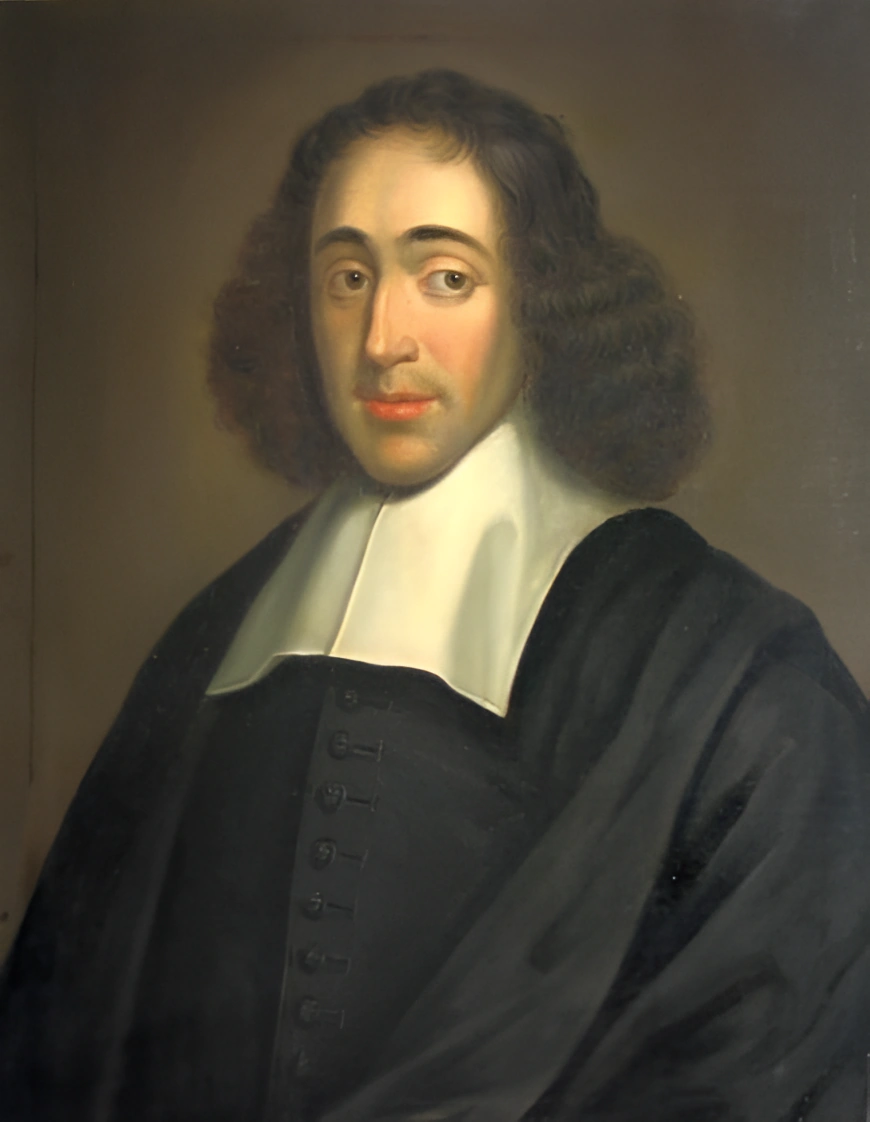
| 46 Quotes | |
| Born as | Baruch Espinosa |
| Known as | Benedictus de Spinoza |
| Occup. | Philosopher |
| From | Netherland |
| Born | November 24, 1632 Amsterdam, Dutch Republic |
| Died | February 21, 1677 The Hague, Dutch Republic |
| Aged | 44 years |
| Cite | |
Citation Formats
APA Style (7th ed.)
Baruch spinoza biography, facts and quotes. (2026, February 11). FixQuotes. https://fixquotes.com/authors/baruch-spinoza/
Chicago Style
"Baruch Spinoza biography, facts and quotes." FixQuotes. February 11, 2026. https://fixquotes.com/authors/baruch-spinoza/.
MLA Style (9th ed.)
"Baruch Spinoza biography, facts and quotes." FixQuotes, 11 Feb. 2026, https://fixquotes.com/authors/baruch-spinoza/. Accessed 13 Feb. 2026.
Early Life and Background
Baruch Spinoza (born Baruch Espinosa) entered the world on 1632-11-24 in Amsterdam, in the Dutch Republic at the height of its commercial and intellectual ascent. His family were Portuguese Sephardic Jews who had fled the Iberian inquisitions; Amsterdam offered relative safety, yet the community survived by strict internal discipline as much as by Dutch toleration. The young Spinoza grew up amid mercantile networks, synagogue authority, and a city where cartesian science, Protestant polemic, and global trade collided daily.Early losses and responsibilities sharpened his inward turn. His mother died when he was a child; later the family business demanded practical competence even as he gravitated toward ideas that loosened inherited certainties. Amsterdam in the 1640s-1650s was also a laboratory of dissent: Remonstrants, Collegiants, Mennonites, and freethinkers argued over Scripture and sovereignty. Spinoza absorbed that atmosphere, learning that peace in a republic was fragile and that identity could be both refuge and constraint.
Education and Formative Influences
Spinoza was educated in the Talmud Torah school, reading Hebrew Bible, rabbinic commentaries, and medieval Jewish philosophy (especially Maimonides), while also acquiring the Portuguese of his household and the Dutch of the street; later he learned Latin under the radical former Jesuit Franciscus van den Enden, where he encountered Descartes, Hobbes, Stoicism, and the new science. That education did not merely add texts to his mind; it created a double vision in which revelation and reason became competing languages for the same human anxieties about fear, hope, and control.Career, Major Works, and Turning Points
The turning point came in 1656, when Amsterdam's Portuguese-Jewish community issued a herem excommunicating him in unusually severe terms, effectively severing him from communal life; the precise provocations remain debated, but his emerging views on God, Scripture, and authority were clearly intolerable to guardians of a precarious diaspora order. He lived thereafter quietly in the Dutch Republic - in and around Rijnsburg, Voorburg, and The Hague - supporting himself as a lens grinder while building one of the era's most rigorous philosophical systems. He published the Principles of Cartesian Philosophy (1663) under his name, but major works appeared anonymously or posthumously: the Theological-Political Treatise (1670) defended freedom to philosophize and a naturalistic reading of Scripture; the Ethics, finished by the mid-1670s, circulated in manuscript and was published after his death on 1677-02-21, alongside the Political Treatise (unfinished), letters, and the Hebrew Grammar. He declined a university chair at Heidelberg (1673) rather than submit to constraints, choosing intellectual integrity over security.Philosophy, Style, and Themes
Spinoza's inner life is visible in the austerity of his method: he wanted thought to be as exact as geometry because passion is not defeated by exhortation but by comprehension. The Ethics presents a universe of necessity in which God or Nature is one substance, and everything follows from its attributes with the inevitability of logic; freedom, in this frame, is not uncaused choice but understanding why one acts. His refusal to moralize is psychological as well as philosophical - a discipline against resentment. "Do not weep; do not wax indignant. Understand". The sentence captures his spiritual temperament: an ethic of lucidity that treats emotions as natural events to be traced, not sins to be scourged.This is why desire, for Spinoza, is not a defect but the engine of human life: "Desire is the very essence of man". He anatomized how attachment and imagination generate bondage - superstition, hatred, servility - and how adequate ideas can reorganize the self into greater power of acting. In politics he sought conditions in which that power becomes compatible with civic stability, insisting that genuine concord is a mental and moral achievement, not a pause between conflicts: "For peace is not mere absence of war, but is a virtue that springs from, a state of mind, a disposition for benevolence, confidence, justice". His style mirrors his aim: spare definitions, proofs, and scholia that read like a mind restraining itself from rhetoric so that the reader might be remade by clear causes rather than stirred by slogans.
Legacy and Influence
Spinoza became a touchstone for the Enlightenment and its discontents: admired by Lessing, Goethe, and later the German idealists; attacked as an atheist while inspiring new forms of pantheism, biblical criticism, and secular ethics. His account of affects shaped modern psychology and political theory, and his insistence that Scripture be read historically helped lay groundwork for critical scholarship. Yet his enduring influence lies in the moral ambition of his system: to replace fear with understanding, to treat human beings as parts of nature without denying dignity, and to define freedom as the hard-won clarity that allows a finite life to become, in his terms, more rational, more joyful, and more at peace.Our collection contains 46 quotes written by Baruch, under the main topics: Ethics & Morality - Wisdom - Truth - Justice - Love.
Other people related to Baruch: Leo Strauss (Philosopher)
Frequently Asked Questions
- How did Baruch Spinoza contribute to the Enlightenment? Spinoza's rationalistic and pantheistic ideas influenced key Enlightenment thinkers, promoting critical thinking, religious tolerance, and democratic ideals.
- God of spinoza meaning: The God of Spinoza refers to his pantheistic conception of God, wherein God and the universe are identical, and God is an abstract, impersonal, and deterministic force.
- I believe in the god of Spinoza: Believing in the god of Spinoza means embracing his pantheistic view that God and the universe are identical, and that God is an abstract, impersonal, and deterministic force.
- How did Baruch Spinoza die? Baruch Spinoza died of a lung illness, likely tuberculosis, in February 1677.
- What was Baruch Spinoza contribution to philosophy? Spinoza contributed significantly to the development of rationalism, metaphysics, and ethics. He proposed the concept of pantheism, arguing that God and the universe are one and the same.
- How old was Baruch Spinoza? He became 44 years old
Baruch Spinoza Famous Works
- 1677 A Political Treatise (Book)
- 1677 Ethics (Philosophical treatise)
- 1670 Theological-Political Treatise (Book)
- 1662 Short Treatise on God, Man, and His Well-Being (Book)
- 1661 Letters (Correspondence)
Source / external links