
Beatrix of the Netherlands Biography Quotes 2 Report mistakes
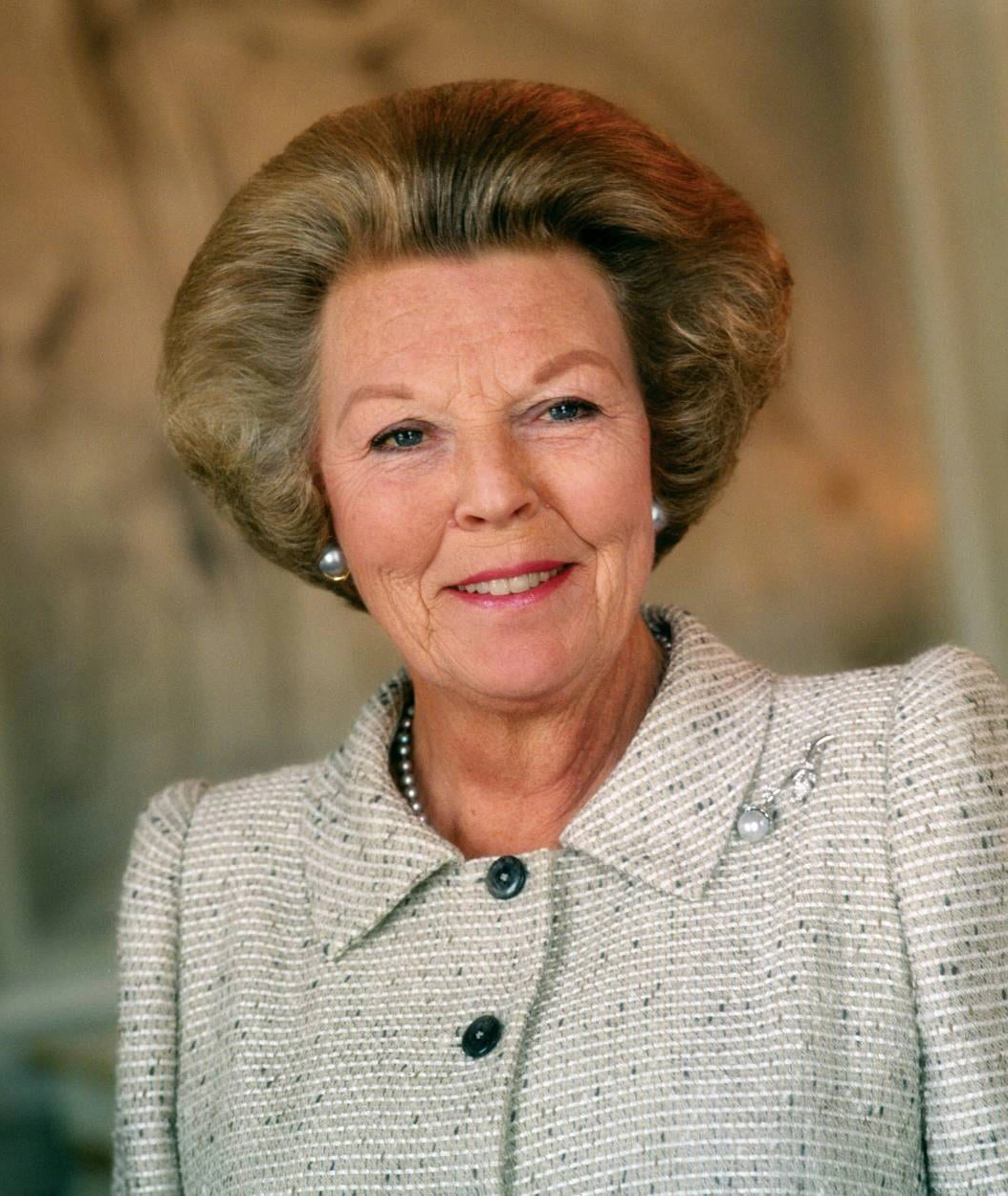
| 2 Quotes | |
| Born as | Beatrix Wilhelmina Armgard |
| Known as | Beatrix |
| Occup. | Royalty |
| From | Netherland |
| Spouse | Claus von Amsberg (1966-2002) |
| Born | January 31, 1938 Soestdijk Palace, Baarn, Netherlands |
| Age | 88 years |
| Cite | |
Citation Formats
APA Style (7th ed.)
Beatrix of the netherlands biography, facts and quotes. (2026, February 11). FixQuotes. https://fixquotes.com/authors/beatrix-of-the-netherlands/
Chicago Style
"Beatrix of the Netherlands biography, facts and quotes." FixQuotes. February 11, 2026. https://fixquotes.com/authors/beatrix-of-the-netherlands/.
MLA Style (9th ed.)
"Beatrix of the Netherlands biography, facts and quotes." FixQuotes, 11 Feb. 2026, https://fixquotes.com/authors/beatrix-of-the-netherlands/. Accessed 12 Feb. 2026.
Early life and family
Beatrix Wilhelmina Armgard was born on 31 January 1938 at Soestdijk Palace in Baarn, the Netherlands. She is the eldest daughter of Princess Juliana, who became Queen Juliana in 1948, and Prince Bernhard of Lippe-Biesterfeld. Her grandmother, Queen Wilhelmina, reigned during the tumultuous decades that preceded Beatrix's childhood and remained an influential figure throughout her early life. Beatrix grew up with three younger sisters: Princess Irene, Princess Margriet, and Princess Christina (originally named Marijke). The family environment was deeply shaped by public service and a strong sense of duty to the Kingdom of the Netherlands.Wartime exile and return
When the Second World War reached the Netherlands in 1940, Beatrix's mother took her and her sister Irene to North America. They settled in Canada while Queen Wilhelmina led the government-in-exile from London. Juliana and the children lived in Ottawa, and arrangements were made so that the 1943 birth of Princess Margriet in an Ottawa hospital would ensure the child's Dutch nationality. The years abroad exposed Beatrix at an early age to international perspectives and the responsibilities that would accompany her lineage. The family returned to the Netherlands after liberation, resuming life at Soestdijk Palace.Education and formation
Beatrix received a broad education that combined rigorous academics with civic awareness. She attended the progressive Werkplaats Kindergemeenschap in Bilthoven, founded by educator Kees Boeke, and later completed secondary studies at the Baarns Lyceum. In 1956 she enrolled at Leiden University, where she studied law and social sciences, including constitutional law, history, and sociology. The focus on constitutional principles and the Dutch system of government became a foundation for her later role. She took part in student life through the Minerva association and graduated in 1961, having built a reputation for diligence and a reserved, thoughtful demeanor.Heir apparent and public role
Beatrix became heir apparent in 1948 when Queen Wilhelmina abdicated in favor of Juliana, at which time Beatrix received the title Princess of Orange. As she matured, she increasingly represented the Crown, undertaking public engagements in the Netherlands and abroad. The shift from postwar reconstruction to a more self-confident society during the 1950s and 1960s provided the backdrop for her early speeches and appearances, often alongside Queen Juliana and Prince Bernhard.Marriage and family
On 10 March 1966 Beatrix married Claus von Amsberg, a German diplomat. The union faced protests in Amsterdam due to Claus's nationality and the wartime memories still fresh in Dutch society, but over time he won widespread respect. Created Prince Claus of the Netherlands, he became known for his modesty, keen intellect, and commitment to development issues. The couple had three sons: Willem-Alexander (born 27 April 1967), Johan Friso (born 25 September 1968), and Constantijn (born 11 October 1969). Their family life balanced public duty with private closeness, at first centered at Drakensteyn Castle and later at Huis ten Bosch in The Hague.Accession and investiture
Beatrix became Queen of the Netherlands on 30 April 1980, upon Queen Juliana's abdication. Her investiture took place in the Nieuwe Kerk in Amsterdam. The day was marked both by ceremony and by clashes linked to the housing movement, a reminder of the shifting social landscape. From the outset she emphasized preparation, continuity, and the constitutional nature of the Dutch monarchy, reflecting her legal training and an instinct for measured leadership. During her reign she met weekly with successive prime ministers, including Dries van Agt, Ruud Lubbers, Wim Kok, Jan Peter Balkenende, and Mark Rutte, maintaining the monarch's role as a neutral and informed interlocutor.Constitutional developments and governance
The 1980s brought significant constitutional and institutional change. The revised Dutch Constitution of 1983 set out civil liberties and clarified the framework within which the monarchy operates. Throughout her reign, Beatrix oversaw the ceremonial aspects of government formation, appointing informateurs and formateurs after elections, a practice that evolved in 2012 when the House of Representatives assumed a greater role in the process. She consistently maintained political neutrality while remaining well-briefed, qualities that earned her a reputation for professionalism and steadiness.The Kingdom in Europe and the Caribbean
As sovereign of the Kingdom of the Netherlands, Beatrix played a central role in representing all constituent parts: the Netherlands in Europe and, in the Caribbean, Aruba, Curacao, and Sint Maarten, as well as the special municipalities of Bonaire, Sint Eustatius, and Saba. Key changes during her tenure included Aruba's separate status within the Kingdom in 1986 and the 2010 dissolution of the Netherlands Antilles, which created a new constitutional arrangement. She visited the Caribbean regularly, maintaining visible ties with communities across the Kingdom.International representation
Beatrix undertook numerous state visits and received heads of state in the Netherlands, strengthening diplomatic relations. Notable among these were visits within Europe and beyond, including a 1995 visit to Indonesia that symbolized a careful, forward-looking engagement with a complex shared history. She promoted cultural exchange, human rights, and development cooperation, often in concert with Prince Claus, whose interests culminated in the establishment of the Prince Claus Fund for Culture and Development in 1996, supported by the Royal House.Public presence, crises, and resilience
Beatrix showed a composed public presence in times of crisis. In 1992, after the Bijlmermeer air disaster in Amsterdam, she visited the affected neighborhood and families. On Queen's Day 2009, a deliberate attack in Apeldoorn targeted the royal procession, leading to multiple deaths and injuries; Beatrix addressed the nation with evident grief and dignity. Personal losses also marked her later years. Prince Claus died in 2002 after a period of ill health, and in 2013 the family mourned the death of Prince Friso, following a 2012 skiing accident in Austria. These events highlighted the royal family's vulnerability and the Queen's steadiness under scrutiny.Cultural patronage and personal interests
A patron of the arts and heritage, Beatrix supported museums, music, and design institutions, and maintained a particular interest in sculpture. She championed volunteerism and social cohesion through activities associated with the House of Orange-Nassau and related foundations. Her public speeches, especially annual addresses, were noted for clear structure and an emphasis on responsibility, community, and mutual respect. Colleagues frequently remarked on her thorough preparation for engagements and her eye for detail.Abdication and later years
On 30 April 2013 Beatrix abdicated in favor of her eldest son, who acceded as King Willem-Alexander. His spouse, Queen Maxima, became consort, and their daughter Catharina-Amalia became Princess of Orange. Beatrix took the title Princess Beatrix, following the precedent set by Queen Juliana in 1980. She remained active in a scaled-back program of engagements and returned to live at Drakensteyn Castle, while continuing to participate in family milestones and national commemorations. She has also supported the public roles of Prince Constantijn and Princess Laurentien, and maintained affectionate ties with her grandchildren.Legacy
Beatrix's reign is remembered for constitutional clarity, a modern yet dignified style, and sustained international engagement. She navigated social change, domestic debate, and moments of national mourning with composure. The relationships that shaped her life and work include those with Queen Juliana and Prince Bernhard, the guidance of Queen Wilhelmina's example, and the partnership of Prince Claus. As mother to King Willem-Alexander and grandmother to the next generation, she bridged a period in which the Dutch monarchy reaffirmed its constitutional role and continued to adapt to contemporary expectations while preserving a recognizable continuity of service.Our collection contains 2 quotes written by Beatrix, under the main topics: Nature - Leadership.
Other people related to Beatrix: James Whistler (Artist), Beatrix Potter (Author), James Mcneill Whistler (Painter)
Source / external links