
Benazir Bhutto Biography Quotes 15 Report mistakes
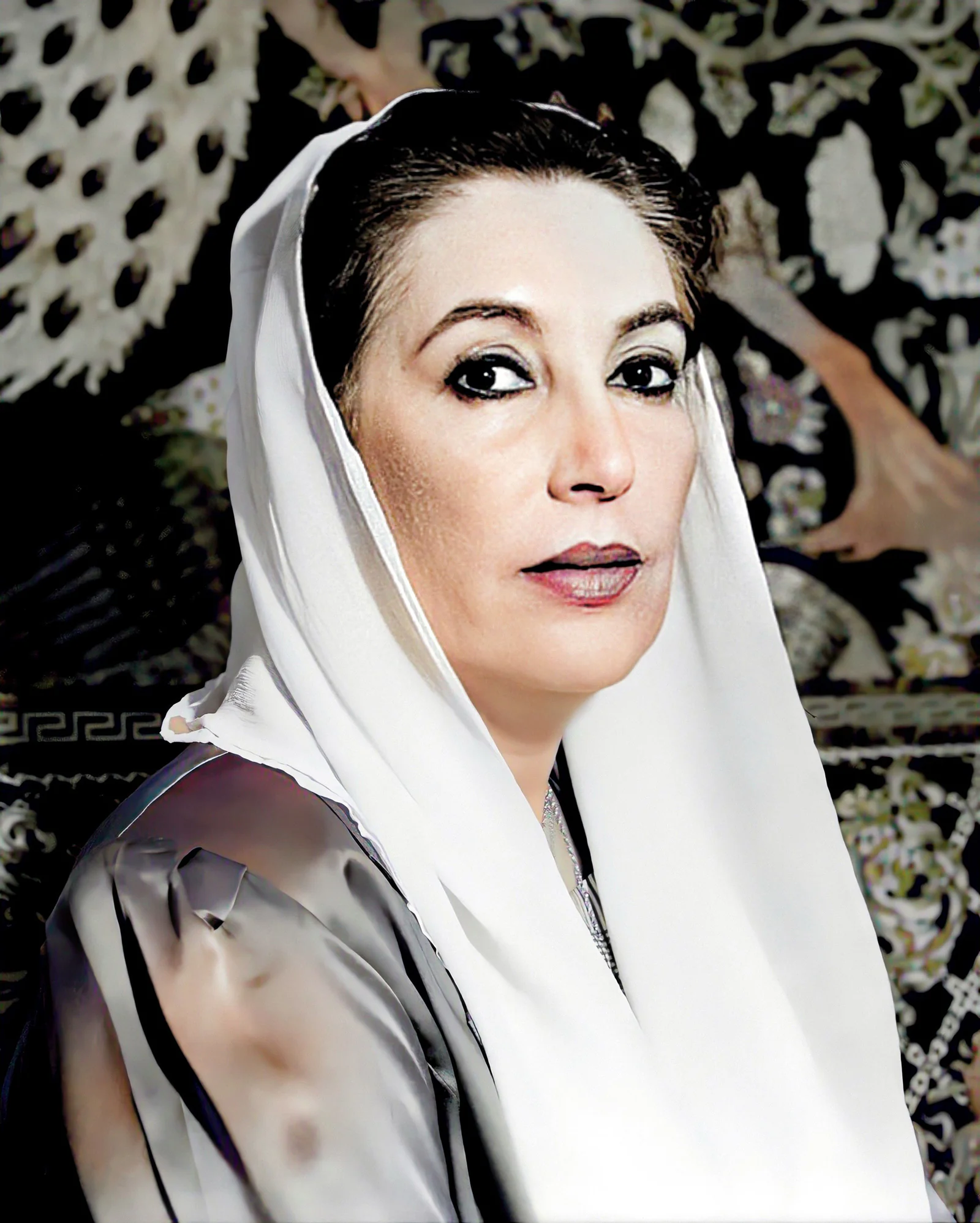
| 15 Quotes | |
| Occup. | Leader |
| From | Pakistan |
| Born | June 21, 1953 Karachi, Pakistan |
| Died | December 27, 2007 |
| Aged | 54 years |
| Cite | |
Citation Formats
APA Style (7th ed.)
Benazir bhutto biography, facts and quotes. (2026, February 3). FixQuotes. https://fixquotes.com/authors/benazir-bhutto/
Chicago Style
"Benazir Bhutto biography, facts and quotes." FixQuotes. February 3, 2026. https://fixquotes.com/authors/benazir-bhutto/.
MLA Style (9th ed.)
"Benazir Bhutto biography, facts and quotes." FixQuotes, 3 Feb. 2026, https://fixquotes.com/authors/benazir-bhutto/. Accessed 5 Mar. 2026.
Early Life and Background
Benazir Bhutto was born on 21 June 1953 in Karachi, Pakistan, into the prominent Bhutto family of Sindh. Her father, Zulfikar Ali Bhutto, a Western-educated politician who founded the Pakistan Peoples Party (PPP), rose from foreign minister to president and then prime minister, while her mother, Nusrat Bhutto, became a formidable organizer in her own right. From childhood, Benazir lived at the seam where private life and state power meet - guarded homes, official visitors, and constant talk of sovereignty, India, Islam, and the military all shaped her earliest sense of what politics cost and what it could redeem.That sense hardened into urgency after the 1977 coup led by Gen Zia-ul-Haq. Zulfikar Ali Bhutto was deposed, tried, and executed in 1979, an event Benazir experienced not as abstract tragedy but as a brutal lesson about Pakistan's recurring struggle between elected authority and the armed forces. She endured repeated house arrests, solitary confinement, and surveillance; her body became a site of coercion, while her name became a symbol that alternately inspired mass devotion and provoked official fear. The Bhutto legacy - populist, polarizing, and dynastic - was now also a story of martyrdom and unfinished political argument.
Education and Formative Influences
Bhutto studied at Harvard University (Radcliffe College) and then at the University of Oxford, where she served as president of the Oxford Union, absorbing the craft of debate and the language of liberal constitutionalism. Her formation fused elite cosmopolitan training with the lived reality of a postcolonial state fractured by class inequality, religious contestation, and civil-military imbalance. Reading political theory alongside Pakistan's crises, she developed a conviction that legitimacy could not be engineered by decree: it had to be renewed through parties, elections, and a public that felt seen.Career, Major Works, and Turning Points
After years of detention, Bhutto went into exile in 1984, reorganized the PPP internationally, and returned in 1986 to massive rallies that tested Zia's controlled political order. When Zia died in a 1988 plane crash, she led the PPP to victory and became prime minister - the first woman to head a government in a Muslim-majority country - promising democracy after dictatorship. Her two nonconsecutive terms (1988-1990, 1993-1996) were marked by attempts to expand social programs and manage sectarian and ethnic violence, while navigating a hostile presidency, an assertive military-intelligence establishment, and constant allegations of corruption centered on her husband, Asif Ali Zardari. Each government was dismissed by presidential decree, illustrating the fragility of Pakistan's parliamentary experiment. In exile again after 1999, she argued her case in books and interviews, including Daughter of Destiny and Reconciliation, framing her return not as restoration of a family throne but as a referendum on civilian supremacy. She came back in October 2007 amid rising militancy and a contested power-sharing effort with Gen Pervez Musharraf; after surviving a deadly attack on her homecoming procession in Karachi, she was assassinated on 27 December 2007 in Rawalpindi after an election rally, a killing that convulsed Pakistan and defined her final turning point as both politician and symbol.Philosophy, Style, and Themes
Bhutto's politics were anchored in a simple but demanding premise: Pakistan could not fight extremism by shrinking democratic life. “Democracy is necessary to peace and to undermining the forces of terrorism”. For her, security was not only a matter of weapons and alliances; it was also a question of whether citizens believed the state belonged to them. This is why she treated elections, party organization, and parliamentary argument as moral instruments, not procedural ornaments - and why she spoke in the language of inclusion even when her opponents cast her as existential danger. “Military hardliners called me a 'security threat' for promoting peace in South Asia and for supporting a broad-based government in Afghanistan”. The psychology behind her rhetoric mixed defiance with a constant awareness of vulnerability: she understood that in Pakistan, a leader could be made or unmade by the charge of disloyalty.Her style blended populist cadence with polished Anglo-American argumentation, a dual register that helped her address both village crowds and foreign capitals - and also exposed her to attacks as insufficiently "authentic". Yet she repeatedly returned to the emotional core of representation: the fear that ordinary people could be silenced by coups, decrees, and technocratic rule. “Right now, they feel they have lost their voice, and their miseries have increased since my departure”. Even her most strategic choices - negotiations with rivals, calls for reconciliation, and appeals to international support - were framed as efforts to reopen political space. The recurring theme in her life was not only ambition, but the insistence that a state built on coercion would always generate more enemies than it could imprison.
Legacy and Influence
Bhutto left an enduring, contested legacy: a democratic icon to supporters, a flawed administrator to critics, and to many Pakistanis a tragic emblem of the country's cycle of hope and interruption. Her assassination intensified scrutiny of militancy, state protection failures, and the unresolved relationship between elected leaders and the security establishment. Internationally she became shorthand for the argument that counterterrorism requires legitimate politics; domestically her death propelled the PPP back to power in 2008 and elevated her husband and later her son Bilawal Bhutto Zardari within the party, keeping dynastic politics alive even as it remained debated. More broadly, she expanded the imaginable horizon for women's leadership in Muslim-majority societies, while her career remained a cautionary study in how fragile institutions can turn charisma and lineage into both a mandate and a target.Our collection contains 15 quotes written by Benazir, under the main topics: Justice - Leadership - Freedom - Peace - Human Rights.
Other people related to Benazir: Theresa May (Politician)
Benazir Bhutto Famous Works
- 2008 Reconciliation: Islam, Democracy, and the West (Non-fiction)
- 1988 Daughter of the East (Autobiography)
Source / external links