
Benito Mussolini Biography Quotes 27 Report mistakes
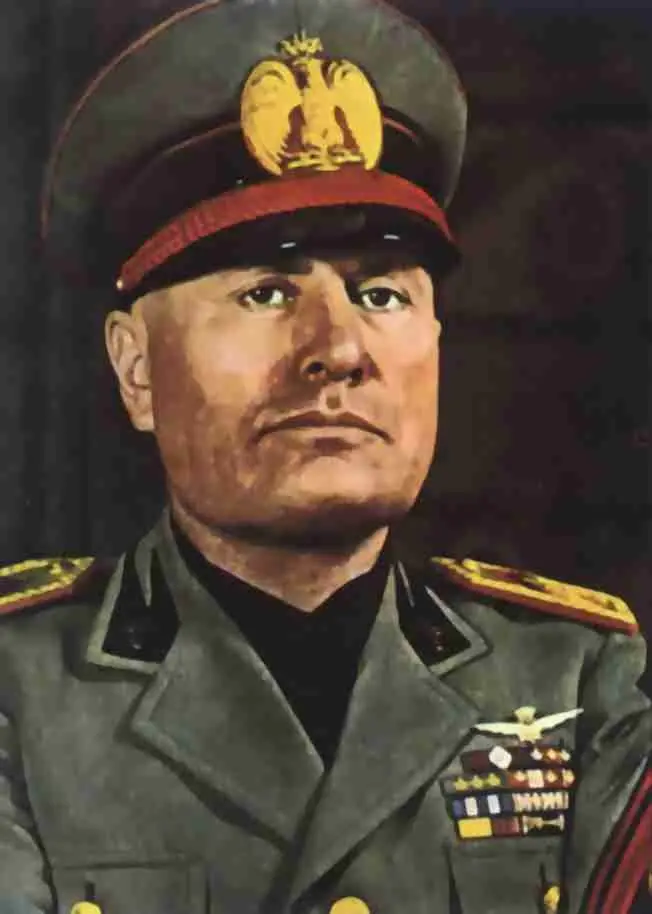
| 27 Quotes | |
| Born as | Benito Amilcare Andrea Mussolini |
| Occup. | Politician |
| From | Italy |
| Born | July 29, 1883 Predappio, Italy |
| Died | April 28, 1945 Giulino di Mezzegra, Italy |
| Cause | Executed by firing squad |
| Aged | 61 years |
Benito Amilcare Andrea Mussolini was born on July 29, 1883, in Predappio, a small town in Romagna, northeastern Italy, then a young kingdom still knitting together regional identities and class resentments. His father, Alessandro Mussolini, was a blacksmith and socialist firebrand; his mother, Rosa Maltoni, a devout schoolteacher. The household fused anticlerical radicalism with moral discipline, a tension that helped form a boy who craved both revolt and order.
Romagna in the 1880s and 1890s was known for hard rural labor, anticlerical politics, and street-level factionalism. Mussolini grew up amid stories of Garibaldi, strikes, and the humiliations of a country hungry for status but late to industrial power. From early on he displayed volatility and pride - a temper that got him expelled more than once - yet also an ability to dominate rooms with sheer will and performance, traits that later became political method.
Education and Formative Influences
Educated first in local schools and later at institutes in Faenza and Forlimpopoli, Mussolini took a teaching diploma (1901) but was drawn more to agitation than classrooms. In 1902 he went to Switzerland, drifting through menial work and socialist circles while absorbing Marxist rhetoric, syndicalist impatience, and Nietzschean ideas about force and elites; arrests and deportation made him practice the role of persecuted militant. Returning to Italy, he rose as a socialist journalist and organizer, learning to treat newspapers as weapons and crowds as material to be shaped by cadence, insult, and promise.
Career, Major Works, and Turning Points
Mussolini became a national figure as editor of the Socialist Party paper Avanti! (1912-1914), where he mixed class war language with a taste for decisive action and personal authority. The turning point was World War I: breaking with socialist neutrality, he argued intervention would forge a stronger Italy and a new political man; expelled from the party, he founded Il Popolo d'Italia (1914) and recast himself as a revolutionary nationalist. After wartime service and injury, he built the Fasci di Combattimento (1919) from veterans, disgruntled middle classes, and anti-socialist squads, exploiting the chaos of strikes and fear of Bolshevism. The March on Rome (October 1922) brought him to power as prime minister; by 1925-1926 he dismantled liberal institutions into a dictatorship. He secured the Lateran Accords with the Vatican (1929), launched corporatist structures, expanded propaganda, and pursued imperial spectacle in Ethiopia (1935-1936). His alignment with Hitler hardened through the Axis and racial laws (1938), ending in disaster during World War II. Overthrown in July 1943, rescued by German commandos, and installed as head of the Italian Social Republic at Salo, he became increasingly dependent and brutal until captured and executed on April 28, 1945, near Lake Como.
Philosophy, Style, and Themes
Mussolini's inner life revolved around a hunger to bend history to his personal narrative - a need to transform humiliation into grandeur through collective motion. His public creed, "All within the state, nothing outside the state, nothing against the state". , was less a policy blueprint than a psychological confession: fear of fragmentation answered by total absorption. The individual, in this view, mattered chiefly as raw energy, valuable when welded into a single body that could act without doubt, dissent, or delay.
His style fused theatrical modernity with archaic myths of empire - balcony oratory, martial imagery, synchronized crowds, and an obsession with youth, speed, and violence as purification. Internationally he distrusted multilateral restraint, sneering that "The League is very well when sparrows shout, but no good at all when eagles fall out". , a line that revealed both contempt for legalism and a predator's model of diplomacy. War and mobilization were not accidents but desired states of being; "War is to man what maternity is to a woman. From a philosophical and doctrinal viewpoint, I do not believe in perpetual peace". Underneath the bombast sat a gambler's temperament - improvisational, tactical, addicted to momentum - which could produce swift coups but also catastrophic overreach when spectacle replaced capacity.
Legacy and Influence
Mussolini's legacy is a cautionary map of how democratic fatigue, postwar grievance, and elite fear can be organized into authoritarian rule through propaganda, paramilitary violence, and the promise of national rebirth. He pioneered techniques later studied in both fascist and anti-fascist vocabularies: the party-state fusion, staged mass politics, cult of leadership, and corporatist bargaining that bound labor and business under coercive supervision. His regime left physical traces in architecture and institutions, but his deeper imprint is conceptual - "fascism" as a term for modern dictatorship that merges nationalist myth with state power - and historical: the Italian path to alliance with Nazi Germany, colonial atrocities, racial persecution, and the shattering defeat that forced postwar Italy to rebuild its republic in explicit rejection of his model.
Our collection contains 27 quotes who is written by Benito, under the main topics: Witty One-Liners - Motivational - Wisdom - Truth - Justice.
Other people realated to Benito: Giulio Andreotti (Politician), Ezra Pound (Poet), Maria Montessori (Educator), Edward F. Halifax (Statesman), John Gunther (Journalist), Anthony Eden (Politician), Aristide Briand (Statesman), Lord Halifax (Politician), Pierre Laval (Politician), George Seldes (Journalist)
Source / external links