
Benjamin Disraeli Biography Quotes 114 Report mistakes
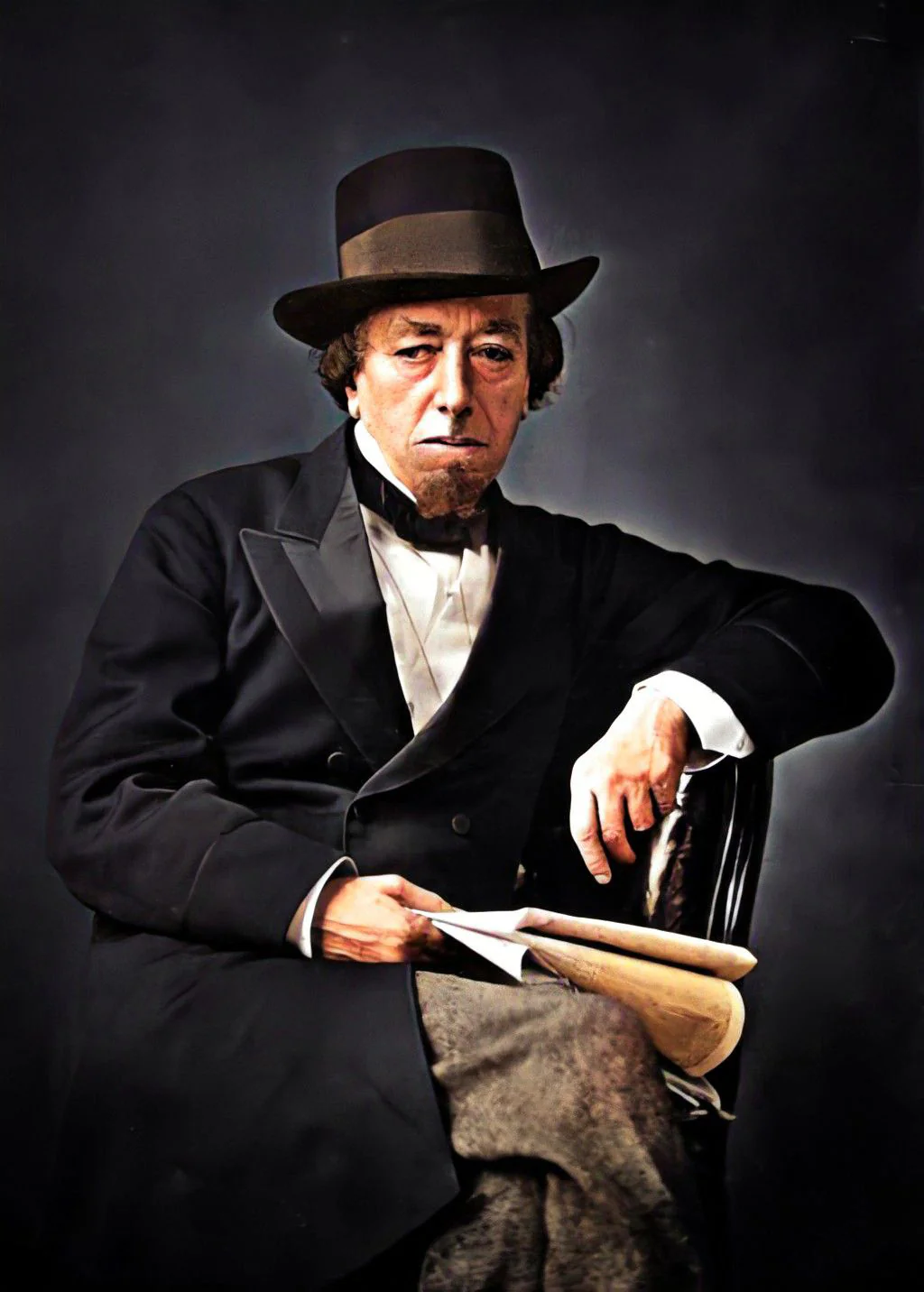
Attr: Cornelius Jabez Hughes
| 114 Quotes | |
| Occup. | Statesman |
| From | United Kingdom |
| Spouse | Mary Anne Evans (1839-1872) |
| Born | December 21, 1804 Bloomsbury, Middlesex, England |
| Died | April 19, 1881 Mayfair, London, England |
| Cause | Stroke |
| Aged | 76 years |
| Cite | |
Citation Formats
APA Style (7th ed.)
Benjamin disraeli biography, facts and quotes. (2026, February 1). FixQuotes. https://fixquotes.com/authors/benjamin-disraeli/
Chicago Style
"Benjamin Disraeli biography, facts and quotes." FixQuotes. February 1, 2026. https://fixquotes.com/authors/benjamin-disraeli/.
MLA Style (9th ed.)
"Benjamin Disraeli biography, facts and quotes." FixQuotes, 1 Feb. 2026, https://fixquotes.com/authors/benjamin-disraeli/. Accessed 26 Mar. 2026.
Early Life and Background
Benjamin Disraeli was born on December 21, 1804, in London, into a Sephardic Jewish family whose position was socially ambiguous - cultured and ambitious, yet marked as outsiders in an Anglican political nation. His father, Isaac D'Israeli, made his name as a man of letters, and the household prized books, conversation, and the theater of reputation. The young Disraeli learned early that identity could be both inheritance and performance: something to defend, refashion, and wield.A family quarrel with the Bevis Marks synagogue helped alter his destiny. In 1817, Isaac had his children baptized into the Church of England, an act that did not erase Benjamin's Jewishness from public perception but made a parliamentary career legally possible. That double consciousness - belonging and not-belonging at once - would become a lifelong engine: it sharpened his sensitivity to status, gave him a novelist's eye for social ritual, and produced a statesman determined to master the inner workings of an establishment that could never fully forget he had once stood outside it.
Education and Formative Influences
Disraeli was educated largely through tutors and reading rather than a conventional public-school or university pipeline, and he briefly trained for the law at Lincoln's Inn. His real formation came from the libraries and salons of Regency and early Victorian London, where he absorbed Byron, the historical novel, and the emerging science of mass politics. The 1820s also taught him risk: he flirted with financial ventures and was burned, then turned that volatility into style and voice - a mixture of irony, bravado, and psychological self-command that would carry him through decades of political humiliation.Career, Major Works, and Turning Points
Disraeli entered Parliament in 1837 as a Conservative after early failures and years of cultivating notice through journalism and fiction. He rose as a brilliant, often abrasive parliamentary performer, and his break came during the Conservative crisis over the Corn Laws: he led the attack on Prime Minister Sir Robert Peel's repeal (1846), positioning himself as champion of party principle and agricultural interests while also redefining Conservatism for an industrial age. His novels - especially the political trilogy Coningsby (1844), Sybil (1845), and Tancred (1847) - were not hobbies but instruments: they dramatized his critique of an unmoored elite and sketched an alternative national story. He became Chancellor of the Exchequer under the Earl of Derby, then Prime Minister briefly in 1868, and decisively in 1874-1880. His second ministry fused social reform with imperial statecraft: the purchase of Suez Canal shares (1875), the Royal Titles Act making Victoria Empress of India (1876), and his role at the Congress of Berlin (1878) defined a public image of audacity and grandeur, even as domestic tensions and Irish crisis helped bring defeat in 1880. He died on April 19, 1881, after serving as leader, rival, and symbol in an era when politics became national theater.Philosophy, Style, and Themes
Disraeli's political psychology was built around cohesion: he feared that a modernizing Britain could become two nations, rich and poor, unless authority accepted a duty of care. That conviction surfaces in his insistence that stability is social, not merely constitutional: “The palace is not safe when the cottage is not happy”. For him, conservatism was not fossilization but a disciplined sympathy - a willingness to reform so that the nation could endure. Even when he spoke in epigrams, the underlying intent was integration: to make hierarchy feel reciprocal, and to make the state seem like the guardian of common belonging.His style - in speech and fiction - blended romantic color with tactical realism. He understood politics as spectacle and as arithmetic, and he treated leadership as a feedback loop between popular mood and parliamentary maneuver: “I must follow the people. Am I not their leader?” That line is often read as cynical, yet it also reveals his acute sense that legitimacy in the age of the press required attunement, not just command. His wit could be weaponized, especially against William Ewart Gladstone, whose moral earnestness he punctured with cruel brilliance - “The difference between a misfortune and a calamity is this: If Gladstone fell into the Thames, it would be a misfortune. But if someone dragged him out again, that would be a calamity”. The joke exposes Disraeli's defensive humor: he met moralism with satire, and turned personal insecurity into a blade that could cut down a rival and electrify a chamber.
Legacy and Influence
Disraeli endures as the architect of a distinctly modern Conservative imagination - patriotic, socially alert, and comfortable with a strong state when it serves national unity. His "One Nation" impulse, his conversion of party leadership into charismatic performance, and his fusion of domestic reform with imperial symbolism reshaped British political language long after his death. He also remains a rare figure whose novels and premiership interpret each other: the outsider who wrote himself into the center, then governed as if narrative, ceremony, and policy were different tools for the same task - holding a divided society together long enough to become a nation in fact, not merely in name.Our collection contains 114 quotes written by Benjamin, under the main topics: Witty One-Liners - Motivational - Ethics & Morality - Truth - Wisdom.
Other people related to Benjamin: John Tenniel (Artist), Countess of Blessington (Novelist), Hesketh Pearson (Actor)
Frequently Asked Questions
- Mary Anne Disraeli: His wife (Countess of Beaconsfield; 1792–1872)
- Benjamin Disraeli Prime Minister years: 1868; 1874–1880
- Benjamin Disraeli books: Vivian Grey; Coningsby; Sybil; Tancred; Lothair; Endymion
- Benjamin Disraeli children: None
- Benjamin Disraeli descendants: None
- Benjamin Disraeli previous offices: Prime Minister; Chancellor of the Exchequer; Leader of the Opposition; Leader of the House of Commons; First Lord of the Treasury
- Benjamin Disraeli died: 19 April 1881
- How old was Benjamin Disraeli? He became 76 years old
Source / external links