
Benjamin Franklin Biography Quotes 163 Report mistakes
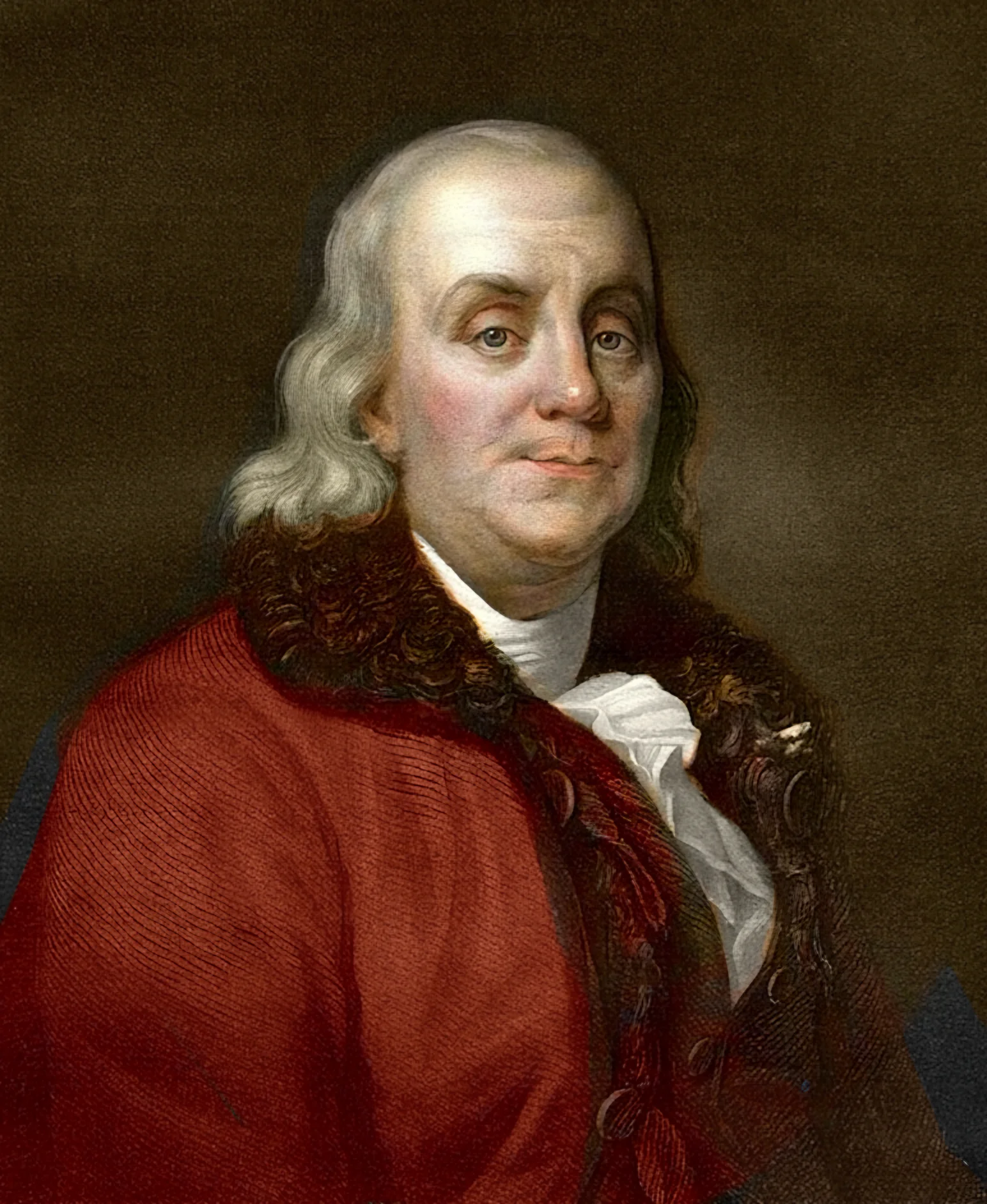
| 163 Quotes | |
| Occup. | Politician |
| From | USA |
| Born | January 17, 1706 Boston, Massachusetts Bay |
| Died | April 17, 1790 Philadelphia, Pennsylvania |
| Aged | 84 years |
| Cite | |
Citation Formats
APA Style (7th ed.)
Benjamin franklin biography, facts and quotes. (2026, February 10). FixQuotes. https://fixquotes.com/authors/benjamin-franklin/
Chicago Style
"Benjamin Franklin biography, facts and quotes." FixQuotes. February 10, 2026. https://fixquotes.com/authors/benjamin-franklin/.
MLA Style (9th ed.)
"Benjamin Franklin biography, facts and quotes." FixQuotes, 10 Feb. 2026, https://fixquotes.com/authors/benjamin-franklin/. Accessed 6 Mar. 2026.
Early Life and Background
Benjamin Franklin was born on January 17, 1706, in Boston, Massachusetts Bay, the fifteenth of seventeen children in a family that lived close to the edge of comfort. His father, Josiah Franklin, was a candle and soap maker; the household ran on thrift, piety, and constant labor. In an Atlantic port shaped by Puritan discipline and imperial trade, Franklin absorbed two durable impressions: that status could be made, not merely inherited, and that public life was built from small habits repeated daily.The inner pressure of that crowded home helped produce his lifelong blend of restlessness and method. He wanted room - physical room, intellectual room, and social room - and he found it by turning himself into an instrument of usefulness. The Boston of his youth was also a city of sermons and pamphlets, where arguments circulated as quickly as goods. That environment taught him that words could be a form of power, and that reputation, once printed, could travel farther than any person.
Education and Formative Influences
Franklin had little formal schooling and became, by necessity and temperament, a self-directed student. Apprenticed in 1718 to his older brother James, a printer, he learned the mechanics of type and the politics of publication while secretly training his voice as a writer through the "Silence Dogood" letters (1722). Reading voraciously - from moral essays to scientific reports - he practiced a plain, persuasive style and a deliberate program of self-improvement. After a quarrel, he fled Boston in 1723 for Philadelphia, then briefly to London (1724-1726), where he studied the metropolis of print, commerce, and skepticism before returning with a sharper sense of how a modern city could be organized around information.Career, Major Works, and Turning Points
In Philadelphia Franklin rose from journeyman printer to civic architect: he founded the Junto discussion club, the Library Company (1731), helped organize the Union Fire Company, and promoted an academy that became the University of Pennsylvania. He published the Pennsylvania Gazette and, from 1732, Poor Richard's Almanack, turning wit into a moral economy of diligence and credit. His scientific investigations - especially on electricity, including the identification of positive and negative charge and the lightning rod - made him internationally famous, giving him a second kind of authority beyond politics. That authority became decisive in imperial crisis: as agent in London for Pennsylvania and other colonies, he witnessed how contempt and misunderstanding hardened into rupture, most notoriously at the Privy Council hearing after the Hutchinson Letters affair (1774). During the Revolution he helped draft the Declaration of Independence, secured French alliance in 1778, and later shaped the U.S. Constitution in 1787, embodying the transition from provincial printer to national elder.Philosophy, Style, and Themes
Franklin's governing philosophy was pragmatic virtue: character as a technology, freedom as a set of workable arrangements, and truth as something tested by results. He distrusted grandiosity, preferring the steady accumulation of small advantages - in science, finance, and politics alike. His maxims are often comic on the surface but psychologically revealing: the man who cultivated sociability also guarded his time and boundaries, insisting that “Guests, like fish, begin to smell after three days”. That line is less mere rudeness than a defense of autonomy, a reminder that dependence - emotional or economic - corrodes dignity.His style joined clarity with instrumentality. Franklin wrote to move people: to save money, start institutions, join a militia, or support a constitution. He treated suspicion not as cynicism but as civic hygiene, crystallized in “Distrust and caution are the parents of security”. The sentiment fits a statesman who had watched empires misread colonies and factions misread one another, and who knew that liberty required safeguards against both tyranny and wishful thinking. Yet his practicality did not exclude cultivation; he argued for a home life animated by learning, implying that comfort without curiosity is unfinished: “A house is not a home unless it contains food and fire for the mind as well as the body”. Behind the aphorisms stands a temperament that believed improvement was possible, but only if it was organized - by habits, institutions, and a press that could turn private insight into public use.
Legacy and Influence
Franklin died on April 17, 1790, in Philadelphia, honored as a founder and mourned internationally, but his deeper legacy is the model he offered of the modern public citizen: secular, experimental, and institution-building. He helped define the American Enlightenment by showing how knowledge could be communal (libraries, societies), preventive (fire companies, public health measures), and diplomatic (reputation as leverage in Paris). As a politician he embodied compromise without softness, proving that coalition, not purity, is often the engine of durable change. His writing and example continue to shape American ideas of self-making, civic responsibility, and the belief that a republic survives not on ideals alone, but on the daily disciplines that make ideals governable.Our collection contains 163 quotes written by Benjamin, under the main topics: Witty One-Liners - Motivational - Ethics & Morality - Wisdom - Justice.
Other people related to Benjamin: Thomas Paine (Writer), Alan Alda (Actor), Walter Isaacson (Writer), John Bigelow (Lawyer), Thomas Mellon (Businessman), Carl Clinton Van Doren (Critic), William Bartram (Environmentalist), Richard Henry Lee (Politician), John Trumbull (Artist), John Hancock (Politician)