
Bernard Baruch Biography Quotes 36 Report mistakes
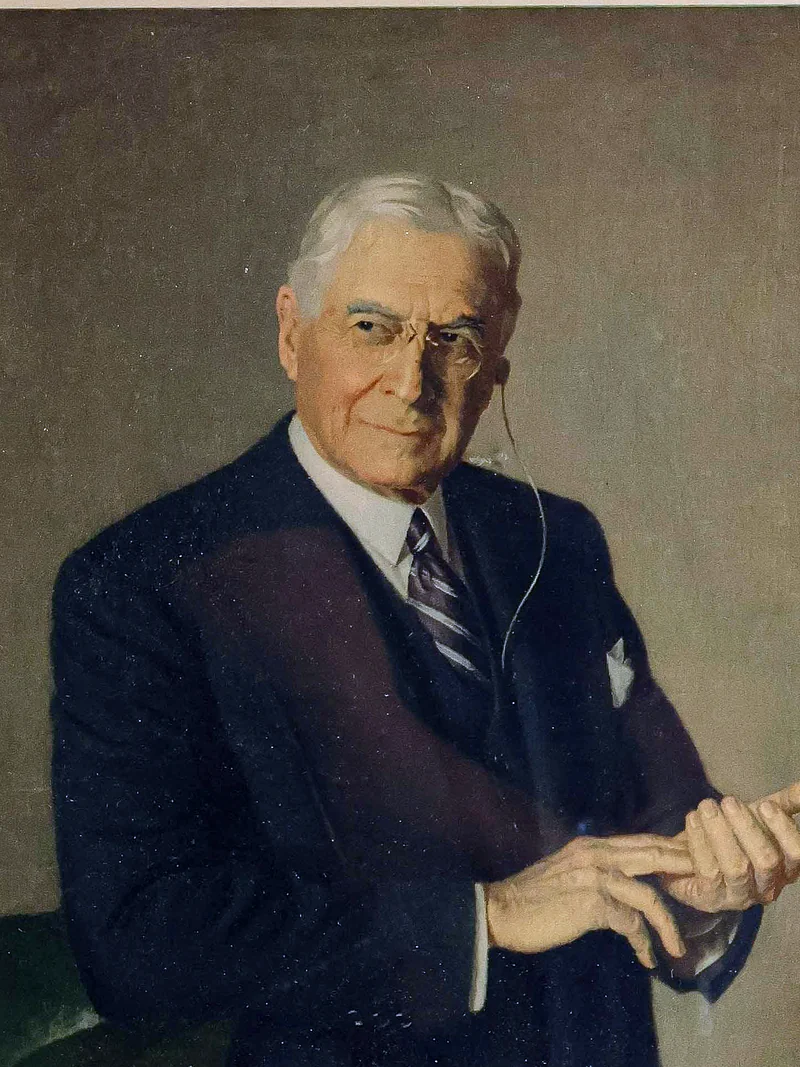
| 36 Quotes | |
| Occup. | Businessman |
| From | USA |
| Born | August 19, 1870 |
| Died | June 20, 1965 |
| Aged | 94 years |
| Cite | |
Citation Formats
APA Style (7th ed.)
Bernard baruch biography, facts and quotes. (2026, February 11). FixQuotes. https://fixquotes.com/authors/bernard-baruch/
Chicago Style
"Bernard Baruch biography, facts and quotes." FixQuotes. February 11, 2026. https://fixquotes.com/authors/bernard-baruch/.
MLA Style (9th ed.)
"Bernard Baruch biography, facts and quotes." FixQuotes, 11 Feb. 2026, https://fixquotes.com/authors/bernard-baruch/. Accessed 31 Mar. 2026.
Early Life and Education
Bernard Mannes Baruch was born in 1870 in South Carolina to Simon Baruch, a physician and Civil War surgeon who later became an influential public health advocate, and Belle Wolfe Baruch. The family moved to New York City during his childhood, placing him at the heart of the nation's financial and political life. He attended the City College of New York, where he finished his studies at a young age, and gravitated to Wall Street almost immediately after graduation. The combination of a rigorous education, a disciplined temperament learned from his father, and sharp observational skills would shape his career.Rise on Wall Street
Starting as a clerk in a brokerage house, Baruch mastered the mechanics of trading and the psychology of markets. By his mid-twenties he was a partner in a leading firm and soon struck out on his own as an independent speculator. He became known as the "Lone Wolf of Wall Street", preferring to rely on his research and instincts rather than pool arrangements or syndicates. He invested heavily in raw materials, including copper and rubber, anticipating the industrial demands of a rapidly modernizing economy. Baruch's fortune grew because he treated information, timing, and risk management as disciplines, not hunches. His circle came to include journalists such as Herbert Bayard Swope, who helped shape his public reputation, and corporate figures whose production decisions he studied with care.Public Service in World War I
With the United States entry into World War I, Baruch shifted from private profit to national mobilization. President Woodrow Wilson called him to Washington to help coordinate industrial resources, first through the Council of National Defense and then as chairman of the War Industries Board. In that role Baruch confronted the chaos of wartime supply: scarce raw materials, competing military needs, and fragmented industrial capacity. He worked with colleagues such as Hugh Johnson and Robert Brookings to set priorities, standardize products, and rationalize distribution. Baruch was not a theoretician of command economies; he was a practical broker of information between the military, regulators, and manufacturers. The War Industries Board became a case study in large-scale coordination, one that influenced later approaches to mobilization and industrial policy.Versailles and the Interwar Years
After the Armistice, Baruch accompanied Wilson to the Paris Peace Conference, advising on economic questions and supply demobilization. He participated in discussions with diplomats including Edward M. House and military leaders such as General John J. Pershing. Back in the United States, he resumed private investments but remained engaged in public affairs, counseling policymakers of both major parties. He worried about speculative excesses in the late 1920s and watched with concern as the Great Depression revealed deep weaknesses in credit and production. During the early Roosevelt years he was at once a supporter and a critic: supportive of firm action, wary of measures he thought might hinder production or unsettle markets. His longstanding friendship with South Carolinian James F. Byrnes and his association with Ferdinand Eberstadt linked him to later wartime planning debates.World War II and the Arsenal of Democracy
As the world again moved toward war, Baruch urged early, centralized mobilization. He pressed the case with President Franklin D. Roosevelt and key aides, arguing for clear lines of authority over materials and priorities. Though he held no permanent wartime office, his memoranda and testimony influenced decisions on raw material allocation and industrial expansion. He worked alongside, and sometimes clashed with, figures such as Donald Nelson at the War Production Board, while encouraging Eberstadt's development of the Controlled Materials Plan to tame bottlenecks in steel, aluminum, and copper. Baruch's proposals emphasized measurable output and accountability. He believed the country's strength lay in aligning private initiative with public purpose, not in replacing one with the other.The Baruch Plan and the Early Cold War
In 1946 President Harry S. Truman asked Baruch to present the U.S. proposal for international control of atomic energy at the newly formed United Nations. Building on the Acheson-Lilienthal framework, Baruch introduced what became known as the Baruch Plan: a system of international inspection, ownership, and sanctions designed to prevent atomic weapons from spreading while allowing peaceful uses of nuclear power. He faced immediate and public resistance from the Soviet representative, Andrei Gromyko, and the plan stalled amid hardening Cold War suspicions. Though it failed, the effort defined an early path not taken in nuclear governance and demonstrated Baruch's belief that technical problems required institutional solutions and credible enforcement, not just declarations.Personal Style, Influence, and Philanthropy
Baruch cultivated an image as a candid counselor who met officials and reporters on park benches or in unpretentious offices. The "park bench statesman" persona captured his preference for plain talk and quiet persuasion over titles. He enjoyed a long association with public figures including Winston Churchill, with whom he conversed on strategy and economics during visits to the United States. A prominent American Jew in finance and government, Baruch confronted prejudice yet won broad trust by insisting on competence and national service as the basis of legitimacy.His wealth supported philanthropic initiatives in education, medical research, and conservation. He made major contributions to his alma mater and to public higher education in New York, support that eventually helped shape the institution now known as Baruch College. In South Carolina he assembled the Hobcaw Barony property as a retreat and working reserve; his daughter Belle Baruch later established a foundation to preserve it for research and conservation. Through gifts to hospitals and universities, he sought to reinforce the civic capacities he thought a modern democracy required.
Writings and Reflections
In later years he set down his experiences in two volumes, My Own Story and The Public Years, blending memoir with lessons drawn from markets, war production, and diplomacy. The books revealed a consistent approach: gather facts, cut through slogans, and hold decision-makers to measurable standards. He was skeptical of panaceas, whether in economics or geopolitics, and believed institutions should be judged by outputs, not intentions. His writings circulated among policymakers and students alike, becoming a common reference for those studying mobilization and economic statecraft.Legacy and Final Years
Bernard Baruch lived into the mid-1960s, long enough to see the nuclear age mature and the postwar economy transform living standards. He remained a sought-after adviser, meeting with presidents from Woodrow Wilson to Harry S. Truman and conversing with members of Congress, generals, and editors who valued his independent perspective. Honors accumulated, but he preferred the role he had fashioned for himself: the informed outsider who could link finance to policy and policy to production.He died in 1965 in New York City. By then his name had become shorthand for a distinctly American blend of entrepreneurial success and public service. His career traced the arc of the United States from the gilded trading floors of the 1890s through two world wars and into the nuclear era. The war boards he helped design, the atomic proposal he championed, the philanthropic institutions he supported, and the students and civil servants who read his books sustain his legacy as a businessman-statesman who treated national power as a practical problem of organization, resources, and responsibility.
Our collection contains 36 quotes written by Bernard, under the main topics: Witty One-Liners - Motivational - Truth - Wisdom - Friendship.
Other people related to Bernard: Warren R. Austin (Politician), David F. Houston (Politician)
Bernard Baruch Famous Works
- 1957 Baruch: My Own Story (Autobiography)
- 1946 The Baruch Plan (Speech)