
Bernard of Clairvaux Biography Quotes 2 Report mistakes
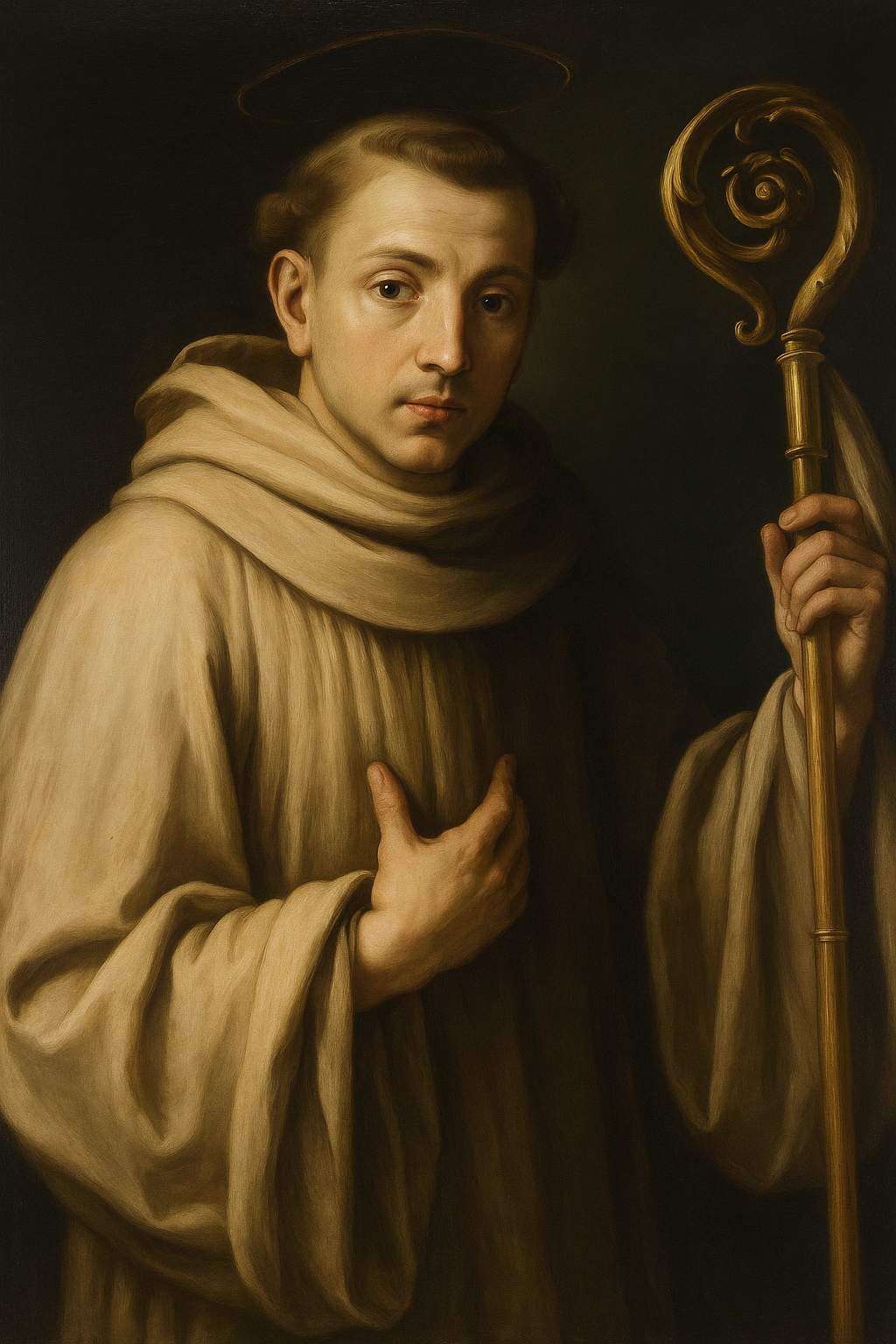
| 2 Quotes | |
| Known as | Saint Bernard |
| Occup. | Saint |
| From | France |
| Born | 1090 AC Fontaines-les-Dijon, France |
| Died | August 20, 1153 Clairvaux, France |
| Cite | |
Citation Formats
APA Style (7th ed.)
Bernard of clairvaux biography, facts and quotes. (2026, February 11). FixQuotes. https://fixquotes.com/authors/bernard-of-clairvaux/
Chicago Style
"Bernard of Clairvaux biography, facts and quotes." FixQuotes. February 11, 2026. https://fixquotes.com/authors/bernard-of-clairvaux/.
MLA Style (9th ed.)
"Bernard of Clairvaux biography, facts and quotes." FixQuotes, 11 Feb. 2026, https://fixquotes.com/authors/bernard-of-clairvaux/. Accessed 27 Mar. 2026.
Early Life and Vocation
Bernard of Clairvaux was born around 1090 in Burgundy, in the kingdom that is now part of France. Raised in a noble milieu and educated in the liberal arts, he displayed early seriousness of character and a strong inclination toward religious life. In his early twenties he chose the austerity of the new Cistercian movement rather than a path expected of a young noble. Around 1112 or 1113 he entered the fledgling abbey of Citeaux, persuading several relatives and friends to join him. There he came under the guidance of Stephen Harding, the influential abbot who consolidated the ideals first set by Robert of Molesme. The Cistercians prized simplicity, manual labor, and fidelity to the Rule of Saint Benedict, and Bernard embraced these commitments with characteristic intensity.Foundation of Clairvaux and the Cistercian Reform
In 1115 Bernard was sent to establish a new monastery in the Valley of the Aube, which he named Clairvaux. Despite the hardships of frontier monastic life, his leadership quickly made the house renowned. Clairvaux embodied strict observance, emphasizing prayer, work, and a spare liturgy. Bernard's personal austerity was severe, yet he also emerged as a compassionate spiritual guide. Under his direction, Clairvaux founded many daughter houses, and through these the Cistercian form of life spread across France, the British Isles, the Empire, and Iberia. He corresponded with other reformers, including the monk and theologian William of Saint-Thierry, and his influence extended even to communities that did not share Cistercian simplicity. He defended Cistercian ideals in an Apologia that compared monastic austerity to the ornate practices of some contemporaries, yet he maintained cordial relations with figures such as Peter the Venerable, the abbot of Cluny, seeking concord more than rivalry.Public Influence and Church Politics
Bernard's authority as a spiritual counselor drew princes, bishops, and popes to seek his advice. The contested papal election of 1130 thrust him into wider politics. He championed Innocent II against the claims of Anacletus II, arguing for unity under the canonically elected pope. Bernard traveled tirelessly to secure support from rulers and bishops. He played a part in winning the allegiance of Louis VI of France, Henry I of England, and Lothair III, king of the Romans, thereby isolating the rival claimant and restoring broader cohesion to the Latin Church. Later, when one of his own Cistercian brethren, Bernardo Paganelli, became Pope Eugene III, Bernard counseled him through the demanding burdens of office. His treatise De Consideratione, addressed to Eugene, remains a searching meditation on pastoral governance and the spiritual perils of power.Preacher and Writer
Bernard's sermons and treatises shaped Latin spirituality for centuries. His Sermons on the Song of Songs are among the high achievements of medieval mystical theology, weaving Scripture with pastoral insight to describe the soul's ascent to God. In On Loving God he laid out the stages of love's growth from self-interest to pure charity. He also wrestled with theological problems in works such as On Grace and Free Will, which sought to hold together divine initiative and human response. His letters, circulated widely, addressed matters as intimate as monastic discipline and as public as peace among feuding lords. Bernard's style combined tenderness with urgency, and his teaching on humility, charity, and contemplative prayer became a touchstone for later writers, including his British Cistercian admirer Aelred of Rievaulx.Templars and the New Knighthood
Bernard's influence extended beyond monasteries into the world of arms. He supported the nascent Order of the Temple, composed of knights who vowed poverty, chastity, and obedience while protecting pilgrims in the Holy Land. For Hugues de Payens, the order's first leader, Bernard wrote In Praise of the New Knighthood, commending a discipline in which martial courage served a higher spiritual end. His counsel helped secure ecclesiastical approval for the order at the Council of Troyes in 1129, giving the Templars a respected place within the church's life and law.Controversies and Intellectual Debates
Bernard saw himself as a guardian of faith and charity, a role that drew him into controversy. He opposed certain teachings of Peter Abelard, whose dialectical method he judged insufficiently reverent toward mystery. The dispute culminated at the Council of Sens in 1141, where Abelard's propositions were condemned by church authorities. Yet the aftermath also showed Bernard's capacity for reconciliation: Abelard found refuge with Peter the Venerable at Cluny, and a measure of peace was restored. Bernard later took part in proceedings concerning the thought of Gilbert of Poitiers, again urging clarity on questions of theology. He also corresponded with figures such as Hildegard of Bingen, encouraging discernment of genuine spiritual gifts while warning against self-deception.The Second Crusade and the Burden of Leadership
In 1146 Pope Eugene III called on Bernard to preach a new crusade in response to setbacks in the Levant. At Vezelay he addressed vast crowds alongside King Louis VII of France and Queen Eleanor of Aquitaine, and he later traveled to the German lands persuading King Conrad III to take the cross. Abbot Suger of Saint-Denis helped marshal resources as regent when Louis departed. The campaign that followed failed to achieve its objectives, and criticism fell heavily on Bernard for having inspired the effort. He responded with humility and penitential appeals, insisting that the failure should lead to self-examination rather than despair. Even amid this disappointment, he continued his work of mediation, peacemaking among nobles, and consolidation of monastic foundations.Final Years, Death, and Legacy
Bernard spent his last years balancing the governance of Clairvaux, the care of the Cistercian family, and counsel to rulers and bishops. Weakened by years of strenuous travel, fasting, and the burdens of guidance, he died at Clairvaux in 1153. His life was recorded by contemporaries such as William of Saint-Thierry and Geoffrey of Auxerre, who preserved the memory of a monk both gentle and formidable. Recognized for holiness soon after his death, he was canonized in 1174 by Pope Alexander III and later honored as a Doctor of the Church. His feast is kept on August 20. Bernard's legacy includes the vast expansion of the Cistercian Order, a body of preaching and theology that shaped Western spirituality, and a model of leadership that sought to join contemplation with action. He influenced kings, popes, and scholars, yet saw himself above all as a monk seeking the face of God. From Burgundy to the courts of Europe, from the cloister of Clairvaux to the councils of the church, Bernard of Clairvaux left a mark that has endured through centuries of Christian thought and practice.Our collection contains 2 quotes written by Bernard, under the main topics: Nature - Faith.
Other people related to Bernard: Johann Arndt (Theologian)
Frequently Asked Questions
- How did St. Bernard of Clairvaux die: Of natural causes after illness at Clairvaux Abbey on 20 August 1153
- Bernard of Clairvaux siblings: Brothers: Guy, Gerard, Andrew, Bartholomew, Nivard; sister: Humbeline
- st. Bernard of Clairvaux patron saint of: Beekeepers, bees, candlemakers, wax workers, the Cistercian Order, and Gibraltar
- Interesting facts about Saint Bernard of Clairvaux: Cistercian reformer who founded Clairvaux Abbey (1115); preached the Second Crusade (1146); advisor to popes and kings; canonized in 1174 and named a Doctor of the Church (1830); known as the Mellifluous Doctor
- Bernard of Clairvaux books: On Loving God; Sermons on the Song of Songs; On Consideration; In Praise of the New Knighthood; On Grace and Free Will; The Steps of Humility and Pride
Source / external links