
Bertolt Brecht Biography Quotes 37 Report mistakes
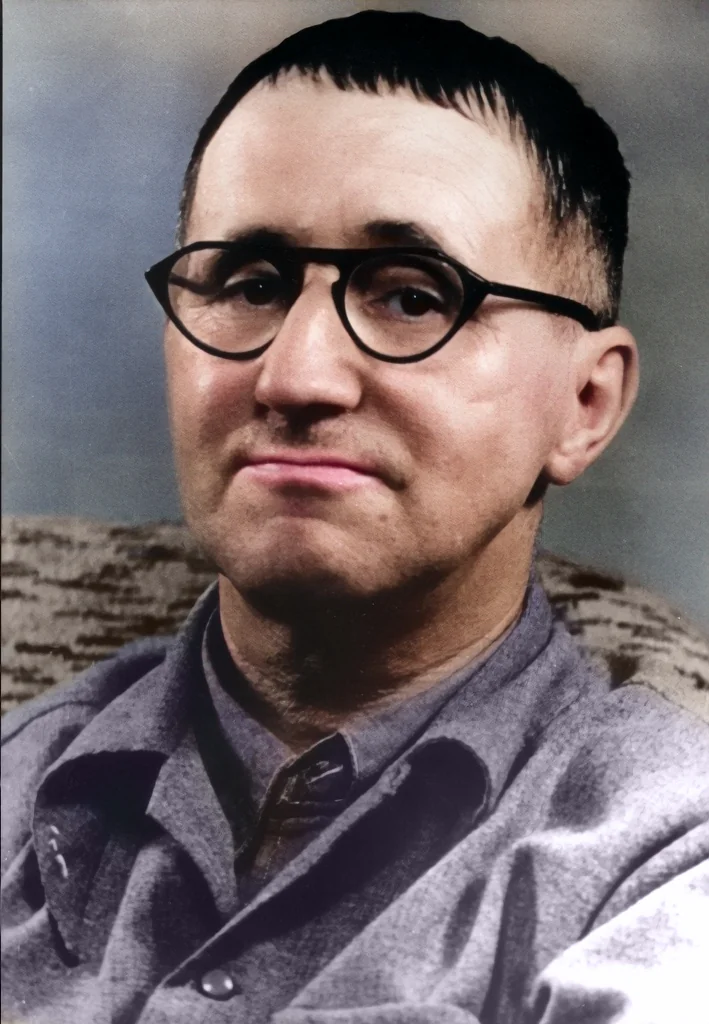
| 37 Quotes | |
| Born as | Eugen Berthold Friedrich Brecht |
| Occup. | Poet |
| From | Germany |
| Born | February 10, 1898 Augsburg, Bavaria, Germany |
| Died | August 14, 1956 East Berlin, East Germany |
| Cause | Heart attack |
| Aged | 58 years |
| Cite | |
Citation Formats
APA Style (7th ed.)
Bertolt brecht biography, facts and quotes. (2026, February 1). FixQuotes. https://fixquotes.com/authors/bertolt-brecht/
Chicago Style
"Bertolt Brecht biography, facts and quotes." FixQuotes. February 1, 2026. https://fixquotes.com/authors/bertolt-brecht/.
MLA Style (9th ed.)
"Bertolt Brecht biography, facts and quotes." FixQuotes, 1 Feb. 2026, https://fixquotes.com/authors/bertolt-brecht/. Accessed 6 Mar. 2026.
Early Life and Background
Eugen Berthold Friedrich Brecht was born on 10 February 1898 in Augsburg, Bavaria, into a respectable lower-middle-class household whose tensions would later feed his sense of class theater. His father, Berthold Brecht, rose to management at a paper factory; his mother, Sophie (nee Brezing), was devoutly Protestant and chronically ill. Brecht grew up with the double education of bourgeois security and moralizing piety, and he learned early how easily virtue could become a social costume.The First World War arrived as the decisive atmosphere of his youth. As a teenager he wrote journalism and poems that already distrusted official language, and in 1917 he began medical studies partly to avoid conscription. Drafted in 1918, he served as a medical orderly in a military hospital, watching bodies returned from mechanized slaughter. The experience hardened his anti-romantic view of heroism and made him suspicious of any ideology that demanded sacrifice while protecting power.
Education and Formative Influences
Brecht studied medicine and then literature at Ludwig Maximilian University in Munich, but his real schooling came from cabarets, the postwar street, and modern theater. He absorbed Francois Villon and Rudyard Kipling alongside German ballad traditions, and he learned from Wedekind, Karl Valentin, and the raw satire of Munich performance culture. After 1918, revolutionary turmoil in Bavaria and the Weimar Republics instability supplied him with a living laboratory of propaganda, hunger, and opportunism - conditions that shaped both his politics and his experimental methods.Career, Major Works, and Turning Points
Brecht broke through with "Drums in the Night" (1922) and achieved a scandalous, era-defining success with "The Threepenny Opera" (1928), created with composer Kurt Weill, whose songs turned criminality into a mirror of respectable society. In Berlin he developed his theory of epic theater and the alienation effect, working with key collaborators such as designer Caspar Neher and, crucially, actor-writer Helene Weigel, who became his wife and most incisive interpreter. After Hitlers rise in 1933, Brecht fled into exile - Prague, Vienna, Zurich, Denmark, Sweden, Finland - writing "Mother Courage and Her Children" (1939), "The Life of Galileo", and "The Good Person of Szechwan" under the pressure of fascism and war. He reached the United States in 1941, wrote screen material and "The Caucasian Chalk Circle", then testified before the House Un-American Activities Committee in 1947 and left America the next day. In 1949 he settled in East Berlin, founded the Berliner Ensemble, and staged landmark productions until his death on 14 August 1956, navigating the moral compromises of state patronage while continuing to provoke it.Philosophy, Style, and Themes
Brecht wrote as a diagnostician of social relations, convinced that human behavior is not timeless character but conditioned practice. His work insists that the stage should not intoxicate spectators into passive identification, but train them to judge causes, costs, and alternatives. That is why he prized interruption - songs, titles, direct address, visible stage machinery - not as gimmick but as ethics: if the audience stays awake, it can see how history is made and unmade. He distrusted consoling sentimentality, preferring the sharper compassion that comes from analysis.His psychology as an artist was pragmatic, even ascetic, about ideals: “Grub first, then ethics”. The line captures his recurring argument that morality preached to the hungry is often a form of domination, a theme running from "Threepenny" to "Mother Courage", where survival bargains corrode virtue. Yet he also treated thought as a tool of resistance, not a luxury: “Hungry man, reach for the book: it is a weapon”. Brecht extended this weapon into theater itself - a public workshop for critical intelligence, where error is inevitable but corrigible: “Intelligence is not to make no mistakes, but quickly to see how to make them good”. Across poems, Lehrstuecke, and parables, he returned to the question of how ordinary people can act inside brutal systems without becoming their image of obedience.
Legacy and Influence
Brecht reshaped modern performance worldwide: epic theater, verfremdung, and the idea of the stage as an engine of social inquiry influenced directors from Erwin Piscator to Peter Brook and Augusto Boal, as well as playwrights such as Durrenmatt, Weiss, and generations of political dramatists. His songs and terse poems entered popular memory, while his rehearsal methods at the Berliner Ensemble became a template for actorly precision joined to argument. Just as importantly, Brecht left a durable challenge: art that flatters empathy without clarifying power is incomplete - and spectators, like citizens, can be trained to see, to doubt, and to choose.Our collection contains 37 quotes written by Bertolt, under the main topics: Witty One-Liners - Ethics & Morality - Wisdom - Truth - Justice.
Other people related to Bertolt: Kenneth Tynan (Critic), Gunther Grass (Author), Frank Wedekind (Playwright), Heinrich Mann (Novelist)
Frequently Asked Questions
- What did Bertolt Brecht do: Brecht was a playwright, poet, and director known for his development of epic theatre and contributions to political theatre.
- Bertolt Brecht writing style: His writing style is characterized by clear, unambiguous language aimed at provoking thought and challenging societal norms.
- How did Bertolt Brecht Die: Brecht died of a heart attack on August 14, 1956, in East Berlin, Germany.
- Bertolt Brecht epic theatre: Epic theatre is a style that emphasizes the audience's perspective as critical observers, breaking the fourth wall to encourage reflection rather than emotional manipulation.
- 10 facts about Bertolt Brecht: 1. Born in Augsburg, Germany. 2. Studied medicine before focusing on theatre. 3. Developed epic theatre. 4. Fled Nazi Germany in 1933. 5. Lived in the U.S. during WWII. 6. Blacklisted during the McCarthy era. 7. Returned to East Germany post-war. 8. Won the Stalin Peace Prize. 9. Founded the Berliner Ensemble. 10. Believed art should serve social change.
- Bertolt Brecht techniques: He was known for the alienation effect, epic theatre, and the use of narrative to provoke critical thinking.
- Bertolt Brecht famous works: Some of his famous works include 'The Threepenny Opera,' 'Mother Courage and Her Children,' and 'The Life of Galileo.'
- How old was Bertolt Brecht? He became 58 years old
Bertolt Brecht Famous Works
- 1948 The Caucasian Chalk Circle (Play)
- 1943 The Good Person of Szechwan (Play)
- 1943 Life of Galileo (Play)
- 1941 Mother Courage and Her Children (Play)
- 1938 Fear and Misery of the Third Reich (Play)
- 1928 The Threepenny Opera (Play)
- 1918 Ba'al (Play)
Source / external links