
Bertrand Russell Biography Quotes 103 Report mistakes
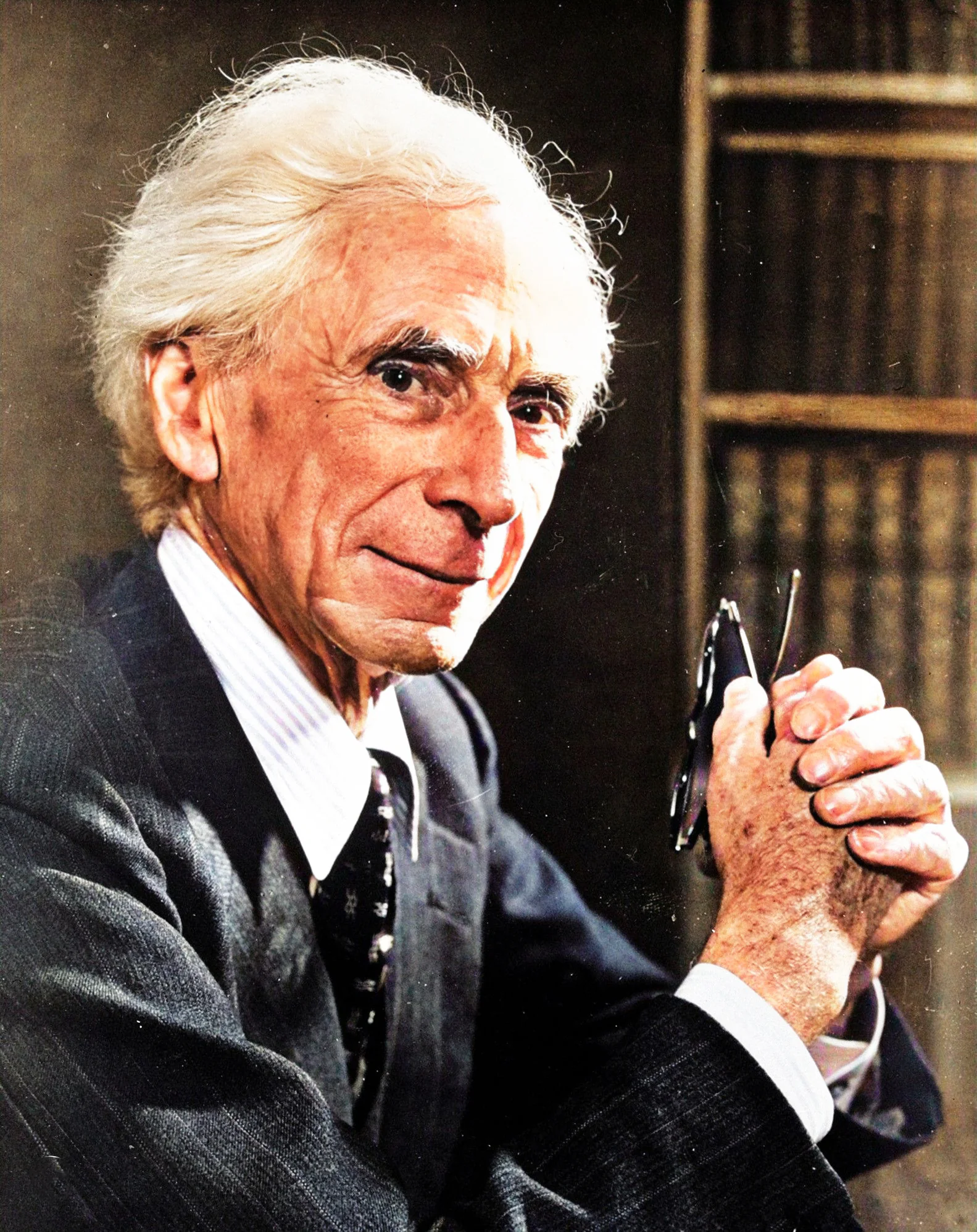
| 103 Quotes | |
| Born as | Bertrand Arthur William Russell |
| Known as | 3rd Earl Russell |
| Occup. | Philosopher |
| From | United Kingdom |
| Born | May 18, 1872 |
| Died | February 2, 1970 |
| Aged | 97 years |
| Cite | |
Citation Formats
APA Style (7th ed.)
Bertrand russell biography, facts and quotes. (2026, February 1). FixQuotes. https://fixquotes.com/authors/bertrand-russell/
Chicago Style
"Bertrand Russell biography, facts and quotes." FixQuotes. February 1, 2026. https://fixquotes.com/authors/bertrand-russell/.
MLA Style (9th ed.)
"Bertrand Russell biography, facts and quotes." FixQuotes, 1 Feb. 2026, https://fixquotes.com/authors/bertrand-russell/. Accessed 24 Mar. 2026.
Early Life and Background
Bertrand Arthur William Russell was born on May 18, 1872, into one of Britains great Whig families, a world where public duty and private strain often coexisted. His father, John Russell, Viscount Amberley, was a radical aristocrat; his mother, Katherine Louisa (Stanley) Russell, came from an influential liberal lineage. Their early deaths left Russell orphaned and emotionally unmoored - his mother and sister died in 1874, his father in 1876 - and he was taken into the care of his paternal grandparents at Pembroke Lodge in Richmond Park, under the stern moral authority of his grandmother, the Dowager Countess Russell.The household was respectable, pious, and watchful, and the child Russell learned early to live inwardly. He endured bouts of loneliness and suicidal thoughts as an adolescent, while simultaneously developing a fierce independence of mind that would later harden into public dissent. The tension between inherited privilege and a relentless conscience became a defining psychological engine: he never stopped feeling responsible for the worlds suffering, yet he also distrusted the cant of respectable opinion, especially when it tried to sanctify cruelty.
Education and Formative Influences
Russell was educated largely at home before entering Trinity College, Cambridge, in 1890, where mathematics offered him a rare sense of clarity and refuge. At Cambridge he encountered the Apostles and a culture of argument that prized truth over deference; he also found mentors in the mathematician-philosopher Alfred North Whitehead and, later, a formidable intellectual rival in G.E. Moore. Early flirtations with Hegelian idealism gave way to analytic rigor, and his marriage in 1894 to Alys Pearsall Smith - a Quaker from an American reformist circle - initially echoed his hope that personal life could be harmonized with ethical purpose, even as his temperament pulled him toward solitude, precision, and difficult honesty.Career, Major Works, and Turning Points
Russells career fused technical innovation with public controversy: he helped found analytic philosophy and modern logic while repeatedly colliding with the state and the academy. After The Principles of Mathematics (1903) and his discovery of Russells paradox, he and Whitehead produced Principia Mathematica (1910-1913), a monumental attempt to ground mathematics in logic that shaped twentieth-century philosophy and computer-age formalism. World War I turned him into a prominent pacifist; his activism cost him a Trinity lectureship and led to imprisonment in 1918. He wrote widely for general readers - The Problems of Philosophy (1912), The Analysis of Mind (1921), Why I Am Not a Christian (1927), A History of Western Philosophy (1945) - and taught in Britain and the United States, though his 1940 appointment at City College of New York was voided after a public moralistic campaign. Awarded the Nobel Prize in Literature in 1950, he became, in old age, a global spokesman against nuclear weapons, co-founding the Pugwash movement and, late in life, lending his name to the Russell Tribunal on the Vietnam War.Philosophy, Style, and Themes
Russell sought clean arguments but never believed that intellect alone redeemed human life; his work is propelled by an ethical psychology that reads like a self-diagnosis. “Three passions, simple but overwhelmingly strong, have governed my life: the longing for love, the search for knowledge, and unbearable pity for the suffering of mankind”. That triad explains both his brilliance and his restlessness: logic and epistemology were not games but disciplines meant to restrain cruelty and self-deception, while love - frequently turbulent in his own relationships - remained for him a counterweight to despair.His prose style is crystalline, combative, and often satirical, sharpened by the conviction that societies consecrate their prejudices as virtue. He attacked moral hypocrisy with aphorisms that expose the arbitrariness of taboo: “Sin is geographical”. He also anatomized domination as the hidden currency of public ideals, insisting that much rhetoric about virtue is really about control: “Much that passes as idealism is disguised hatred or disguised love of power”. These themes unite his technical and popular writing - the refusal to let comforting metaphysics, religious authority, or nationalist fervor override evidence, sympathy, and the sober recognition of how power bends institutions, education, and even intimate life.
Legacy and Influence
Russell died on February 2, 1970, in Wales, leaving a legacy unusual in its range: he was both a creator of the logical tools that underlie analytic philosophy and an exemplar of the public intellectual as moral dissenter. In philosophy of language, logic, and epistemology, his ideas about descriptions, logical form, and the limits of knowledge set agendas for generations from Wittgenstein to contemporary analytic work; in public life, his pacifism, anti-nuclear leadership, and critique of authoritarian pieties modeled a kind of rational courage that remains a touchstone. His enduring influence lies in the fusion of exacting argument with an exposed conscience - a belief that clarity is not merely intellectual hygiene, but a civic duty owed to fallible, suffering human beings.Our collection contains 103 quotes written by Bertrand, under the main topics: Witty One-Liners - Ethics & Morality - Truth - Wisdom - Justice.
Other people related to Bertrand: Ludwig Wittgenstein (Philosopher), Saul Kripke (Philosopher), Dora Russell (Celebrity), Stephen Cole Kleene (Mathematician), Satish Kumar (Activist), Peter Frederick Strawson (Philosopher), Ernest Gellner (Philosopher), Bryan Magee (Author)
Bertrand Russell Famous Works
- 1957 Why I Am Not a Christian (Book)
- 1945 A History of Western Philosophy (Book)
- 1930 The Conquest of Happiness (Book)
- 1912 The Problems of Philosophy (Book)
- 1910 Principia Mathematica (Book)
Source / external links