
Bess Myerson Biography Quotes 2 Report mistakes
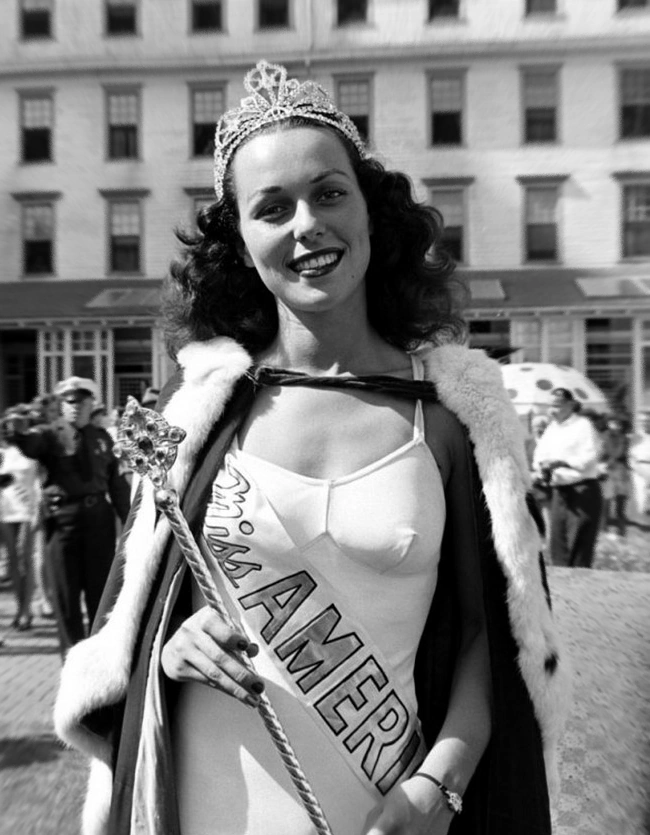
| 2 Quotes | |
| Known as | Miss America 1945 |
| Occup. | Model |
| From | USA |
| Born | July 16, 1924 The Bronx, New York, USA |
| Age | 101 years |
| Cite | |
Citation Formats
APA Style (7th ed.)
Bess myerson biography, facts and quotes. (2026, February 11). FixQuotes. https://fixquotes.com/authors/bess-myerson/
Chicago Style
"Bess Myerson biography, facts and quotes." FixQuotes. February 11, 2026. https://fixquotes.com/authors/bess-myerson/.
MLA Style (9th ed.)
"Bess Myerson biography, facts and quotes." FixQuotes, 11 Feb. 2026, https://fixquotes.com/authors/bess-myerson/. Accessed 28 Mar. 2026.
Early Life and Background
Bess Myerson was born on July 16, 1924, in the Bronx, New York City, to Jewish immigrant parents whose economic life was shaped by the long shadow of the Great Depression. She grew up in a crowded, striving borough where neighborhood life mixed Yiddishkeit, union politics, and the everyday pressure to "make it" in America. That tension - pride in origins alongside a keen awareness of social ceilings - became a quiet engine in her adult identity.Her early years unfolded in an era when public images of beauty were narrow and when antisemitism was not an abstraction but a practical barrier: job ads could exclude Jews, universities used quotas, and social clubs drew lines. Myerson absorbed those realities without surrendering to them, cultivating a poise that was less about glamour than about self-command. Even before fame, she was learning how visibility could be weaponized - against you or for you.
Education and Formative Influences
Myerson attended New York City public schools and studied at Hunter College, a tuition-free institution that trained many first-generation New Yorkers for professional life. In the city of Fiorello La Guardia and then postwar liberal reform, she encountered the civic ideal that government could be a tool for uplift if citizens demanded it - and also the counter-lesson that public virtue and private incentives often collide. Those themes later resurfaced when she moved from modeling into public office and, eventually, public scandal.Career, Major Works, and Turning Points
In 1945, Myerson entered - and won - the Miss America pageant, becoming the first Jewish Miss America, a milestone that forced national audiences to confront who could represent "American" beauty. Facing pressure to change her name or downplay her identity, she refused, and her reign included speaking against prejudice and appearing in war-bond and morale efforts during the final phase of World War II's aftermath. She parlayed fame into broadcasting and television work and, in the reform-minded 1960s, into municipal service: she was appointed New York City's Commissioner of Consumer Affairs under Mayor John Lindsay. Her life then took a harder turn. In the late 1970s and early 1980s, her association with financier and convicted felon Malcolm Wilson and her role as a witness in a bribery investigation drew intense scrutiny; she ultimately served time for criminal contempt after refusing to answer questions before a grand jury, a fall that recast her public persona from trailblazer to cautionary tale.Philosophy, Style, and Themes
Myerson's philosophy was forged at the intersection of aspiration and exclusion. Her most consistent theme was that visibility carries obligation: the same spotlight that rewards a "first" can be redirected to widen the frame for others. That moral calculus informed her post-pageant advocacy against discrimination and her later consumer-protection work, where she treated everyday fraud and predation as political issues rather than mere bad luck. She understood the psychology of crowds and institutions - how prejudice can be normalized, and how reform depends on public attention sustained beyond a single news cycle.Her own words show an acute suspicion of passive bystanding, and they read like a self-indictment as much as a credo. “The accomplice to the crime of corruption is frequently our own indifference”. The line captures her belief that civic decay is not only caused by villains but enabled by spectators, a belief sharpened by her experience inside city government and later by the way scandal metastasized around her. She also had a romantic realism that mirrored her public life: “To fall in love is awfully simple, but to fall out of love is simply awful”. In Myerson's story, love is not merely private feeling; it is attachment - to people, to status, to a version of oneself. Her rise and fall suggest how hard it is to detach from relationships and arrangements once they have become intertwined with identity, comfort, and the fear of losing relevance.
Legacy and Influence
Bess Myerson remains a complicated American symbol: a boundary-breaking Jewish Miss America who broadened mid-century representations of national beauty, and a public servant whose later entanglements exposed the moral hazards of proximity to power. Her legacy lives in two parallel narratives - the emancipatory force of refusing to edit one's identity for acceptance, and the sobering reminder that reformist rhetoric does not immunize anyone from compromised judgment. In that tension, she endures as both pioneer and parable, still useful for understanding how celebrity, politics, and personal need can collide in the modern public sphere.Our collection contains 2 quotes written by Bess, under the main topics: Justice - Heartbreak.
Other people related to Bess: Ed Koch (Politician)