
Bil Keane Biography Quotes 3 Report mistakes
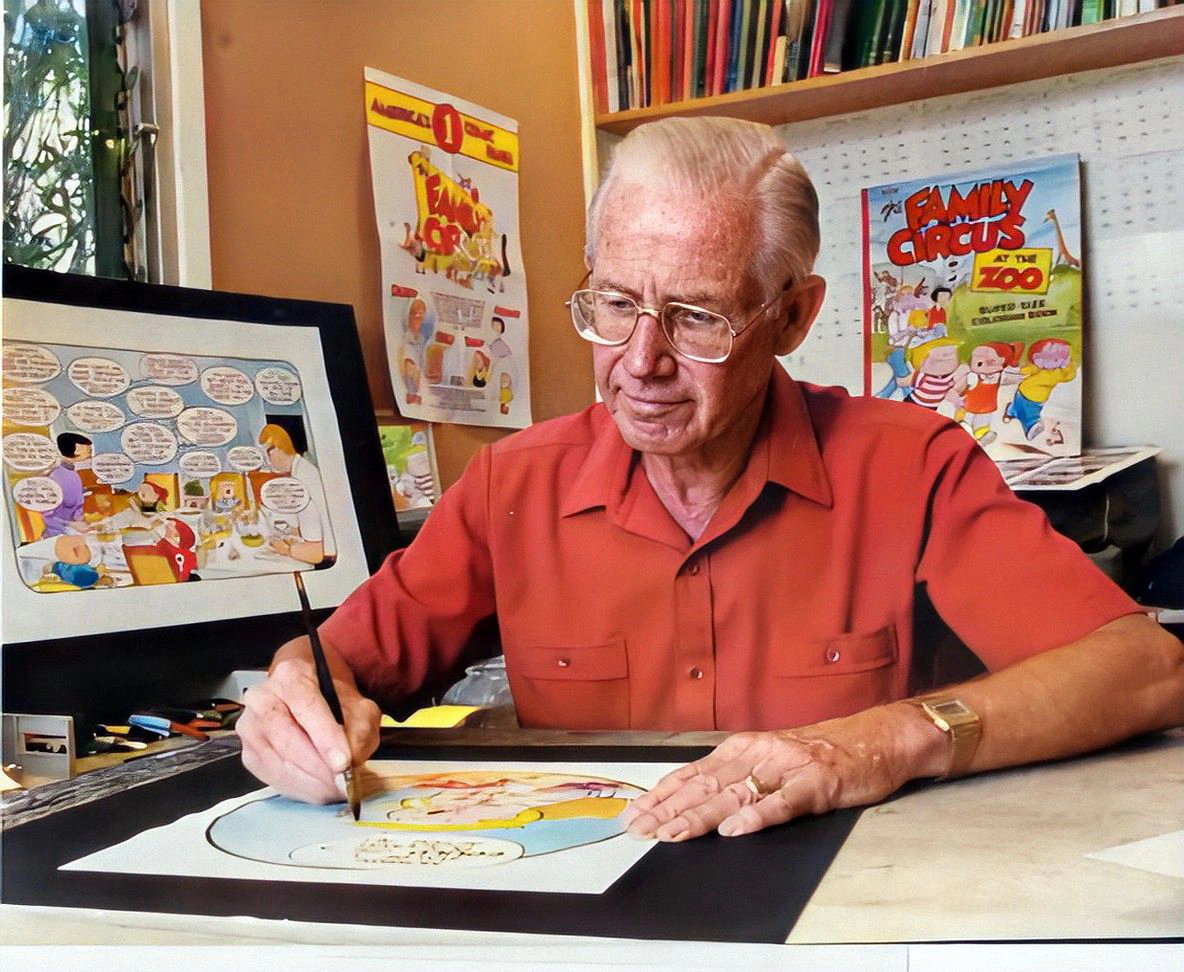
Attr: Christopher Keane, CC BY-SA 3.0
| 3 Quotes | |
| Born as | William Aloysius Keane |
| Occup. | Cartoonist |
| From | USA |
| Spouse | Thelma Carne |
| Born | October 5, 1922 Philadelphia, Pennsylvania, USA |
| Died | November 8, 2011 Paradise Valley, Arizona, USA |
| Cause | Natural Causes |
| Aged | 89 years |
| Cite | |
Citation Formats
APA Style (7th ed.)
Bil keane biography, facts and quotes. (2026, February 11). FixQuotes. https://fixquotes.com/authors/bil-keane/
Chicago Style
"Bil Keane biography, facts and quotes." FixQuotes. February 11, 2026. https://fixquotes.com/authors/bil-keane/.
MLA Style (9th ed.)
"Bil Keane biography, facts and quotes." FixQuotes, 11 Feb. 2026, https://fixquotes.com/authors/bil-keane/. Accessed 27 Mar. 2026.
Early Life and Background
William Aloysius "Bil" Keane was born on October 5, 1922, in Philadelphia, Pennsylvania, into a large Irish Catholic family whose rhythms of parish life, neighborhood commerce, and crowded domesticity would later become the emotional architecture of his art. His earliest memories were shaped by the lingering austerity of the Great Depression and the ordinary heroism of parents balancing humor and hardship - a sensibility that trained him to see comedy not as escape but as a tool for endurance. Even as a boy he drew constantly, sketching teachers, relatives, and street scenes with an instinct for capturing personality in a few quick lines.Keane came of age as the United States moved from economic crisis into wartime mobilization. That pivot - from scarcity to shared national purpose - sharpened his attention to the small unit that persists through every upheaval: the family. Long before he became famous, his private ambition was already forming into a public vocation: to defend everyday affection and foibles against cynicism, and to elevate the domestic sphere into something worthy of newspaper front pages.
Education and Formative Influences
He studied at the Philadelphia School of Industrial Art (later the University of the Arts), where he refined draftsmanship, lettering, and the disciplined clarity needed for mass print reproduction. The period steeped him in the American tradition of newspaper cartooning - clean silhouettes, readable gesture, and jokes that land in one glance - while also teaching him the practical realities of deadlines and syndication. His formative influences were less avant-garde than civic: the look of daily papers, the cadence of radio-era punchlines, and the belief that popular art can be both technically serious and morally gentle.Career, Major Works, and Turning Points
After World War II, Keane moved into professional cartooning, working for newspapers and building a portfolio rooted in family humor; the decisive breakthrough came with the creation of "The Family Circus", a single-panel feature centered on the Keane household and their four children. Launched nationally in 1960 and distributed by King Features Syndicate, the strip became a staple of American Sunday reading, recognizable for its rounded panel border, airy compositions, and the "Billy's notepad" device that translated a child's logic into visual shorthand. A major turning point was Keane's choice to keep the strip anchored in innocence rather than satire - a countercurrent to the sharper edge of much postwar editorial comedy - which made the work widely reprintable, brand-friendly, and durable across decades. He drew the strip for most of his life, eventually passing the tradition to his son Jeff Keane, and he died on November 8, 2011, leaving behind one of the most commercially successful family comics in U.S. history.Philosophy, Style, and Themes
Keane's philosophy was built around domestic love as a daily practice rather than a grand declaration, and his humor functioned like reassurance. His line was deceptively simple - open space, minimal shading, expressive hands and heads - but it was engineered for instant emotional recognition. In an era that increasingly celebrated irony, he insisted on sincerity, treating childhood as a serious worldview with its own metaphysics: time is elastic, rules are negotiable, and affection is the hidden infrastructure of the home. The strip's comedy often arrived as a miscommunication between adult intention and child interpretation, but the joke never required cruelty; the adult world is baffled, not vindictive, and the child is misguided, not corrupt.That psychology appears in the way he framed comfort as reciprocal rather than transactional. “A hug is like a boomerang - you get it back right away”. The sentence reads like a greeting-card aphorism, yet it also reveals Keane's inner premise: emotional generosity is self-renewing, and family life is a closed loop where what you give returns in altered, often funnier form. Likewise, “They invented hugs to let people know you love them without saying anything”. Keane trusted gestures over speeches, which is why his panels favor bodies in motion - arms flung wide, toddlers tumbling, parents bending down to listen - and why his comedy depends on physical staging more than verbal sparring. Even his view of time aimed at tenderness rather than urgency: “Yesterday's the past, tomorrow's the future, but today is a gift. That's why it's called the present”. In Keane's hands, the "present" was not a slogan but a craft principle: isolate one moment, see it clearly, and it becomes enough.
Legacy and Influence
Keane's legacy is the normalization of a gentle, family-centered comic voice at national scale, one that helped define the tone of mid-to-late 20th-century American newspaper culture. "The Family Circus" demonstrated that enormous readership could be built on warmth, legibility, and everyday domestic observation, influencing countless greeting cards, family-humor cartoonists, and syndicated strips that prioritized universality over topical bite. Just as important, his work preserved a record of postwar American ideals and anxieties - prosperity, suburban order, generational change - filtered through a child's-eye lens that made those themes feel intimate rather than ideological. The continuation of the strip by Jeff Keane underscores what Bil Keane always implied: the family is both subject and method, and the art endures by being handed down.Our collection contains 3 quotes written by Bil, under the main topics: Friendship - Love - Live in the Moment.
Source / external links