
Bonnie Blair Biography Quotes 6 Report mistakes
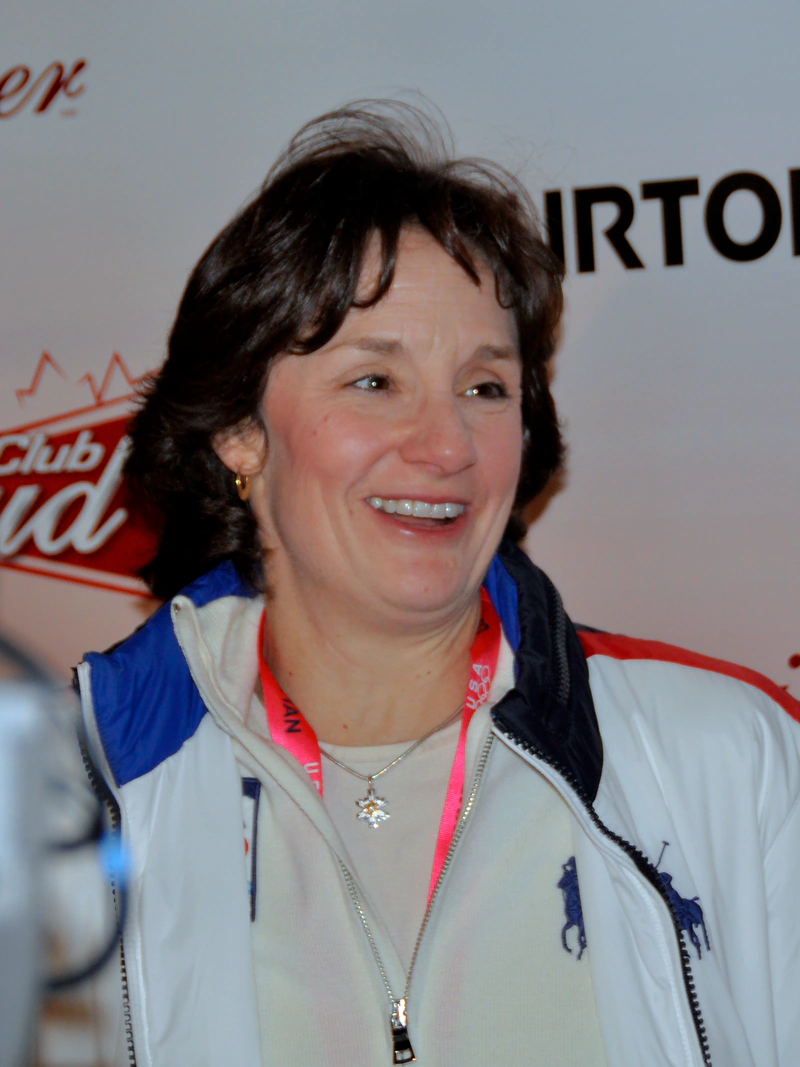
Attr: VancityAllie, CC BY 2.0
| 6 Quotes | |
| Born as | Bonnie Kathleen Blair |
| Occup. | Athlete |
| From | USA |
| Born | March 18, 1964 Champaign, Illinois, United States |
| Age | 61 years |
| Cite | |
Citation Formats
APA Style (7th ed.)
Bonnie blair biography, facts and quotes. (2026, February 11). FixQuotes. https://fixquotes.com/authors/bonnie-blair/
Chicago Style
"Bonnie Blair biography, facts and quotes." FixQuotes. February 11, 2026. https://fixquotes.com/authors/bonnie-blair/.
MLA Style (9th ed.)
"Bonnie Blair biography, facts and quotes." FixQuotes, 11 Feb. 2026, https://fixquotes.com/authors/bonnie-blair/. Accessed 6 Mar. 2026.
Early Life and Background
Bonnie Kathleen Blair was born on March 18, 1964, in Cornwall, New York, and grew up in a working, sports-minded Midwestern household after her family relocated to Champaign, Illinois. The region did not offer the ready-made speedskating infrastructure of the Netherlands or Scandinavia, but it did offer winter and a culture of disciplined youth athletics. Blair absorbed an early lesson that excellence is usually homemade - assembled from cold mornings, repetition, and family logistics rather than glamour.Skating began as play and quickly became identity. Her parents brought her into the sport as a toddler, and the ritual of rinks, blades, and timed laps formed a private geography of belonging. In the 1970s, as Title IX widened the horizon for American girls in sport, Blair was part of a generation learning that ambition could be ordinary and publicly endorsed. That social permission mattered: it allowed her intensity to look less like eccentricity and more like vocation.
Education and Formative Influences
Blair trained through local clubs and the U.S. amateur circuit, then left Illinois to pursue higher-level coaching and competition while also attending college, including study in Wisconsin, a state with stronger speedskating traditions. Her formative influences were practical rather than theoretical: coaches who demanded clean technique, teammates who treated splits and lap charts as moral documents, and the emerging internationalization of the sport as indoor ovals and sports science began to reshape elite preparation in the 1980s.Career, Major Works, and Turning Points
Blair reached the Olympic stage at Sarajevo in 1984, where she finished eighth in the 500 meters, a result that sharpened rather than satisfied her. The turning point came with a move to Milwaukee and the Wisconsin skating program, where her start mechanics and race modeling became weapons; in Calgary in 1988 she won gold in the 500 meters, then became the face of American sprint consistency: gold in the 500 and 1000 meters at Albertville in 1992, and again gold in both at Lillehammer in 1994, plus a bronze in the 1000 in 1988 - five Olympic medals, four of them gold, built on repeated mastery of the same unforgiving distances. She set world records in the early 1990s, endured the era's escalating competition and technology, and retired after the 1994 Games, later serving as a public advocate for fitness and as a leader in sport administration, including as chair of the U.S. Olympic Committee.Philosophy, Style, and Themes
Blair's inner life, as it can be inferred from her career choices and the emotional economy of sprint racing, revolved around controllables: cadence, entry speed, and the fierce calm required to treat a 38-second effort as a solvable problem. Her statement that “No matter what the competition is, I try to find a goal that day and better that goal”. describes a psychology built to survive comparison. In a sport where a medal can hinge on a stumble at the line, she cultivated a mindset that measured victory by precision and progress rather than by theater.That ethic also protected her from the corrosive anxiety of reputation. “Winning doesn't always mean being first. Winning means you're doing better than you've ever done before”. The line is not motivational wallpaper in her case; it reads like a coping mechanism turned into principle, a way to keep training honest when applause threatens to distort purpose. Even her retrospective emphasis on health goals - “I never could have achieved the success that I have without setting physical activity and health goals”. - reveals a sprinter who understood longevity as an achievement in itself. Blair skated with economical power and an unusually stable upper body, but her deeper style was moral: take the short race seriously enough that it becomes a long-term practice.
Legacy and Influence
Blair helped make speedskating legible to a mass American audience at a time when Winter Olympic stars were still sporadic national phenomena. Her four sprint gold medals set a benchmark of repeatable excellence that later U.S. champions had to answer, and her presence in Olympic leadership extended her impact beyond the rink. Just as important, she left an enduring template for competitive selfhood: disciplined without melodrama, fiercely ambitious without needing to mythologize suffering, and committed to the idea that the cleanest triumph is often the one you can measure on your own stopwatch.Our collection contains 6 quotes written by Bonnie, under the main topics: Motivational - Sports - Goal Setting - Training & Practice - Fitness.