
Boris Yeltsin Biography Quotes 24 Report mistakes
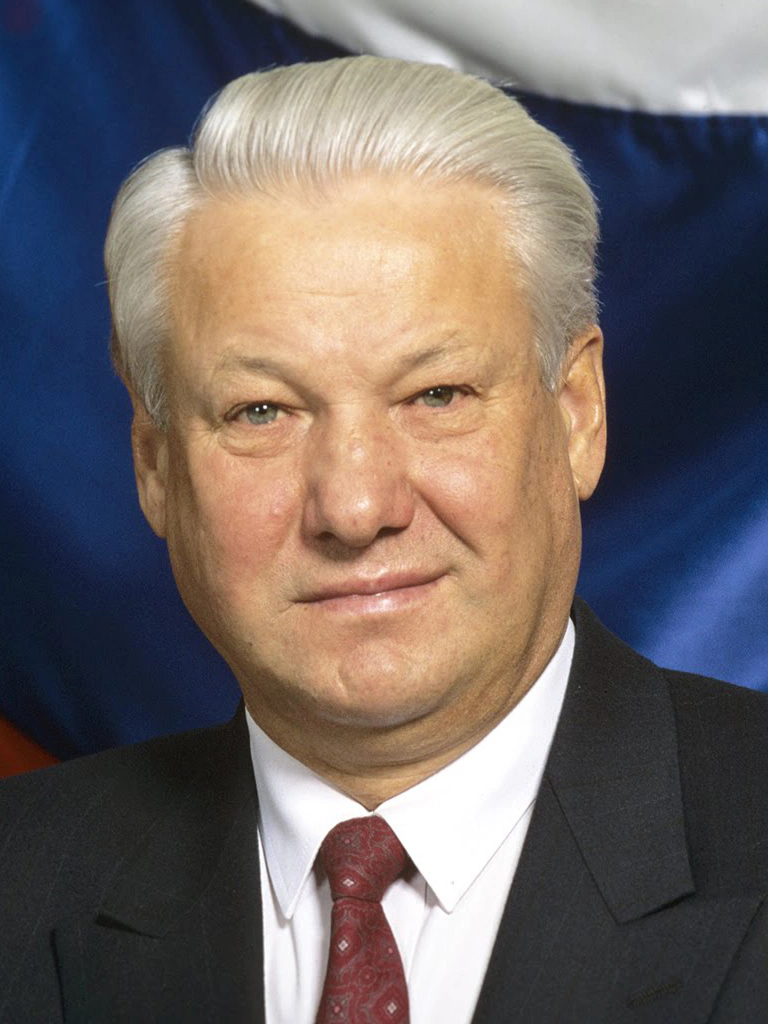
Attr: Kremlin.ru, CC BY 3.0
| 24 Quotes | |
| Occup. | President |
| From | Russia |
| Born | February 1, 1931 |
| Died | April 23, 2007 |
| Aged | 76 years |
| Cite | |
Citation Formats
APA Style (7th ed.)
Boris yeltsin biography, facts and quotes. (2026, February 16). FixQuotes. https://fixquotes.com/authors/boris-yeltsin/
Chicago Style
"Boris Yeltsin biography, facts and quotes." FixQuotes. February 16, 2026. https://fixquotes.com/authors/boris-yeltsin/.
MLA Style (9th ed.)
"Boris Yeltsin biography, facts and quotes." FixQuotes, 16 Feb. 2026, https://fixquotes.com/authors/boris-yeltsin/. Accessed 26 Mar. 2026.
Early Life and Background
Boris Nikolayevich Yeltsin was born on 1931-02-01 in Butka, Sverdlovsk Oblast, in the Ural hinterland of the Soviet Union, a world of hard labor, rationed horizons, and constant official scrutiny. His family carried the scars typical of Stalin-era villages: his father, Nikolai, was swept into the penal system during the 1930s and later returned, a presence that made the state feel both omnipotent and intimate in its intrusions. Yeltsin grew up amid wartime deprivation and postwar rebuilding, where survival rewarded bluntness and physical endurance.The Urals also offered an education in materials and power: forests, mines, and expanding industrial cities where concrete, steel, and party committees structured daily life. Yeltsin took risks early and lived with consequences, including a childhood accident that cost him fingers on one hand - a private reminder that willpower did not repeal reality. By temperament he was combative, impatient with humiliation, and unusually attentive to how ordinary people talked about the state behind closed doors, an instinct that later made him both a populist and an unpredictable insider.
Education and Formative Influences
Yeltsin studied engineering at the Ural Polytechnic Institute in Sverdlovsk, graduating in the 1950s and rising through construction management. The building trade trained him to treat plans as provisional, to value speed over paperwork, and to equate authority with results - habits that translated easily into Soviet administrative life. Joining the Communist Party in 1961, he learned how patronage and discipline worked, but also how provincial officials manipulated statistics and shortages. The Thaw after Stalin and the later stagnation under Brezhnev formed his core paradox: a believer in order who came to despise the lies needed to maintain it.Career, Major Works, and Turning Points
Yeltsin climbed the party hierarchy in Sverdlovsk, becoming first secretary of the regional party committee in 1976, where he pushed aggressive modernization and cultivated a reputation for personal intervention. In 1985 Mikhail Gorbachev brought him to Moscow as party boss; Yeltsin attacked privilege and bureaucratic inertia, then broke with the leadership in 1987, a televised humiliation that turned him into a symbol of revolt against the nomenklatura. Elected chair of the Russian Supreme Soviet in 1990 and President of the Russian Federation in June 1991, he became the face of sovereignty inside the collapsing USSR. His defining moment came during the August 1991 coup attempt, when he rallied resistance from the Russian parliament building and the coup collapsed, accelerating the Soviet end. In December 1991 he helped dissolve the USSR via the Belovezha Accords, then led Russia through "shock therapy" privatization, hyperinflation, and a violent struggle with parliament that culminated in the 1993 shelling of the White House. Reelected in 1996 amid war in Chechnya and deep social dislocation, he presided over the 1998 financial crash, declining health, and the rise of security elites; on 1999-12-31 he resigned, naming Vladimir Putin acting president. Yeltsin died on 2007-04-23 in Moscow.Philosophy, Style, and Themes
Yeltsin's inner drama was the collision between liberation and control. He insisted the Soviet promise had become a hollow liturgy, treating ideology as a cover for domination rather than a moral compass: “Let's not talk about Communism. Communism was just an idea, just pie in the sky”. The line was less philosophical than autobiographical - an admission that his own party career had taught him how easily grand narratives could excuse petty cruelty and systemic theft. Yet he never stopped believing that power had to be seized decisively, and that hesitation could be fatal in a collapsing state.His most consistent theme was freedom as a physical condition, not an abstract right, which helps explain why he could speak like a democrat while acting like an emergency commander. “We don't appreciate what we have until it's gone. Freedom is like that. It's like air. When you have it, you don't notice it”. For Yeltsin, the airlessness of late Soviet life - censorship, queues, enforced unanimity - justified dramatic ruptures, even at high cost. At the same time, he feared authority sustained by coercion alone, warning from experience that force corrodes legitimacy: “You can build a throne with bayonets, but you can't sit on it for long”. The tragedy of his presidency is that, under pressure from separatism, economic collapse, and institutional sabotage, he repeatedly reached for the very instruments he distrusted, leaving Russia with freedom that felt fragile and a state that learned to govern by crisis.
Legacy and Influence
Yeltsin remains the pivotal, polarizing founder of post-Soviet Russia: he dismantled the one-party state, legalized competitive politics, opened media space, and anchored Russia's formal sovereignty, while also presiding over mass impoverishment, oligarchic privatization, corruption, and the brutalization of the Chechen conflict. His 1993 constitutional settlement created a super-presidency that outlived his intentions and empowered successors far more disciplined than he was. In memory he is both the man who stood against the 1991 putsch and the president whose improvisational rule normalized executive force - a biography that reads like Russia's 1990s themselves: emancipating, chaotic, and permanently consequential.Our collection contains 24 quotes written by Boris, under the main topics: Sarcastic - Freedom - Live in the Moment - Overcoming Obstacles - War.
Other people related to Boris: Alexander Rutskoy (Vice President), Vladimir Putin (President), Vladimir Zhirinovsky (Politician), Anatoly Chubais (Politician), Robert Kocharian (Statesman)
Boris Yeltsin Famous Works
- 1994 The Struggle for Russia (Book)
- 1990 Against the Grain (Book)
Source / external links