
Brian Greene Biography Quotes 10 Report mistakes
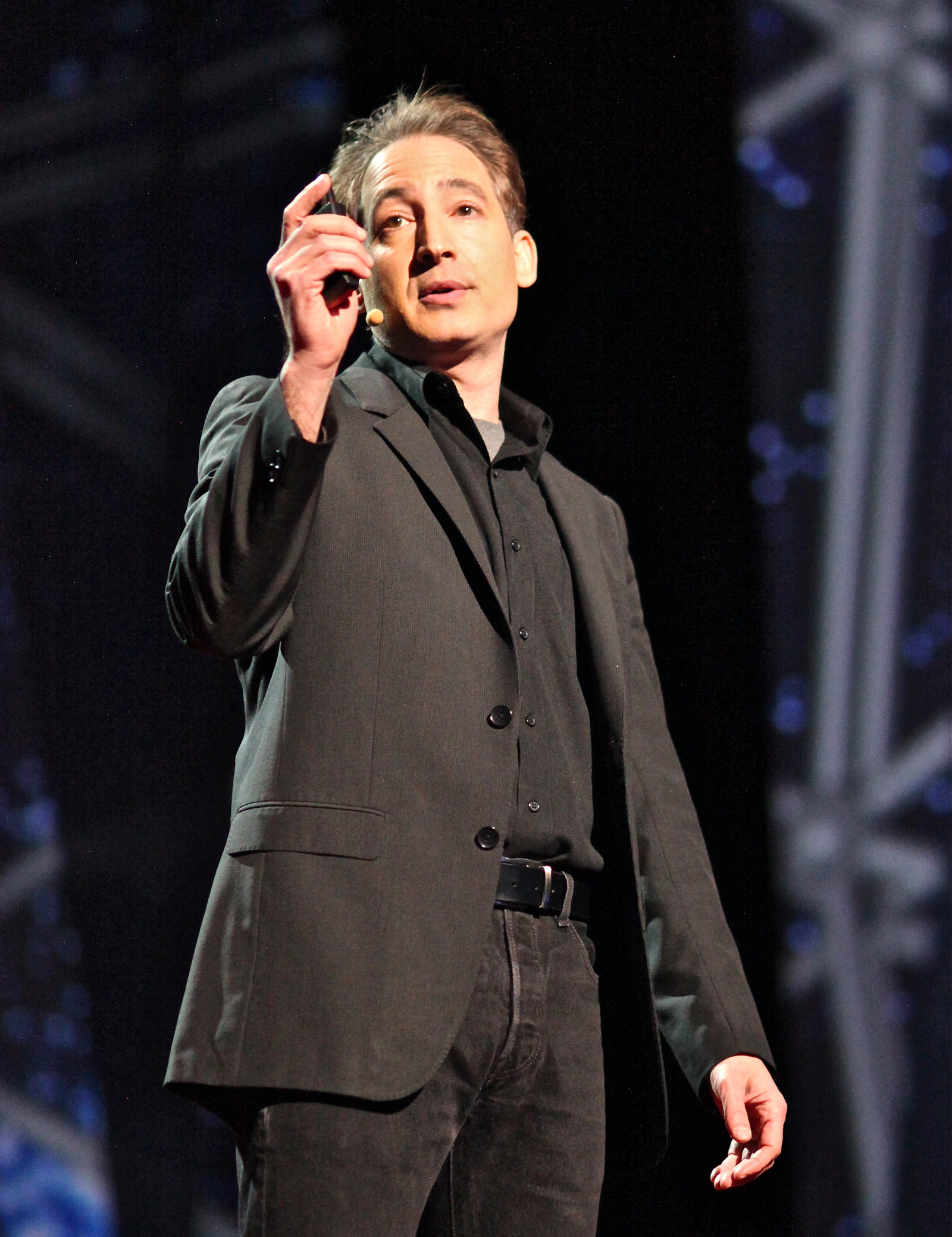
Attr: Steve Jurvetson, CC BY 2.0
| 10 Quotes | |
| Born as | Brian Randolph Greene |
| Occup. | Physicist |
| From | USA |
| Born | February 9, 1963 New York City, New York, USA |
| Age | 63 years |
| Cite | |
Citation Formats
APA Style (7th ed.)
Brian greene biography, facts and quotes. (2026, March 3). FixQuotes. https://fixquotes.com/authors/brian-greene/
Chicago Style
"Brian Greene biography, facts and quotes." FixQuotes. March 3, 2026. https://fixquotes.com/authors/brian-greene/.
MLA Style (9th ed.)
"Brian Greene biography, facts and quotes." FixQuotes, 3 Mar. 2026, https://fixquotes.com/authors/brian-greene/. Accessed 1 Apr. 2026.
Early Life and Background
Brian Randolph Greene was born on February 9, 1963, in New York City, in a United States still riding the long wake of the space race and the cultural authority of physics. He grew up in Manhattan, absorbing a city where museums, public lectures, and a certain argumentative confidence were part of the air. That urban intimacy with big ideas mattered later: Greene would become a physicist who treated the public square not as a distraction but as a natural extension of intellectual life.His early temperament combined two traits that rarely coexist comfortably - mathematical discipline and showman clarity. Friends and colleagues would later describe an ease with performance, but it was never merely theatrical. It reflected a deeper drive to make abstraction feel lived-in, to turn the invisible architecture of nature into something a reader or listener could picture. That impulse, rooted in childhood curiosity, eventually became one of his signatures: an urge to connect technical ambition with human-scale awe.
Education and Formative Influences
Greene studied physics at Harvard University (AB, 1984), then completed his PhD in physics at the University of Oxford as a Rhodes Scholar (DPhil, 1987). Oxford refined his taste for foundational questions, while the broader post-1970s revival of string theory - sparked by new mathematical consistency arguments and the emergence of supersymmetry - gave his generation a grand target: unification. By the late 1980s and early 1990s, as theoretical physics reorganized around the "first superstring revolution", Greene entered a community intoxicated by possibility yet constrained by the need for rigorous, calculable results.Career, Major Works, and Turning Points
After postdoctoral work, Greene joined Cornell University and later Columbia University, where he became a central voice in string theory and related aspects of fundamental physics. In research, he contributed to the development of mirror symmetry and the study of Calabi-Yau compactifications - the intricate geometries through which extra dimensions might hide in plain sight. His larger public turning point arrived with The Elegant Universe (1999), a book that made string theory and higher-dimensional geometry legible without flattening their strangeness; it was amplified by the PBS/NOVA adaptation (2003), turning Greene into a rare figure: a frontline theorist who could also narrate the frontier. Subsequent books - Icarus at the Edge of Time (2008), The Fabric of the Cosmos (2004), and Until the End of Time (2020) - tracked his widening arc from unification toward cosmology, time, entropy, and meaning. He also co-founded the World Science Festival (launched 2008 in New York), institutionalizing the idea that the hardest science can be a public art.Philosophy, Style, and Themes
Greene's inner life as a thinker is marked by a tension between audacity and epistemic humility. He repeatedly returns to the lure of a final framework while acknowledging that nature may outstrip the cognitive tools evolution handed us. This psychological balance - ambition without triumphalism - shapes both his technical writing and his public voice. He uses humor not to trivialize but to mark boundaries: “No matter how hard you try to teach your cat general relativity, you're going to fail”. The joke carries a serious implication: understanding has biological preconditions, and human brilliance may still face ceilings.Yet Greene is animated by the conviction that unification is not only aesthetic but practical, a gateway to sharper predictions and deeper reach. “A unified theory would put us at the doorstep of a vast universe of things that we could finally explore with precision”. In his books, equations become narratives of constraint: consistency, symmetry, and geometry act like plotlines that narrow what the universe is allowed to do. Even when speculation enters - extra dimensions, multiverse reasoning, holography - he frames it as a disciplined response to mathematical and conceptual pressure, not mere metaphysical appetite.
His style is to braid wonder with method. The night sky functions in his work as both emotional trigger and epistemological reminder: “I have long thought that anyone who does not regularly - or ever - gaze up and see the wonder and glory of a dark night sky filled with countless stars loses a sense of their fundamental connectedness to the universe”. This is not decorative lyricism; it explains why he refuses the stereotype of physics as cold reduction. For Greene, awe is motivational infrastructure - the feeling that keeps a mind returning to problems that may take decades, or centuries, to settle.
Legacy and Influence
Greene's enduring influence lies in a dual legacy: within theoretical physics as a prominent contributor to the string-theoretic program and its geometric machinery, and within culture as one of the era's most effective translators of deep physics for general audiences. He helped normalize the idea that a working researcher can be a public intellectual without abandoning rigor, and he built platforms - especially the World Science Festival - that outlast any single book cycle. Whether or not string theory ultimately becomes the definitive unification framework, Greene's larger imprint persists: he gave a generation a vocabulary for thinking about dimensions, time, and cosmic origin as simultaneously technical and intimate, and he modeled a scientific character that is ambitious, candid about uncertainty, and anchored in wonder.Our collection contains 10 quotes written by Brian, under the main topics: Witty One-Liners - Deep - Meaning of Life - Knowledge - Science.
Brian Greene Famous Works
- 2020 Until the End of Time: Mind, Matter, and Our Search for Meaning in an Evolving Universe (Book)
- 2011 The Hidden Reality: Parallel Universes and the Deep Laws of the Cosmos (Book)
- 2008 Icarus at the Edge of Time (Book)
- 2004 The Fabric of the Cosmos: Space, Time, and the Texture of Reality (Book)
- 1999 The Elegant Universe: Superstrings, Hidden Dimensions, and the Quest for the Ultimate Theory (Book)
Source / external links