
Brian Mulroney Biography Quotes 27 Report mistakes
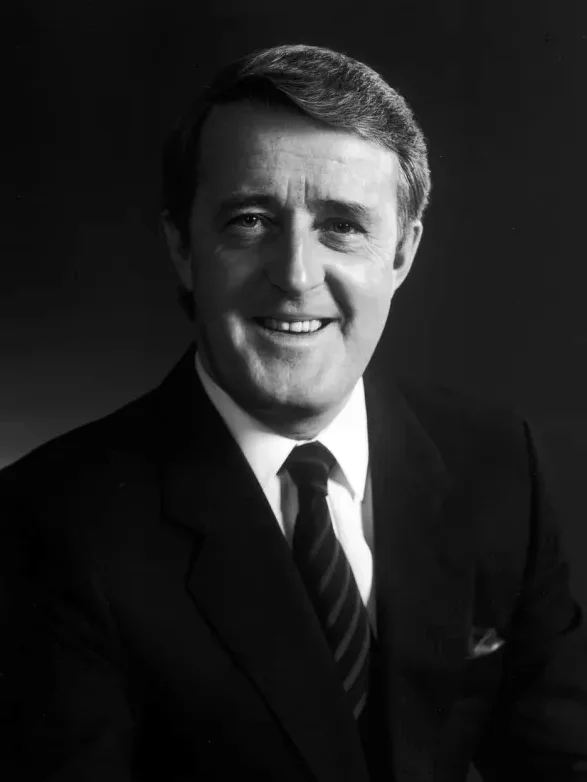
Attr: Yousuf Karsh
| 27 Quotes | |
| Born as | Martin Brian Mulroney |
| Occup. | Statesman |
| From | Canada |
| Born | March 20, 1939 Baie-Comeau, Quebec, Canada |
| Died | February 29, 2024 |
| Aged | 84 years |
| Cite | |
Citation Formats
APA Style (7th ed.)
Brian mulroney biography, facts and quotes. (2026, February 2). FixQuotes. https://fixquotes.com/authors/brian-mulroney/
Chicago Style
"Brian Mulroney biography, facts and quotes." FixQuotes. February 2, 2026. https://fixquotes.com/authors/brian-mulroney/.
MLA Style (9th ed.)
"Brian Mulroney biography, facts and quotes." FixQuotes, 2 Feb. 2026, https://fixquotes.com/authors/brian-mulroney/. Accessed 25 Mar. 2026.
Early Life and Background
Martin Brian Mulroney was born on March 20, 1939, in Baie-Comeau, Quebec, a young company town on the North Shore shaped by pulp, paper, and the rhythms of industrial work. The son of Irish Catholic parents - his father worked as an electrician at the mill - he grew up hearing both the cadences of anglophone community life and the dominant pull of francophone Quebec, a bilingual reality that later became an instinct rather than a platform. The modesty of his origins mattered to him: he carried an acute sensitivity to status, loyalty, and the ways institutions can open or shut doors.His early adulthood coincided with a Canada in motion: the Quiet Revolution in Quebec, the rise of a more assertive federal state, and the sharpening of debates over language, identity, and sovereignty. Mulroney, tall, socially magnetic, and ambitious, learned to treat politics as a human craft - the careful construction of trust across divides - even before he held office. That temperament, equal parts charm and discipline, would later let him act as a broker between regions, parties, and even presidents, while also exposing him to charges of transactional politics when consensus frayed.
Education and Formative Influences
Mulroney studied political science and law at St. Francis Xavier University and then at Universite Laval, where he encountered Quebec nationalism up close and understood how constitutional arguments were also arguments about dignity. Called to the Quebec bar, he built a legal career in labor and corporate circles, becoming a skilled negotiator in high-stakes disputes; those years taught him to read rooms, not just briefs, and to treat compromise as a tool rather than a surrender. He later attended Harvard Business School, broadening a network and deepening a managerial view of government that would define his prime ministership.Career, Major Works, and Turning Points
After rising as a corporate lawyer and serving as president of the Iron Ore Company of Canada, Mulroney entered party leadership at a moment when the Progressive Conservatives needed renewal after the Pierre Trudeau era. He won the PC leadership in 1983 and, in 1984, led a historic electoral landslide, becoming Canadas 18th prime minister; he repeated with another majority in 1988. His government pursued three defining projects: economic liberalization through the Canada-United States Free Trade Agreement (and the later North American trajectory), constitutional reconciliation through the Meech Lake Accord (1987) and Charlottetown Accord (1992), and a more activist international role, notably on South African apartheid and in relations with the United States under Ronald Reagan and George H. W. Bush. The arc turned sharply in the early 1990s as recession, the failure of constitutional accords, and fatigue with patronage allegations drove his approval down; he resigned in 1993, and his party suffered near-annihilation that year, a coda that underscored how quickly a coalition can dissolve when national unity projects fail.Philosophy, Style, and Themes
Mulroneys inner life as a statesman revolved around a paradox: he believed politics should be practical, yet he was drawn to grand national wagers. His best days came when he could translate moral urgency into usable alliances - whether persuading allies to isolate the apartheid regime, or convincing skeptical Canadians that market access and rules could strengthen sovereignty rather than weaken it. He also approached government as a disciplined executive enterprise, insisting on hierarchy, messaging, and measurable aims, a style that fit the late-20th-century turn toward managerial politics.His rhetoric revealed a psychology of prioritization and risk. “If everything is very important, then nothing is important”. It was not merely aphorism; it was a coping mechanism for a leader who faced simultaneous fires - unity, economy, and geopolitics - and needed to impose order by choosing what to elevate and what to disappoint. The same impulse shaped his willingness to gamble reputation on marquee files: “You have to spend your political capital on great causes for your country”. In that frame, Meech and free trade were not just policies but tests of courage, and his greatest failures stung because they were failures of persuasion after he had already wagered the full stake. Yet his sense of stewardship could also look long-term and geostrategic, particularly on northern sovereignty and resources: “A hundred years from now, the strength of Canada is going to be coming from our resources in the Arctic”. That futurism, blending nationhood with economic realism, was characteristic - optimistic about Canadas leverage, anxious about complacency.
Legacy and Influence
Mulroney died on February 29, 2024, leaving a legacy that remains contested yet substantial: he helped reorient Canadas economic framework toward continental integration, strengthened the prime ministers diplomatic reach, and demonstrated that a Canadian leader could shape allied policy on an issue as morally charged as apartheid. His constitutional agenda failed, but it clarified the depth of Quebecs demands and the limits of elite-driven compromise, lessons that later governments absorbed even when they avoided the same battleground. In memory he is often measured by outcomes - free trade endured; Meech collapsed - but his deeper imprint lies in the model of leadership he embodied: coalition-building through personal diplomacy, a willingness to bet big, and an insistence that power has meaning only when spent on causes larger than the office.Our collection contains 27 quotes written by Brian, under the main topics: Wisdom - Sarcastic - Nature - Leadership - Honesty & Integrity.
Other people related to Brian: Kim Campbell (Statesman), Jack Layton (Politician), Joe Clark (Scientist), Conrad Black (Businessman), John Turner (Statesman), Robert Bourassa (Politician), Peter Munk (Businessman), Peter MacKay (Politician), Lucien Bouchard (Lawyer)