
Brice Oligui Nguema Biography Quotes 8 Report mistakes
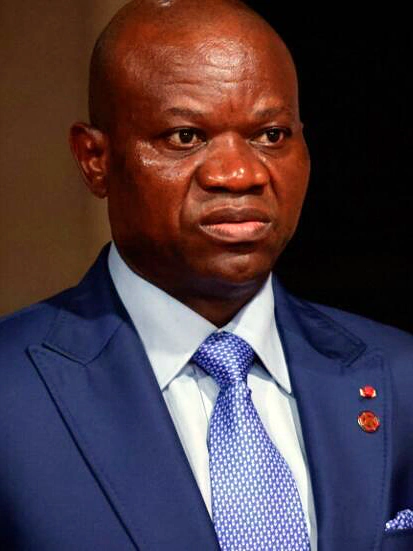
| 8 Quotes | |
| Born as | Brice Clotaire Oligui Nguema |
| Occup. | President |
| From | Gabon |
| Spouse | Zita Oligui Nguema |
| Born | March 3, 1975 Ngouoni, Haut-Ogooué Province, Gabon |
| Age | 51 years |
| Cite | |
Citation Formats
APA Style (7th ed.)
Brice oligui nguema biography, facts and quotes. (2026, March 14). FixQuotes. https://fixquotes.com/authors/brice-oligui-nguema/
Chicago Style
"Brice Oligui Nguema biography, facts and quotes." FixQuotes. March 14, 2026. https://fixquotes.com/authors/brice-oligui-nguema/.
MLA Style (9th ed.)
"Brice Oligui Nguema biography, facts and quotes." FixQuotes, 14 Mar. 2026, https://fixquotes.com/authors/brice-oligui-nguema/. Accessed 6 Apr. 2026.
Early Life and Background
Brice Clotaire Oligui Nguema was born in 1975 in southeastern Gabon, commonly linked to Haut-Ogooue, the province that long served as the political heartland of the Bongo state. He emerged from a country whose postcolonial history was dominated by a single system of power: Omar Bongo's rule from 1967, the oil-financed patronage networks that radiated from Libreville, and the gradual fusion of family, military, and party authority. Oligui Nguema's own rise cannot be understood outside that world. He belonged to a generation shaped by apparent national stability masking deeper frustrations - inequality despite petroleum wealth, strong presidential ritual, and a widening gap between official prosperity and ordinary life.He was also connected to the ruling elite by kinship and regional association, a fact that both aided and complicated his public image. In Gabon, where the security services were central to regime survival, personal trust often mattered as much as formal rank. Oligui Nguema came of age in an atmosphere where discretion, loyalty, and command discipline were prized, and where ambitious officers learned that politics in uniform was never merely military. His later posture as a restorer of state authority drew on that background: he was not an outsider crashing the system, but a product of it who came to present himself as the man who would correct its exhaustion.
Education and Formative Influences
Publicly available detail about his formal schooling is limited, but his formative education was unmistakably military and institutional. He trained as an officer and was shaped by the habits of elite security culture - hierarchy, surveillance, ceremony, and the close reading of political risk. He served in environments where presidential protection was inseparable from state management, and he reportedly spent periods attached to Gabonese diplomatic or security functions abroad, including in Morocco and Senegal, experiences that exposed him to other Francophone African regimes and to the practical mechanics of state continuity. If his generation inherited the mythology of the strong presidency, his professional formation taught him how fragile such systems become when succession, legitimacy, and public patience begin to fray.Career, Major Works, and Turning Points
Oligui Nguema built his career inside the Republican Guard, the regime's most sensitive military formation, and eventually became one of Gabon's most powerful security chiefs. Under Ali Bongo, especially after the president's 2018 stroke weakened the old equilibrium, security politics grew more tense and opaque. Oligui Nguema's command of the Guard placed him near the center of those anxieties. On 30 August 2023, immediately after the official announcement of a disputed election extending Ali Bongo's rule, he led the officers who annulled the result, dissolved institutions, and announced the end of the existing regime. He then became transitional president, presenting the takeover not as ideological revolution but as national rescue from institutional decay. The turning point of his life was therefore also the turning point of contemporary Gabon: a palace coup recast as a corrective to dynastic stagnation. As head of the transition, he sought domestic legitimacy through symbolic austerity, outreach beyond the old ruling circle, constitutional revision, and a timetable meant to reassure both citizens and foreign partners that military intervention would culminate in a managed return to civilian constitutional order.Philosophy, Style, and Themes
Oligui Nguema's public language reveals a leader trying to convert force into moral authority. His rhetoric is devotional, paternal, and reparative, invoking not class struggle or sweeping ideology but duty, order, and national healing. “May God grant me the wisdom and discernment necessary to govern in the interest of the flourishing of the Gabonese people”. That sentence is revealing: it casts power as burden rather than triumph and frames his legitimacy in ethical, almost pastoral terms. The constant appeal to "the Gabonese people" suggests a man aware that a coup creates an immediate deficit of consent, one that must be repaired through humility, ritual seriousness, and promises of restoration.At the same time, his themes are unmistakably material. “Gabon can no longer continue to be an endless well from which everything is extracted without any real benefit to the Gabonese people”. Here he names the psychological core of modern Gabonese discontent - abundance without broad reward, sovereignty without felt ownership. His style is therefore populist in the literal sense: he presents himself as the instrument through which captured wealth and captured institutions might be returned to the nation. “I promise to serve, protect and unite all Gabonese, that is the meaning of my oath”. The triad - serve, protect, unite - is also the self-portrait of a guard commander seeking rebirth as a national arbiter. It implies discipline before charisma, cohesion before pluralism, and legitimacy earned through stewardship.
Legacy and Influence
Because his historical role is still unfolding, Oligui Nguema's legacy remains provisional yet significant. He stands at the hinge between two Gabons: the long Bongo era of personalized continuity and an uncertain experiment in post-dynastic reordering. To supporters, he is the officer who halted an exhausted succession system and reopened the question of how Gabon's oil wealth, institutions, and constitutional life should serve the public. To skeptics, he is a regime insider who changed the operators more than the machine. Either way, his importance is clear. He has come to symbolize a wider African pattern in which militaries justify intervention not by rejecting democracy outright but by claiming to reset it. Whether history remembers him as a transitional fixer, a state rebuilder, or simply the most effective heir to the old order will depend on whether Gabon's promised constitutional renewal becomes durable practice rather than another chapter in elite adaptation.Our collection contains 8 quotes written by Brice, under the main topics: Justice - Hope - Change - Peace - Servant Leadership.
Source / external links