
Cardinal Richelieu Biography Quotes 6 Report mistakes
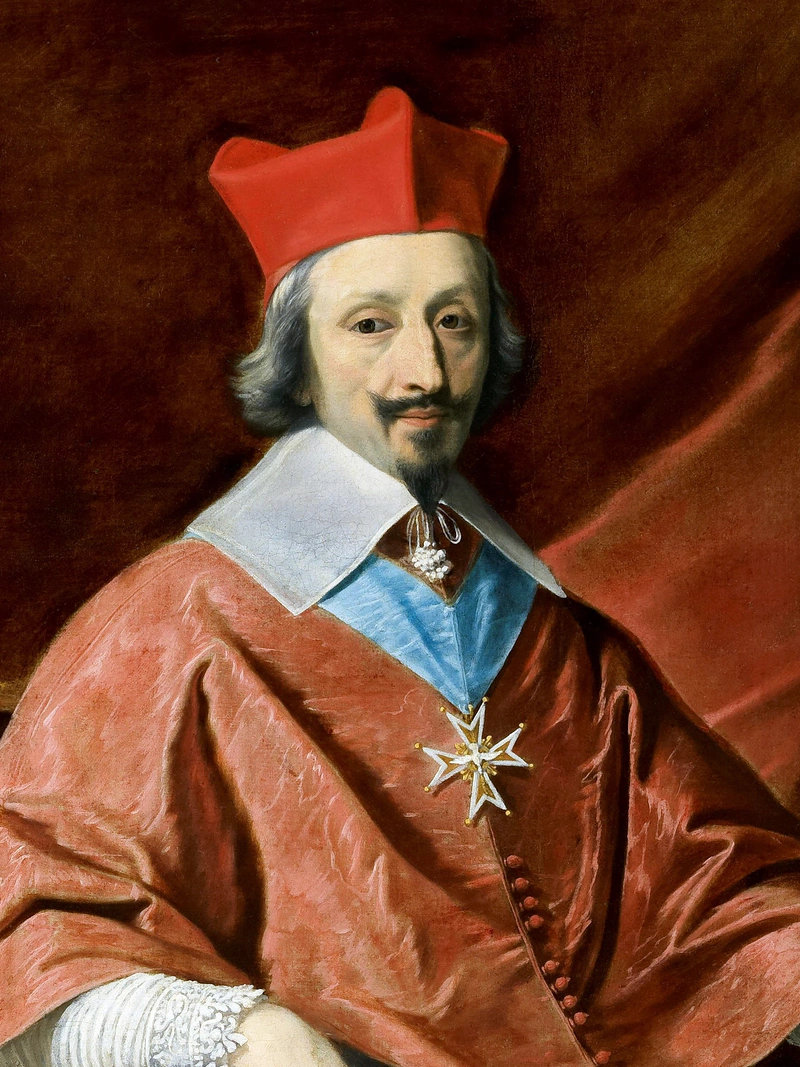
| 6 Quotes | |
| Born as | Armand Jean du Plessis |
| Known as | Cardinal-Duc de Richelieu; Duc de Richelieu |
| Occup. | Clergyman |
| From | France |
| Born | September 9, 1585 Paris, France |
| Died | December 4, 1642 Paris, France |
| Aged | 57 years |
| Cite | |
Citation Formats
APA Style (7th ed.)
Cardinal richelieu biography, facts and quotes. (2026, February 11). FixQuotes. https://fixquotes.com/authors/cardinal-richelieu/
Chicago Style
"Cardinal Richelieu biography, facts and quotes." FixQuotes. February 11, 2026. https://fixquotes.com/authors/cardinal-richelieu/.
MLA Style (9th ed.)
"Cardinal Richelieu biography, facts and quotes." FixQuotes, 11 Feb. 2026, https://fixquotes.com/authors/cardinal-richelieu/. Accessed 5 Mar. 2026.
Early Life and Background
Armand Jean du Plessis was born on 1585-09-09 in Paris into a minor noble family whose status outpaced its cash. His father, Francois du Plessis, served as grand provost of France; his early death left debts and a household managed by his formidable mother, Suzanne de La Porte. The boy grew up in the shadow of the late Wars of Religion, when confessional violence and noble factionalism had taught the monarchy that survival required administrative muscle as much as chivalric bravado.Health was a recurring companion - headaches, fevers, and bouts of fragility that alternated with a will of iron. The family expected a military career, but the practical needs of patronage pushed him toward the Church. That redirection became an inner turning point: ambition did not fade, it changed uniform, and the future cardinal learned early to treat institutions as instruments, not ornaments, in a France still healing from civil war and learning to obey again.
Education and Formative Influences
Educated at the College de Navarre in Paris and trained in theology, Richelieu absorbed both scholastic argument and the new political vocabulary of raison d'Etat emerging across Europe. When the family resolved to secure the bishopric of Lucon, he completed ecclesiastical preparation with the speed of a man racing circumstance; he was ordained and became bishop in 1607. Lucon, poor and administratively slack, became his laboratory: he enforced discipline, rebuilt revenues, and practiced the arts of inspection and report that would later scale to a kingdom.Career, Major Works, and Turning Points
Richelieu entered national politics at the Estates-General of 1614, representing the clergy, and soon attached himself to the court orbit of Marie de Medicis. After a period of exile during the fall of Concini and the rise of Louis XIII's favorites, he returned, was made cardinal in 1622, and became the king's chief minister in 1624. His ministry fused repression and construction: the siege and capitulation of La Rochelle (1627-1628) broke the Huguenot party as a fortified political power; the Alais settlement limited their military privileges while leaving private worship. At home he struck at the great nobles through trials, executions, and the demolition of private fortresses; he sent intendants to tighten royal control in the provinces; and he promoted the navy and commerce. Abroad, though a cardinal, he aligned France against Habsburg encirclement, subsidizing Protestants and later entering the Thirty Years' War (1635) to shift the European balance. He wrote the Political Testament and the Memoirs, and patronized letters through the founding of the Academie francaise (1635), turning cultural authority into statecraft. He died in Paris on 1642-12-04, leaving Louis XIII a more centralized state and a war still unfolding.Philosophy, Style, and Themes
Richelieu's inner life reads as a sustained argument with disorder. He feared anarchy more than he feared blood, and he treated politics as a realm where moral intention did not exempt anyone from consequences. He believed in the monarchy as the only vessel large enough to contain France's factions, and his piety, whatever its sincerity, was inseparable from utility - a Churchman who could prioritize the state's survival over confessional solidarity. “Secrecy is the first essential in affairs of state”. That sentence captures his method: private councils, controlled correspondence, parallel channels of information, and a preference for dossiers over spectacle.His style was administrative and prosecutorial, built on surveillance, paper, and precedent, yet animated by personal intensity. The famous hard edge of his justice was less sadism than preventive logic: if conspiracies multiplied, the cure had to be exemplary, even brutal. “If you give me six lines written by the hand of the most honest of men, I will find something in them which will hang him”. The remark, however apocryphal in phrasing, expresses a worldview in which language is evidence, reputation is irrelevant, and power must be defended with tools sharper than courtesy. Yet he was not careless about force; war, for him, was both instrument and calamity, and he held together two truths at once - necessity and grief. “War is one of the scourges with which it has pleased God to afflict men”. That tension shaped his policy: he escalated conflict to end greater conflicts, betting lives to buy a stronger peace.
Legacy and Influence
Richelieu left a template for the modern French state: centralized authority, professional administration, managed culture, and foreign policy driven by national interest. To admirers he was the architect who made Louis XIV possible; to enemies he was the cold engineer of repression. Either way, his imprint endured in the vocabulary of state reason, in the bureaucratic habit of governing by reports, and in the idea that sovereignty must be defended not only with armies, but with institutions that outlast any minister's breath.Our collection contains 6 quotes written by Cardinal, under the main topics: Justice - Work Ethic - Vision & Strategy - War - Self-Love.
Other people related to Cardinal: Francois de La Rochefoucauld (Writer), Pierre Corneille (Dramatist), Vincent Voiture (Poet), George Villiers (Politician)