
Carl Friedrich Gauss Biography Quotes 17 Report mistakes
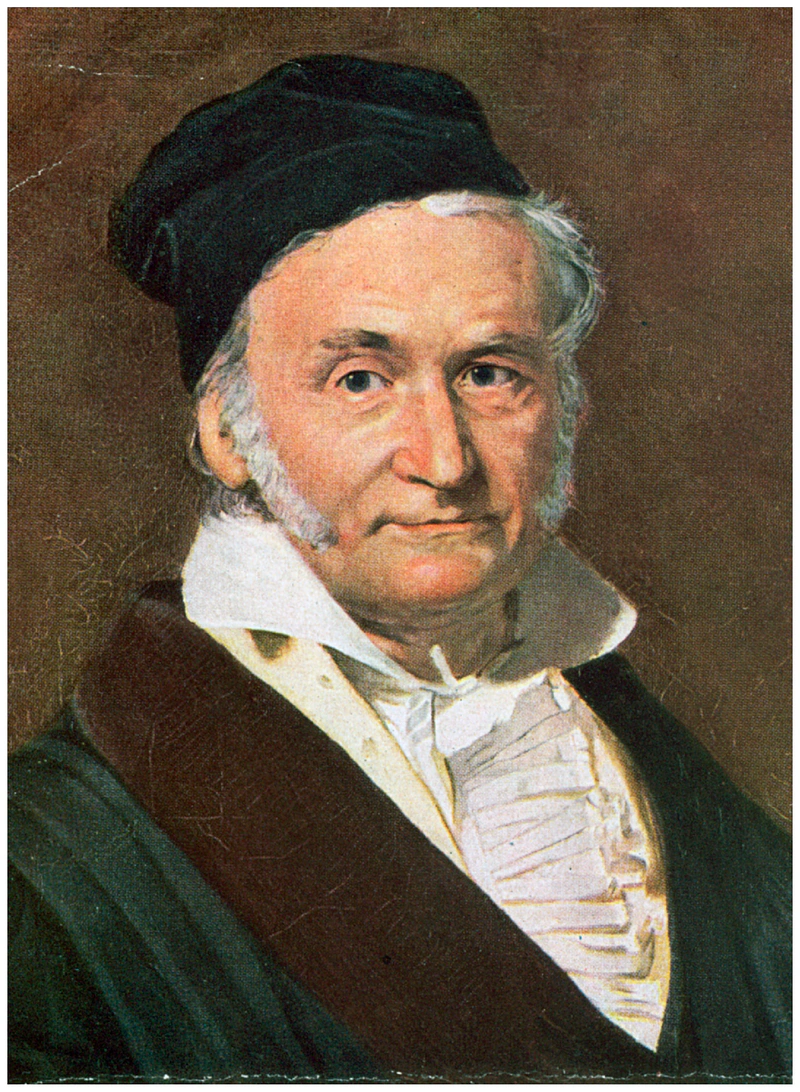
| 17 Quotes | |
| Born as | Johann Carl Friedrich Gauss |
| Known as | Prince of Mathematics; Carl Gauss |
| Occup. | Mathematician |
| From | Germany |
| Born | April 30, 1777 Braunschweig, Duchy of Brunswick |
| Died | February 23, 1855 Goettingen, Kingdom of Hanover |
| Aged | 77 years |
| Cite | |
Citation Formats
APA Style (7th ed.)
Carl friedrich gauss biography, facts and quotes. (2026, February 11). FixQuotes. https://fixquotes.com/authors/carl-friedrich-gauss/
Chicago Style
"Carl Friedrich Gauss biography, facts and quotes." FixQuotes. February 11, 2026. https://fixquotes.com/authors/carl-friedrich-gauss/.
MLA Style (9th ed.)
"Carl Friedrich Gauss biography, facts and quotes." FixQuotes, 11 Feb. 2026, https://fixquotes.com/authors/carl-friedrich-gauss/. Accessed 24 Mar. 2026.
Early Life and Background
Johann Carl Friedrich Gauss was born on 1777-04-30 in Brunswick (Braunschweig), in the Duchy of Brunswick-Wolfenbuettel, a small north German state poised between Enlightenment rationalism and the coming shocks of the French Revolutionary and Napoleonic wars. His father, Gebhard Dietrich Gauss, worked in modest trades and bookkeeping; his mother, Dorothea Benze, was illiterate but remembered for practical intelligence and steady piety. Gauss later cultivated an image of rigorous self-discipline, and the family setting mattered: scarcity made accuracy a moral habit, and early aptitude became not a charm but an obligation.His childhood legends - mental arithmetic performed before schooling, error-free corrections of wage calculations - have been embellished, yet they point to a recognizable temperament: quick pattern recognition fused to impatience with sloppiness. In Brunswick he encountered a culture that could reward talent if it proved useful; the city valued applied calculation for administration, surveying, and trade. The same environment also trained him to distrust empty talk and to prefer results that could survive the harshest audit.
Education and Formative Influences
Gauss attended the Catherineum in Brunswick, where his teacher Johann Georg Buentner and the assistant J.F. Zimmermann helped secure patronage from Duke Carl Wilhelm Ferdinand. That support sent him to the Collegium Carolinum (1792-1795) and then the University of Goettingen (1795-1798), where he chose mathematics over philology and law and began the private notebooks that show his method: long incubation, sudden consolidation, then relentless polishing. In 1796 he discovered the constructibility of the regular 17-gon, and in 1799 he produced a doctoral proof of the fundamental theorem of algebra, early signs that he intended to rebuild arithmetic and analysis from bedrock rather than add ornament to existing edifices.Career, Major Works, and Turning Points
After returning to Brunswick, Gauss completed Disquisitiones Arithmeticae (1801), a masterpiece that reorganized number theory around congruences, quadratic reciprocity, and a unified language for residues; it quickly became the discipline's central reference. In 1807 he accepted the directorship of the Goettingen Observatory, a post that anchored him for life and redirected part of his genius toward astronomy, geodesy, and computation: his orbit determination of Ceres (1801) helped publicize his least squares ideas, later formalized in Theoria motus (1809), while his geodetic surveys of Hanover (1820s-1830s) fed deep work in differential geometry and error theory. Personal losses - the deaths of his first wife Johanna (1809) and later his second wife Minna (1831) - tightened his inwardness; a demanding household and administrative duties encouraged his habit of withholding publication until certainty was complete, leaving much of his most radical thinking (especially on non-Euclidean geometry) to letters and notebooks.Philosophy, Style, and Themes
Gauss worked as if mathematics were both a craft and a moral discipline. He prized the pleasure of pursuit over the vanity of display, insisting that “It is not knowledge, but the act of learning, not possession but the act of getting there, which grants the greatest enjoyment”. That line fits his private workflow: he often delayed writing while ideas matured below the surface, aiming for proofs that felt inevitable rather than merely persuasive. In his hands, elegance was not decoration but compression - the shortest path that still carried the full weight of certainty.His exacting standard of demonstration was famously unforgiving: “I mean the word proof not in the sense of the lawyers, who set two half proofs equal to a whole one, but in the sense of a mathematician, where half proof = 0, and it is demanded for proof that every doubt becomes impossible”. This was psychology as much as epistemology: anxiety about error transmuted into an ethic of total verification, one reason he guarded results until he could see every seam. Yet he also recognized limits to what the human mind can compel, especially in geometry: “I am coming more and more to the conviction that the necessity of our geometry cannot be demonstrated, at least neither by, nor for, the human intellect”. Here Gauss sounds modern - wary of metaphysical certainty, open to alternative geometries, and attentive to the gap between intuitive space and logical systems, even as his public work remained strategically conservative.
Legacy and Influence
Gauss died in Goettingen on 1855-02-23, leaving a body of work that defined whole fields: modern number theory and algebraic integers, least squares and the normal distribution's mathematical infrastructure, potential theory, and the geometry that later bore his name in curvature and the Theorema Egregium. His influence is amplified by what he did not publish: private priority notes seeded later developments in non-Euclidean geometry, elliptic functions, and complex analysis, while his standards helped set the 19th-century ideal of rigor. The epithet "Prince of Mathematicians" endures not as a compliment to speed alone but to a rare combination of internal severity, methodological restraint, and an ability to make disparate problems - from primes to planets to the shape of Earth - speak a single, exact language.Our collection contains 17 quotes written by Carl, under the main topics: Truth - Writing - Learning - Life - Knowledge.
Other people related to Carl: Janos Bolyai (Mathematician)