
Carl Sagan Biography Quotes 24 Report mistakes
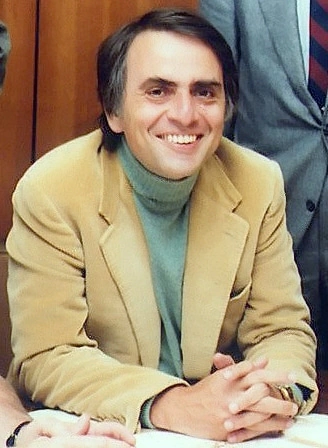
| 24 Quotes | |
| Occup. | Scientist |
| From | USA |
| Born | November 9, 1934 |
| Died | December 20, 1996 |
| Aged | 62 years |
| Cite | |
Citation Formats
APA Style (7th ed.)
Carl sagan biography, facts and quotes. (2026, February 11). FixQuotes. https://fixquotes.com/authors/carl-sagan/
Chicago Style
"Carl Sagan biography, facts and quotes." FixQuotes. February 11, 2026. https://fixquotes.com/authors/carl-sagan/.
MLA Style (9th ed.)
"Carl Sagan biography, facts and quotes." FixQuotes, 11 Feb. 2026, https://fixquotes.com/authors/carl-sagan/. Accessed 4 Mar. 2026.
Early Life and Background
Carl Edward Sagan was born on November 9, 1934, in Brooklyn, New York, to a working-class Jewish family shaped by the American immigrant experience. His father, Sam Sagan, had come to the United States from what is now Ukraine and worked in New Yorks garment trade; his mother, Rachel Molly Gruber Sagan, was known in the family for her fierce intelligence and theatrical spark. The Great Depression and then World War II framed his earliest years, an era that prized practical survival while also unveiling the terrifying new power of science.Sagan later described childhood moments that felt like ignition points: the 1939 New York Worlds Fair, with its promises of a technocratic future, and long visits to the Brooklyn Public Library, where he learned that the universe could be approached as something readable. In a city alive with radio, newspapers, and the first glow of postwar optimism, he absorbed both the grandeur of modernity and its dangers, a dual awareness that never left his work.
Education and Formative Influences
He entered the University of Chicago at sixteen, an environment unusually hospitable to polymaths, and earned degrees in physics and then astronomy and astrophysics (BA 1954; MS 1956). He completed a PhD in astronomy and astrophysics in 1960, working at the intersection of observation, chemistry, and planetary physics at a time when the Space Age was turning speculation into data. Early professional years included Miller Institute work at UC Berkeley and a Harvard appointment; his habits of synthesis were sharpened by mentors and rivals in a field rapidly professionalizing under Cold War funding, where planetary science, radio astronomy, and atmospheric chemistry were becoming central to national prestige.Career, Major Works, and Turning Points
Sagan became a leading interpreter of the Solar System as NASA missions transformed planets from points of light into worlds with weather, geology, and history. He helped show that Venus is blisteringly hot due to a runaway greenhouse effect, developed influential ideas about Titan and the chemistry of lifes origins, and served as a key participant in Mariner, Viking, Voyager, and Galileo-era planning and interpretation, including public-facing explanations that made mission science legible. In 1968 he joined Cornell University, where he built a laboratory culture around comparative planetology and mentored a generation of scientists. Turning points came when he chose not only to publish technical papers but to write for the public: The Cosmic Connection (1973), the Pulitzer-winning The Dragons of Eden (1977), Cosmos (1980) and its landmark television series, and later Pale Blue Dot (1994). Another pivot was political: his research on nuclear winter with colleagues in the early 1980s made him an influential voice in arms-control debates, admired by many and resented by some for crossing the invisible border between scientist and advocate. He died on December 20, 1996, in Seattle, Washington, from complications of myelodysplasia after a bone marrow transplant.Philosophy, Style, and Themes
Sagan wrote as a scientist with a poets ear, building arguments from first principles and then widening them into moral consequence. His favorite move was scale: to place human quarrels against cosmic time, not to belittle life but to clarify what is precious about it. “Who are we? We find that we live on an insignificant planet of a humdrum star lost in a galaxy tucked away in some forgotten corner of a universe in which there are far more galaxies than people”. The sentence is less nihilism than a psychological discipline - a controlled deflation of ego meant to make wonder and responsibility possible in the same breath.Equally central was his insistence that reality, even when indifferent, is a sturdier home than comforting illusion. “For me, it is far better to grasp the Universe as it really is than to persist in delusion, however satisfying and reassuring”. This was an ethical claim about attention: the courage to look, to test, to change ones mind. It underwrote his lifelong campaign against pseudoscience and credulity, later distilled in The Demon-Haunted World (1995), where he argued that skepticism is not cynicism but care for the public mind. He also treated knowledge as cumulative and communal rather than proprietary, compressing cosmology into kitchen-table metaphor: “If you wish to make an apple pie from scratch, you must first invent the universe”. In Sagan, metaphor was not decoration; it was an instrument for turning abstraction into shared mental experience, a way to convert private awe into civic literacy.
Legacy and Influence
Sagan helped define what the scientist could be in late 20th-century America: rigorous researcher, mission architect, and public teacher whose charisma did not cancel his empiricism. He normalized the idea that planetary science is about climate, atmospheres, and habitability as much as craters, and his work on nuclear winter shaped public debate on existential risk. As a communicator, he set the template for modern science outreach - narrative, visual, historically grounded, and morally awake - influencing figures from Neil deGrasse Tyson to entire institutions of public astronomy. His deepest legacy is a cultural stance: that humility before the cosmos can coexist with fierce devotion to human flourishing, and that the habits of scientific thinking are not merely professional tools but democratic necessities.Our collection contains 24 quotes written by Carl, under the main topics: Witty One-Liners - Truth - Love - Deep - Meaning of Life.
Other people related to Carl: Martin Gardner (Mathematician), Steven Squyres (Scientist), Joshua Lederberg (Scientist), Paul Kurtz (Philosopher)
Carl Sagan Famous Works
- 1997 Billions and Billions: Thoughts on Life and Death at the Brink of the Millennium (Book)
- 1995 The Demon-Haunted World: Science as a Candle in the Dark (Book)
- 1994 Pale Blue Dot: A Vision of the Human Future in Space (Book)
- 1985 Contact (Novel)
- 1980 Cosmos (Book)
- 1979 Broca's Brain: Reflections on the Romance of Science (Book)
- 1977 The Dragons of Eden: Speculations on the Evolution of Human Intelligence (Book)
- 1973 Cosmic Connection: An Extraterrestrial Perspective (Book)
Source / external links