
Carlos Alcaraz Biography Quotes 8 Report mistakes
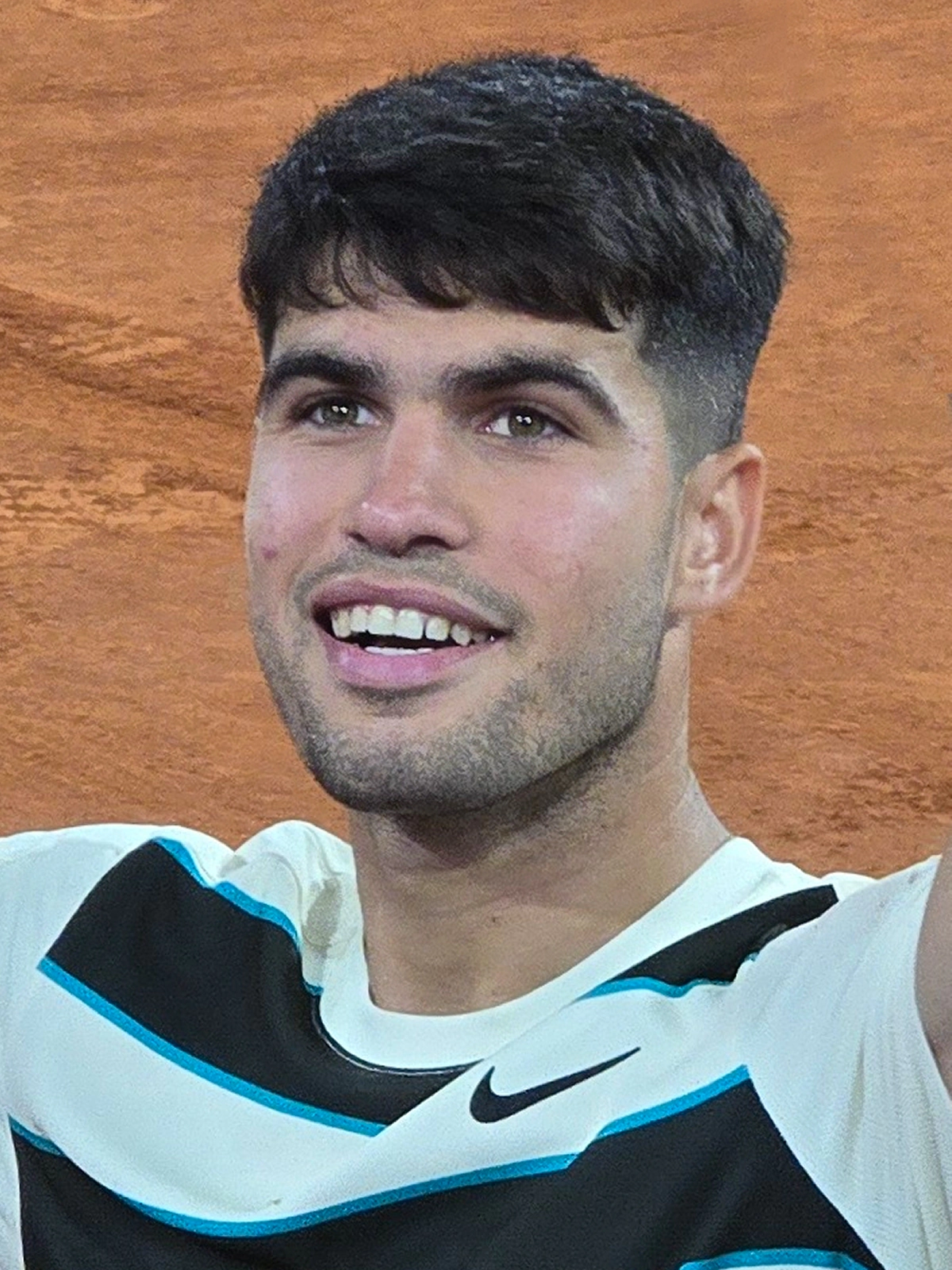
| 8 Quotes | |
| Born as | Carlos Alcaraz Garfia |
| Occup. | Athlete |
| From | Spain |
| Born | May 5, 2003 El Palmar, Murcia, Spain |
| Age | 22 years |
| Cite | |
Citation Formats
APA Style (7th ed.)
Carlos alcaraz biography, facts and quotes. (2026, February 11). FixQuotes. https://fixquotes.com/authors/carlos-alcaraz/
Chicago Style
"Carlos Alcaraz biography, facts and quotes." FixQuotes. February 11, 2026. https://fixquotes.com/authors/carlos-alcaraz/.
MLA Style (9th ed.)
"Carlos Alcaraz biography, facts and quotes." FixQuotes, 11 Feb. 2026, https://fixquotes.com/authors/carlos-alcaraz/. Accessed 22 Mar. 2026.
Early Life and Background
Carlos Alcaraz Garfia was born on May 5, 2003, in El Palmar, a working, sunlit district on the edge of Murcia in southeastern Spain. He grew up in a country where tennis success carried the long shadow of Rafael Nadal and the clay-court culture of the Iberian peninsula, yet his earliest world was local - family routines, schoolmates, and the steady rhythm of training amid orange groves and heat. Tennis was not a glamorous escape so much as a daily craft, learned one repetition at a time.His father, Carlos Alcaraz Gonzalez, had played competitively and later worked at a local tennis club, giving the boy both access and an unromantic view of the sport: courts to sweep, balls to collect, sessions to endure. That environment shaped an inner sturdiness - an ability to treat performance as something earned rather than granted. From a young age he showed a rare combination of speed, coordination, and appetite for problem-solving, traits that would later define him as more than a highlight-maker.
Education and Formative Influences
Alcaraz trained in Murcia before committing to an elite pathway, eventually linking with former world No. 1 Juan Carlos Ferrero, whose academy system in Villena became central to his development. Ferrero offered more than technique - he carried institutional memory from the era when Spanish tennis was remaking itself into a modern, physical, baseline-dominant power. Under that influence, Alcaraz learned to marry discipline with imagination: to use heavy topspin and court coverage without surrendering initiative, and to treat professionalism - nutrition, scheduling, recovery, and emotional control - as part of the game, not an accessory to it.Career, Major Works, and Turning Points
Turning professional as a teenager, Alcaraz rose quickly through the ATP ranks with a style that made him must-watch: explosive acceleration, ferocious forehands, and an instinct for changing patterns mid-point. His breakout accelerated in 2021-2022, when he began winning at the highest levels and proved his stamina in long matches against elite opposition. In 2022 he captured the US Open and became the youngest man to reach world No. 1 in the ATP rankings, a landmark that announced Spain had not only an heir to its tennis tradition but a new kind of all-court threat. Subsequent seasons tested his body and calendar with injuries and intense expectations, yet he continued to stack major titles - including Wimbledon and Roland Garros - while building a rivalry ecosystem defined by the post-Big Three era and the sport's search for its next dominant narrative.Philosophy, Style, and Themes
Alcaraz plays like someone taught to attack without panicking. His tennis is built on first-step speed and a willingness to take the ball early, but its deeper engine is choice: the drop shot as a psychological probe, the sudden net rush as an assertion of agency, the willingness to change height and spin to break an opponents certainty. Behind the showmanship is a practical mind that treats matches as moving puzzles. His best stretches reveal an athlete who does not merely impose pace; he manipulates attention, luring opponents forward and then turning defense into offense in a single sprint.The inner life he projects is unusually explicit for a young star: improvement as identity, joy as a performance tool, character as a long-term goal. “I'm not obsessed with being the best in the world. I'm obsessed with improving every day”. That sentence frames his emotional economy - pressure becomes information, not a verdict. “I try to enjoy. If I'm enjoying, I play my best tennis”. Enjoyment here is not leisure; it is his trigger for freedom, the state where instinct and training merge. And the ethic underneath the competitor is social as much as sporting: “I want to be a good person, not just a good tennis player”. In an era that monetizes persona, he has tried to keep the private compass visible, suggesting that resilience is easier when success is not the only measure of self.
Legacy and Influence
Alcaraz has already helped define mens tennis after the Nadal-Djokovic-Federer epoch by demonstrating that modern dominance can include variety, risk, and warmth rather than pure attrition. For Spanish sport, he extends a lineage of grit while widening its aesthetic, showing younger players that a Mediterranean baseline education can coexist with improvisation at the net and on the return. His enduring influence may be less about statistics - though the milestones are historic - than about the model he offers: a champion who treats growth as the point, competition as a craft, and fame as secondary to the work that happens, quietly, between matches.Our collection contains 8 quotes written by Carlos, under the main topics: Motivational - Ethics & Morality - Learning - Sports - Learning from Mistakes.
Source / external links