
Caspar Weinberger Biography Quotes 4 Report mistakes
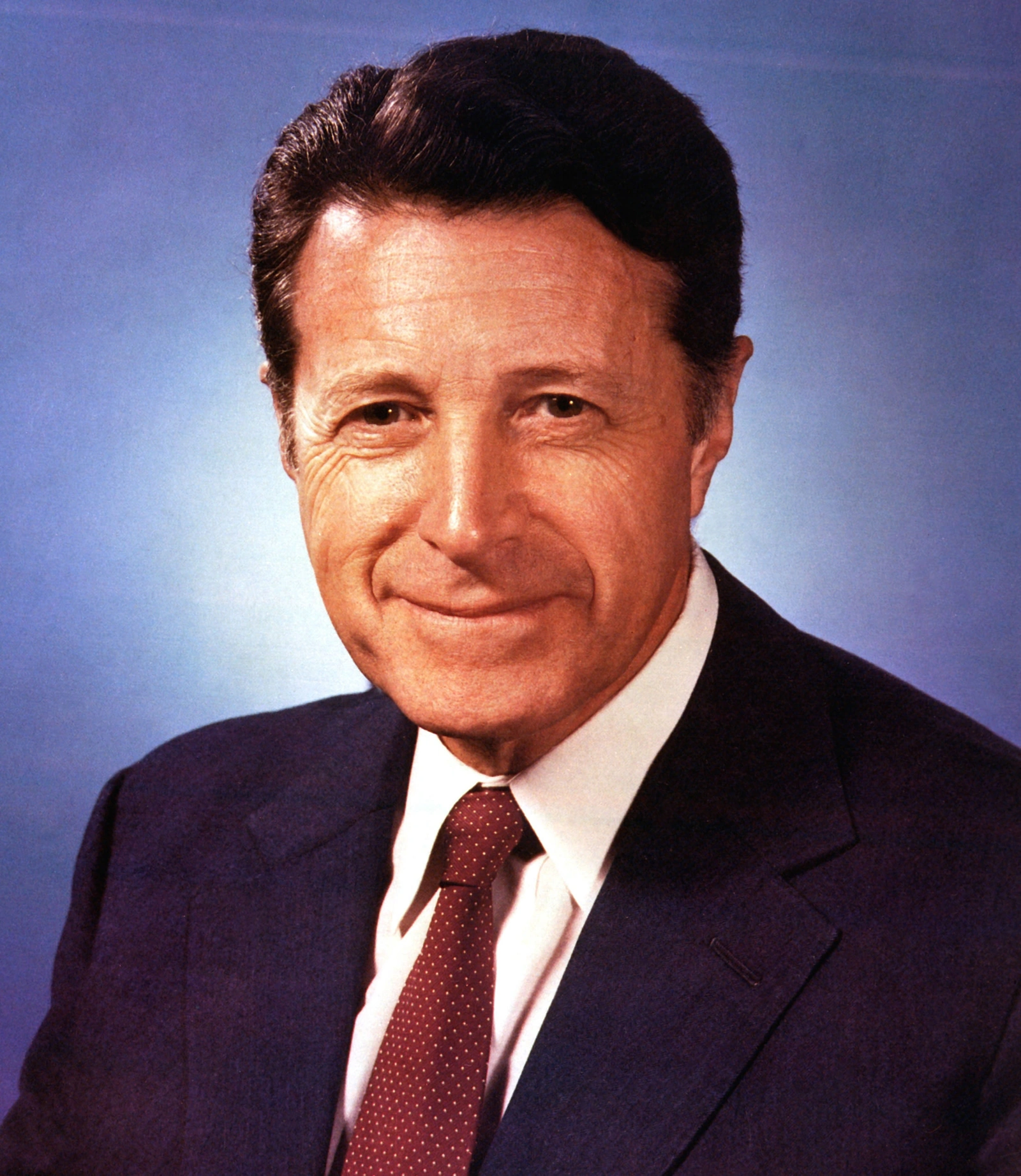
| 4 Quotes | |
| Born as | Caspar Willard Weinberger |
| Occup. | Public Servant |
| From | USA |
| Born | August 18, 1917 San Francisco, California, USA |
| Died | March 28, 2006 Bangor, Maine, USA |
| Cause | Complications of pneumonia |
| Aged | 88 years |
| Cite | |
Citation Formats
APA Style (7th ed.)
Caspar weinberger biography, facts and quotes. (2026, February 11). FixQuotes. https://fixquotes.com/authors/caspar-weinberger/
Chicago Style
"Caspar Weinberger biography, facts and quotes." FixQuotes. February 11, 2026. https://fixquotes.com/authors/caspar-weinberger/.
MLA Style (9th ed.)
"Caspar Weinberger biography, facts and quotes." FixQuotes, 11 Feb. 2026, https://fixquotes.com/authors/caspar-weinberger/. Accessed 12 Feb. 2026.
Early Life and Education
Caspar Willard Weinberger, widely known as Cap, was born in San Francisco in 1917 and became one of the most prominent American public servants of the late twentieth century. He attended Harvard College, graduating in 1938, and continued on to Harvard Law School, completing his degree in 1941. The rigorous academic training he received at Harvard shaped a disciplined legal and analytical approach that he later brought to state government, federal regulatory work, and defense policy. Even early in life, his interests ranged from literature and history to the nuts and bolts of budgets and administration, a combination that would mark his career as both manager and strategist.Military Service
With the United States entering World War II, Weinberger joined the U.S. Army, serving in the Pacific theater. His wartime experience, including staff and intelligence responsibilities and the demands of coordinating complex operations, left a lasting imprint on his view of national defense and the need for readiness. He left military service with a strong belief that clear objectives, adequate resources, and careful planning were essential prerequisites to sending Americans into harm's way.California Politics and Reputation as a Budget Reformer
After the war, Weinberger practiced law and entered public service in California. He won election to the California State Assembly in the 1950s, representing a San Francisco district. Colleagues and journalists noticed his facility with numbers and his insistence on scrutinizing expenditures line by line. That reputation deepened when he took on statewide responsibilities and later joined the administration of Governor Ronald Reagan, where he served as California's director of finance. In Sacramento he earned the sobriquet "Cap the Knife" for his efforts to pare back spending and impose managerial discipline, and he cultivated a close working relationship with Reagan and several of the governor's top aides. Those experiences cemented his status in Republican policy circles as a principled budget cutter who nonetheless understood the practicalities of governing.National Roles under Presidents Nixon and Ford
Weinberger moved to Washington at the start of the 1970s. President Richard Nixon tapped him for senior posts, including chairman of the Federal Trade Commission, where he pursued administrative modernization and enforcement consistency, and director of the Office of Management and Budget, where he applied his fiscal rigor to the federal ledger. He later served as Secretary of Health, Education, and Welfare, managing one of the government's largest departments during a period of rapidly expanding social programs. In these roles he worked with senior officials such as George Shultz, who also held economic and Cabinet positions during that era, and with congressional leaders across the aisle, building a reputation as an effective manager and administrator. When he left government in the mid-1970s, he carried with him a record of technocratic competence and a network that spanned the regulatory, budgetary, and social policy domains.Private Sector Interlude
After his early Washington service, Weinberger spent several years in the private sector, including a senior role with a major engineering and construction firm. The corporate experience broadened his perspective on international business, large-scale project management, and the intersection of global markets with technology and infrastructure. It also kept him connected to debates over energy, trade, and the financial implications of federal policy choices.Secretary of Defense under President Reagan
Weinberger returned to Washington in 1981 as Secretary of Defense under President Ronald Reagan, a post he held until 1987. He arrived with a mandate for rebuilding U.S. military strength after a period of perceived decline. Working with other key figures in the administration, including Secretary of State Alexander Haig and later George Shultz, National Security Advisor William P. Clark, CIA Director William J. Casey, Navy Secretary John Lehman, and senior Pentagon leaders such as General John Vessey Jr. and Admiral William J. Crowe, he presided over a far-reaching defense modernization.He championed revitalization across the services: strategic nuclear forces modernization, the deployment of the Trident submarine and its missiles, the reintroduction of the B-1 bomber program, and the development and testing associated with the Strategic Defense Initiative. He supported a larger Navy, backed by Lehman's maritime strategy, and emphasized training, readiness, and maintenance to ensure that expanded budgets translated into operational capability. These moves were intertwined with diplomacy. The deployment of intermediate-range missiles in Europe under NATO's dual-track decision, combined with arms control talks championed by Reagan and Shultz, framed negotiations with Soviet leaders, culminating in breakthroughs after Mikhail Gorbachev came to power. Weinberger remained a consistent advocate for negotiating from strength, and he worked closely with allies, notably Prime Minister Margaret Thatcher and other NATO defense ministers, to maintain cohesion during contentious debates over deployments.
His tenure encompassed crises that tested civil-military decision-making: the 1983 Beirut barracks bombing, which prompted reassessments of the scope and rules governing Marine deployments; the 1983 U.S.-led intervention in Grenada; and the 1986 air strikes against Libya. These episodes required close coordination within the administration and with Congress. Weinberger emphasized clear objectives and exit strategies, principles he articulated publicly and in later writings.
Controversy and Departure
Late in the Reagan years, the Iran-Contra affair roiled Washington. Although Weinberger had often argued for strict adherence to law and process in national security matters, he became entangled in the investigations. In 1992, after he had long since left the Pentagon, an independent counsel indicted him on charges related to congressional testimony and document handling. He denied wrongdoing and planned to contest the charges in court. President George H. W. Bush issued a pardon in December 1992, halting the case. The episode remained a point of contention among his critics and defenders, with some citing it as evidence of systemic failures in oversight and others viewing the pardon as recognition of his service and intentions.Later Career, Writing, and Honors
In the years after his Pentagon service, Weinberger remained active in public debate. He wrote on defense and foreign policy, including a memoir of his Pentagon years that laid out his principles for the use of force and his view of the strategic competition that preceded the end of the Cold War. He also collaborated on a work of speculative military analysis that explored potential future conflicts and technological change. In the private sector he held leadership and advisory roles, including in publishing, which amplified his voice on national security and economic issues.Weinberger received high honors reflecting his status among allies and at home. He was awarded the Presidential Medal of Freedom, and the United Kingdom conferred on him an honorary knighthood in recognition of his contributions to the transatlantic alliance. These decorations, alongside numerous honorary degrees and professional awards, underscored the breadth of his influence as both manager and strategist.
Personal Life and Character
Weinberger married Jane Dalton, whose own work as an author and advocate complemented his public life. Friends and colleagues often described him as disciplined, private, and meticulous, with a wry sense of humor that surfaced in unguarded moments. He prized loyalty to institutions and the importance of strong alliances, convictions that shaped his dealings with figures such as Reagan, Shultz, Thatcher, and senior military officers who served alongside him. He preferred careful staff work and insisted on thorough briefings, habits that reflected his training as a lawyer and his wartime appreciation for preparation.Legacy
Caspar Weinberger's legacy rests on three pillars. First, he was a distinctive steward of public finances and bureaucratic systems, from Sacramento to Washington, with a capacity to translate broad goals into practical administrative actions. Second, as Secretary of Defense, he was central to the 1980s military buildup that affected the final phase of the Cold War, working in tandem with Reagan, Shultz, Lehman, and allied leaders to combine strength with diplomacy. Third, his experience highlights the tensions inherent in national security policymaking: the necessity of secrecy and speed versus the demands of law, oversight, and public accountability. He died in 2006 in Maine, leaving a record that continues to inform debates about the size, scope, and purposes of American power, and about the standards that should govern the decision to use force.Our collection contains 4 quotes written by Caspar, under the main topics: Ethics & Morality - Military & Soldier - Honesty & Integrity - War.
Other people related to Caspar: Colin Powell (Statesman), George Schultz (Public Servant), Ike Skelton (Politician), Frank Carlucci (Politician), Edwin Meese (Public Servant), Richard V. Allen (Public Servant), John W. Vessey, Jr. (Soldier), John Poindexter (Public Servant), John F. Lehman, Jr. (Businessman), Jeane Kirkpatrick (Diplomat)