
Cesare Pavese Biography Quotes 25 Report mistakes
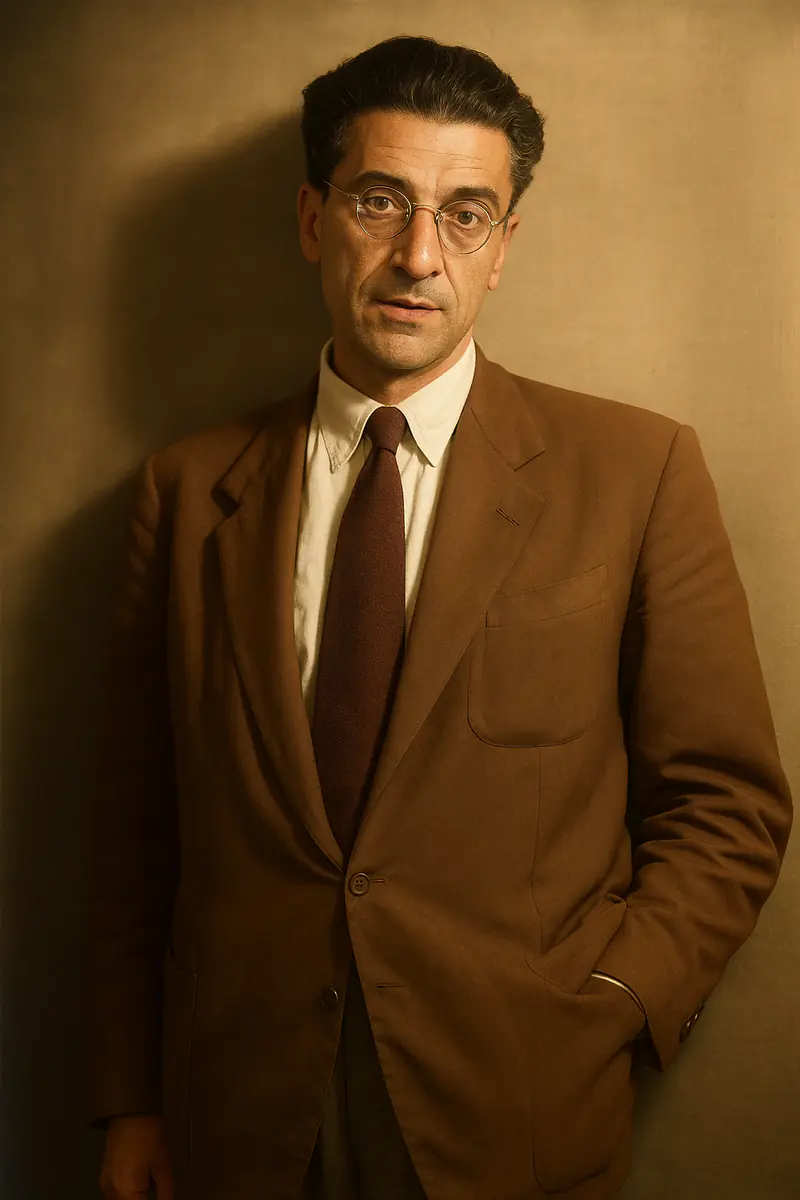
| 25 Quotes | |
| Occup. | Poet |
| From | Italy |
| Born | September 9, 1908 Santo Stefano Belbo, Piedmont, Italy |
| Died | August 27, 1950 Turin, Italy |
| Cause | suicide (barbiturate overdose) |
| Aged | 41 years |
Cesare Pavese was born on 1908-09-09 in Santo Stefano Belbo, a small town in the Langhe hills of Piedmont, Italy, a landscape of vineyards, riverbeds, and hard seasonal labor that would become his private myth. His father, a judicial official, died when Pavese was still a boy, leaving a household ruled by his mother, a woman remembered as severe and practical. The early loss and the resulting domestic austerity hardened his inwardness: he learned to live in observation, storing details of places and gestures the way others stored consolation.
As a child and adolescent he moved between the rural Langhe and the city of Turin, absorbing the contrast between peasant endurance and urban modernity. Italy in Pavese's youth was tightening under Fascism, with public speech constrained and private life pushed toward conformity. In that climate, his temperament - shy, exacting, hungry for meaning, and quick to self-accusation - found refuge in books and in an idea of literature as both disguise and confession.
Education and Formative Influences
In Turin he studied at the University of Turin, completing a thesis on Walt Whitman and gravitating toward the citys anti-Fascist intellectual circles. He was formed by American literature (Whitman, Melville, Sinclair Lewis, later Dos Passos and Steinbeck), which he translated with a feel for colloquial force, and by Italian modernists who treated the self as a problem rather than a given. Turin between the wars was also the seat of the Einaudi milieu, where editorial work, clandestine politics, and aesthetic argument mingled; for Pavese, those rooms and friendships supplied a community he desired but never fully trusted.
Career, Major Works, and Turning Points
Pavese became a central figure at Giulio Einaudi Editore, editing and translating while writing poems and prose that fused autobiography with emblem. Arrested in 1935 in a Fascist sweep because of associations with an anti-Fascist woman and circle, he was sentenced to internal exile in Brancaleone Calabro; the experience sharpened his sense of separation and produced the notebook discipline that later fed his journals. Returning to Turin, he published the poetry collection Lavorare stanca (1936), whose plainspoken rhythms made labor, desire, and boredom into modern subjects, and after the war he turned increasingly to narrative: Dialoghi con Leuco (1947), a sequence of mythic conversations probing fate and sexuality; the novel Il compagno (1947) with its political disillusion; the Langhe novel La casa in collina (1948) and the morally bruised war vision of Prima che il gallo canti (1949). In 1950 he won the Premio Strega for La bella estate, yet the accolade coincided with a deepening crisis after a painful love affair and the exhaustion of postwar hopes; he died by suicide on 1950-08-27 in a Turin hotel, leaving behind his journal Il mestiere di vivere as an afterimage of a mind arguing with itself to the end.
Philosophy, Style, and Themes
Pavese wrote as if experience were never raw but always already arranged into symbols: the hill, the river, the city street at dusk, the woman glimpsed and lost. His realism is therefore double - social on the surface, archetypal underneath - and his most characteristic stance is the observer who wants intimacy but cannot endure its cost. That psychology surfaces in his pitiless aphorisms, where tenderness is framed as a wound that keeps reopening. "Life is pain and the enjoyment of love is an anesthetic". The sentence is not merely bleak; it shows his way of handling emotion: to name it clinically is to keep it at a distance, and to admit that love helps is also to confess dependence.
Memory, for Pavese, is both salvation and trap - the only continuity he trusts, and the very mechanism that prevents renewal. He returns obsessively to childhood places not as nostalgia but as the laboratory where desire first learned its language. "We do not remember days, we remember moments". In his poems and in La luna e i falo (published posthumously in 1950), moments become talismans that can be reread like myths, yet they also accuse the present of falling short. Even his understanding of maturity is shaped by the suspicion that speech cannot cure loneliness: "One stops being a child when one realizes that telling one's trouble does not make it any better". The line condenses the ethic of his style - spare, unsentimental, and exact - as if clarity were a moral obligation when comfort is unreliable.
Legacy and Influence
Pavese endures as one of the key Italian voices to translate the psychological wreckage of the Fascist era and the moral ambiguity of the Resistance into literature without propaganda or consolation. His hybrid of neorealist attention and mythic structure influenced postwar fiction and poetry, and his editorial work at Einaudi helped shape a canon for modern Italy while opening Italian readers to American narrative energies. Il mestiere di vivere remains a touchstone for writers and readers confronting depression, desire, and artistic discipline, not because it romanticizes despair but because it documents, with unnerving lucidity, how a mind can be brilliant at interpretation and still fail at living.
Our collection contains 25 quotes who is written by Cesare, under the main topics: Ethics & Morality - Wisdom - Truth - Meaning of Life - Learning.
Frequently Asked Questions
- Cesare Pavese Occupation: Novelist, poet, short story writer, translator, literary critic, essayist
- Cesare Pavese pronunciation: CHEH-zah-ray pah-VEH-zeh (IPA: ˈtʃeːzare paˈveːze)
- How did Cesare Pavese die: Suicide by barbiturate overdose
- Cesare Pavese born: 9 September 1908, Santo Stefano Belbo, Italy
- Cesare Pavese death: 27 August 1950, Turin, Italy
- Cesare Pavese poems: Lavorare stanca (Hard Labor); Verrà la morte e avrà i tuoi occhi; I mari del Sud
- Cesare Pavese books: The Moon and the Bonfires; The Beautiful Summer; The House on the Hill; The Devil in the Hills; Dialogues with Leucò; Among Women Only
- How old was Cesare Pavese? He became 41 years old
Cesare Pavese Famous Works
- 1952 Il mestiere di vivere (Memoir)
- 1951 Verrà la morte e avrà i tuoi occhi (Poetry)
- 1950 La luna e i falò (Novel)
- 1949 Tra donne sole (Collection)
- 1948 La casa in collina (Novel)
- 1947 Dialoghi con Leucò (Collection)
- 1946 Feria d'agosto (Collection)
- 1936 Lavorare stanca (Poetry)
Source / external links