
Charles Bukowski Biography Quotes 168 Report mistakes
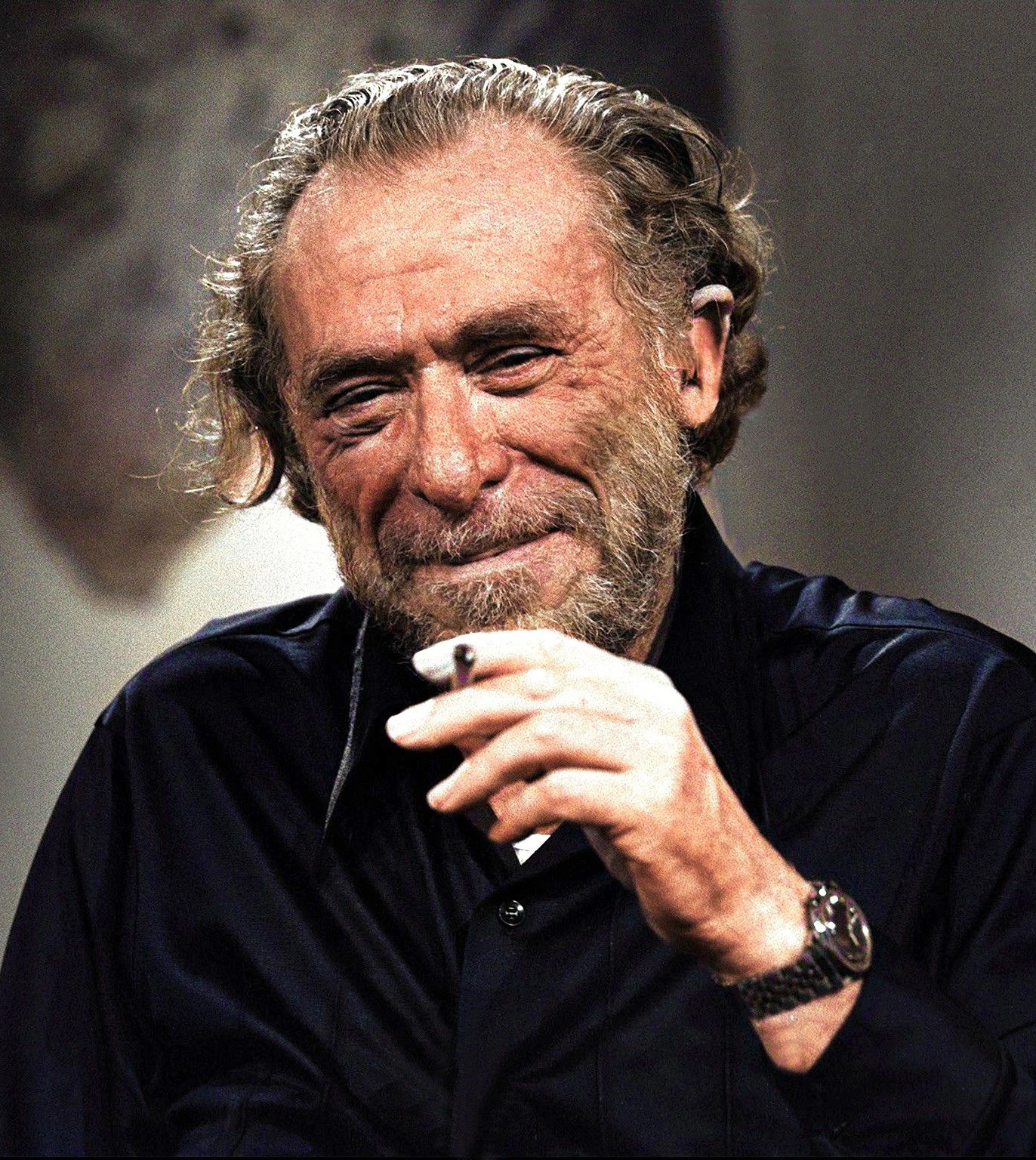
| 168 Quotes | |
| Born as | Heinrich Karl Bukowski |
| Occup. | Poet |
| From | USA |
| Spouses | Barbara Frye (1957-1959) Linda Lee Beighle (1985) |
| Born | August 16, 1920 Andernach, Rhineland-Palatinate, Germany |
| Died | March 9, 1994 Los Angeles, California, United States |
| Cause | Leukemia |
| Aged | 73 years |
| Cite | |
Citation Formats
APA Style (7th ed.)
Charles bukowski biography, facts and quotes. (2026, February 11). FixQuotes. https://fixquotes.com/authors/charles-bukowski/
Chicago Style
"Charles Bukowski biography, facts and quotes." FixQuotes. February 11, 2026. https://fixquotes.com/authors/charles-bukowski/.
MLA Style (9th ed.)
"Charles Bukowski biography, facts and quotes." FixQuotes, 11 Feb. 2026, https://fixquotes.com/authors/charles-bukowski/. Accessed 25 Mar. 2026.
Early Life and Background
Charles Bukowski was born Heinrich Karl Bukowski on 1920-08-16 in Andernach, Germany, to Heinrich Bukowski, an American soldier stationed after World War I, and Katharina Fett. In 1923, amid inflation and instability in Weimar Germany, the family emigrated to the United States and settled in Los Angeles. The dislocation marked him early: he would grow up speaking the language of outsiders - immigrants, the poor, the mocked - and later turn that estrangement into a deliberate literary posture.In South Central Los Angeles during the Depression, he endured a household ruled by his father's harsh discipline and a neighborhood pecking order shaped by money, accent, and toughness. Adolescence brought severe acne (and the humiliation that followed), long hours in public libraries, and an early sense that respectable life was a rigged game. Los Angeles, with its storefront churches, racetracks, boarding houses, and back-alley economies, became his lifelong stage - not the Hollywood of dreams, but the city of rent due, cheap beer, and men who took whatever work they could.
Education and Formative Influences
Bukowski attended Los Angeles City College intermittently in the late 1930s and early 1940s, studying journalism, art, and literature while drifting through low-wage jobs. He absorbed the American hard-boiled line - Ernest Hemingway's compression, John Fante's raw Los Angeles intimacy, and the punchy rhythms of H.L. Mencken and the newspaper column. World War II-era America, with its conformity and suspicion, sharpened his contrarian streak; a brief detention by the FBI in 1944, after he failed to report for a draft physical, reinforced his instinct to keep institutions at arm's length and to treat authority as a kind of theater.Career, Major Works, and Turning Points
After early stories in small magazines, he quit writing for nearly a decade in the late 1940s, sinking into heavy drinking and a circuit of rooming houses, factories, and skid-row nights that would later supply his most vivid material. In the late 1950s he returned with poems published widely in mimeographed journals; a 1955 hospitalization for a bleeding ulcer forced him to confront mortality and re-commit to the page. The major turn came in 1969 when he left his job at the U.S. Post Office in Los Angeles to write full-time, backed by publisher John Martin at Black Sparrow Press; that wager produced the novel Post Office (1971), the further autobiographical run of Factotum (1975), Women (1978), and Ham on Rye (1982), as well as the long-running newspaper column "Notes of a Dirty Old Man". By the 1970s and 1980s he had become both cult hero and international best-seller, reading to crowds who wanted the myth and receiving enough money to make the later work wrestle - sometimes uneasily - with comfort, fame, and repetition.Philosophy, Style, and Themes
Bukowski's style fused plain speech, comic brutality, and sudden lyrical clarity. He wrote as if confession were a tool for accuracy rather than penance: the goal was not self-improvement but unblinking record-keeping. The recurring narrator - half stand-up comic, half wounded child - uses drinking, sex, and gambling not as glamour but as anesthesia, and the prose and poems keep testing whether numbness can be mistaken for freedom. His best work turns ugliness into a moral instrument: if life is going to be degraded, the writing will refuse to beautify it.Under the swagger, his psychology is built around vigilance against soul-loss. “If you're losing your soul and you know it, then you've still got a soul left to lose”. That sentence is Bukowski's self-diagnosis: the awareness of corrosion becomes the last proof of interior life, and his work keeps circling back to that thin remaining core. His mistrust of politics and public virtue is similarly defensive: “The difference between a democracy and a dictatorship is that in a democracy you vote first and take orders later; in a dictatorship you don't have to waste your time voting”. The bitterness is not merely ideological; it is the voice of someone who expects systems to grind the individual down, and who therefore bets on private honesty over collective promises. Yet he also leaves a countermelody of self-preservation that complicates the caricature of nihilism: “If you have the ability to love, love yourself first”. In Bukowski, that is less pop comfort than survival tactic - an argument that a damaged person must build a minimal shelter inside the self before any tenderness can be sustained.
Legacy and Influence
Bukowski died on 1994-03-09 in San Pedro, California, after being diagnosed with leukemia, and he was buried in Los Angeles County. His influence runs through late-20th-century American poetry and prose as a permission slip: to write in the vernacular, to treat working life as worthy subject, to mix comedy with despair, and to make the self both specimen and storyteller. He helped reshape the small-press ecosystem, proved that poems could sell to non-academic audiences, and left a model - imitated and often diluted - of the artist as unvarnished witness to the daily humiliations of modern urban life.Our collection contains 168 quotes written by Charles, under the main topics: Witty One-Liners - Ethics & Morality - Funny - Truth - Wisdom.
Other people related to Charles: Bernard Pivot (Journalist), Matt Dillon (Actor), Ben Gazzara (Actor)
Charles Bukowski Famous Works
- 1994 Pulp (Novel)
- 1989 Hollywood (Novel)
- 1982 Ham on Rye (Novel)
- 1978 Women (Novel)
- 1977 Love is a Dog From Hell (Poetry Collection)
- 1975 Factotum (Novel)
- 1971 Post Office (Novel)
Source / external links