
Charles de Gaulle Biography Quotes 50 Report mistakes
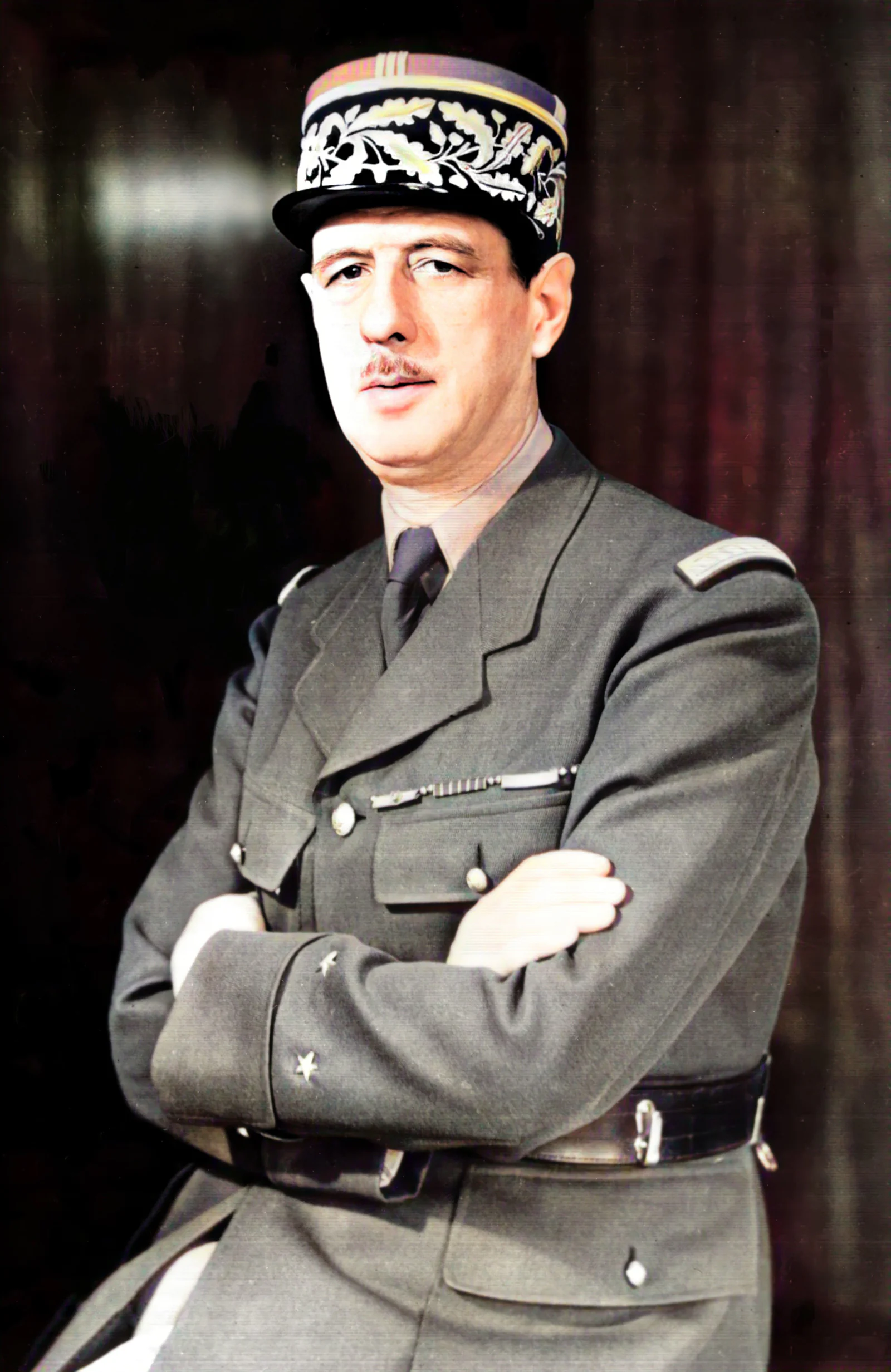
| 50 Quotes | |
| Born as | Charles André Joseph Marie de Gaulle |
| Occup. | Leader |
| From | France |
| Spouse | Yvonne de Gaulle |
| Born | November 22, 1890 Lille, Nord, France |
| Died | November 9, 1970 Colombey-les-Deux-Églises, Haute-Marne, France |
| Cause | Natural causes |
| Aged | 79 years |
| Cite | |
Citation Formats
APA Style (7th ed.)
Charles de gaulle biography, facts and quotes. (2026, February 2). FixQuotes. https://fixquotes.com/authors/charles-de-gaulle/
Chicago Style
"Charles de Gaulle biography, facts and quotes." FixQuotes. February 2, 2026. https://fixquotes.com/authors/charles-de-gaulle/.
MLA Style (9th ed.)
"Charles de Gaulle biography, facts and quotes." FixQuotes, 2 Feb. 2026, https://fixquotes.com/authors/charles-de-gaulle/. Accessed 26 Mar. 2026.
Early Life and Background
Charles Andre Joseph Marie de Gaulle was born on November 22, 1890, in Lille, into a devout, patriotic Catholic family whose identity was shaped by the trauma of 1870 and the lost provinces. His father, Henri de Gaulle, taught literature and history and steeped his children in a cultivated, argumentative household where France was discussed as a moral idea as much as a state. Tall, cerebral, and inwardly severe, Charles grew up with a precocious sense of destiny and a taste for solitary reading that fed both confidence and a lifelong impatience with mediocrity.The France of his boyhood was the Third Republic - parliamentary, scandal-prone, and divided by the Dreyfus Affair, secularism, and class conflict. De Gaulle absorbed these fractures as evidence that national grandeur could be squandered by faction. Family summers and northern landscapes formed his memory of a rooted, provincial France, but his imagination was already oriented toward national command: he wanted to serve France not as a technician of power, but as the embodiment of continuity when institutions faltered.
Education and Formative Influences
He entered Saint-Cyr in 1909 and graduated in 1912, choosing the infantry and the 33rd Regiment under Colonel Philippe Petain, then a rising figure of tactical realism. World War I made his temperament: wounded at Dinant (1914), cited for bravery, and captured at Verdun in 1916, he endured repeated failed escape attempts and years of captivity, using books, debate, and disciplined routine to master himself. The humiliation of defeat and the spectacle of industrial war taught him that modern conflict required both material strength and strategic imagination - lessons he later pressed against conservative orthodoxies in the interwar army.Career, Major Works, and Turning Points
Between the wars he served in Poland, worked in military staffs, and wrote as a soldier-intellectual: Le fil de l'epee (1932) argued that leadership is an art of character under uncertainty, while Vers l'armee de metier (1934) urged professional armored forces and mobile doctrine, ideas only partially heeded before 1940. That collapse - and the armistice embraced by the Vichy regime - became his defining rupture. From London he issued the Appeal of 18 June 1940 and slowly constructed Free France, then the provisional government that restored republican legitimacy at liberation. Resigning in 1946 when party politics reasserted itself, he waited in political exile until the Algerian crisis and the breakdown of Fourth Republic authority brought him back in 1958. He founded the Fifth Republic with a strong presidency, ended the Algerian War through the Evian Accords (1962), weathered assassination attempts and the shock of May 1968, and resigned after losing a 1969 referendum, dying at Colombey-les-Deux-Eglises on November 9, 1970.Philosophy, Style, and Themes
De Gaulle thought in centuries and spoke in symbols. His politics were not a program so much as a drama of sovereignty: France must decide for itself, command its armed forces, and keep the state standing above parties. His disdain for political caste was blunt - “I have come to the conclusion that politics are too serious a matter to be left to the politicians”. Psychologically, the line reveals both contempt and a protective instinct: he trusted institutions only when they were animated by duty, and he trusted men only when they rose above interest to serve an idea.His style joined austerity to irony, distance to theatrical timing, as if the mask of authority could summon authority into being. He could puncture vanity with a veteran's fatalism - “The graveyards are full of indispensable men”. - yet he built a constitutional system that made the presidency indispensable in practice. The tension was characteristic: he wanted a state strong enough to outlast individuals, but he believed crisis demanded a voice that could incarnate France. That is why independence, especially strategic and nuclear autonomy, became a moral category for him - “No country without an atom bomb could properly consider itself independent”. Underneath the doctrine lay a fear of subordination, born from 1940 and disciplined into policy: withdraw from NATO's integrated command (1966), pursue an independent deterrent, and treat alliances as instruments rather than destinies.
Legacy and Influence
De Gaulle left a durable architecture - the Fifth Republic, a model of executive-centered stability - and a vocabulary in which "grandeur" meant national agency rather than mere pride. His wartime leadership supplied France with a narrative of resistance that tempered the shame of occupation, even as historians later complicated the myth. Internationally he proved that a middle power could play above its weight through institutional design, diplomatic audacity, and strategic deterrence; domestically he set the standard for a certain French presidential role: elevated, solitary, and accountable directly to the people. Admired and contested in equal measure, he remains the modern benchmark for political authority in France - a figure who treated history not as backdrop, but as a demanding interlocutor.Our collection contains 50 quotes written by Charles, under the main topics: Witty One-Liners - Motivational - Wisdom - Sarcastic - Mortality.
Other people related to Charles: Harold Macmillan (Politician), Jacques Maritain (Philosopher), Yousuf Karsh (Photographer), Jean Moulin (Activist), Edward Heath (Leader), Raymond Aron (Philosopher), Frederick Forsyth (Author), Francois Mitterrand (Statesman), Diana Cooper (Celebrity), Adolfo Lopez Mateos (Statesman)
Charles de Gaulle Famous Works
- 1954 The War Memoirs (Book)
- 1934 The Army of the Future (Book)
- 1932 The Edge of the Sword (Book)