
Charles Eames Biography Quotes 16 Report mistakes
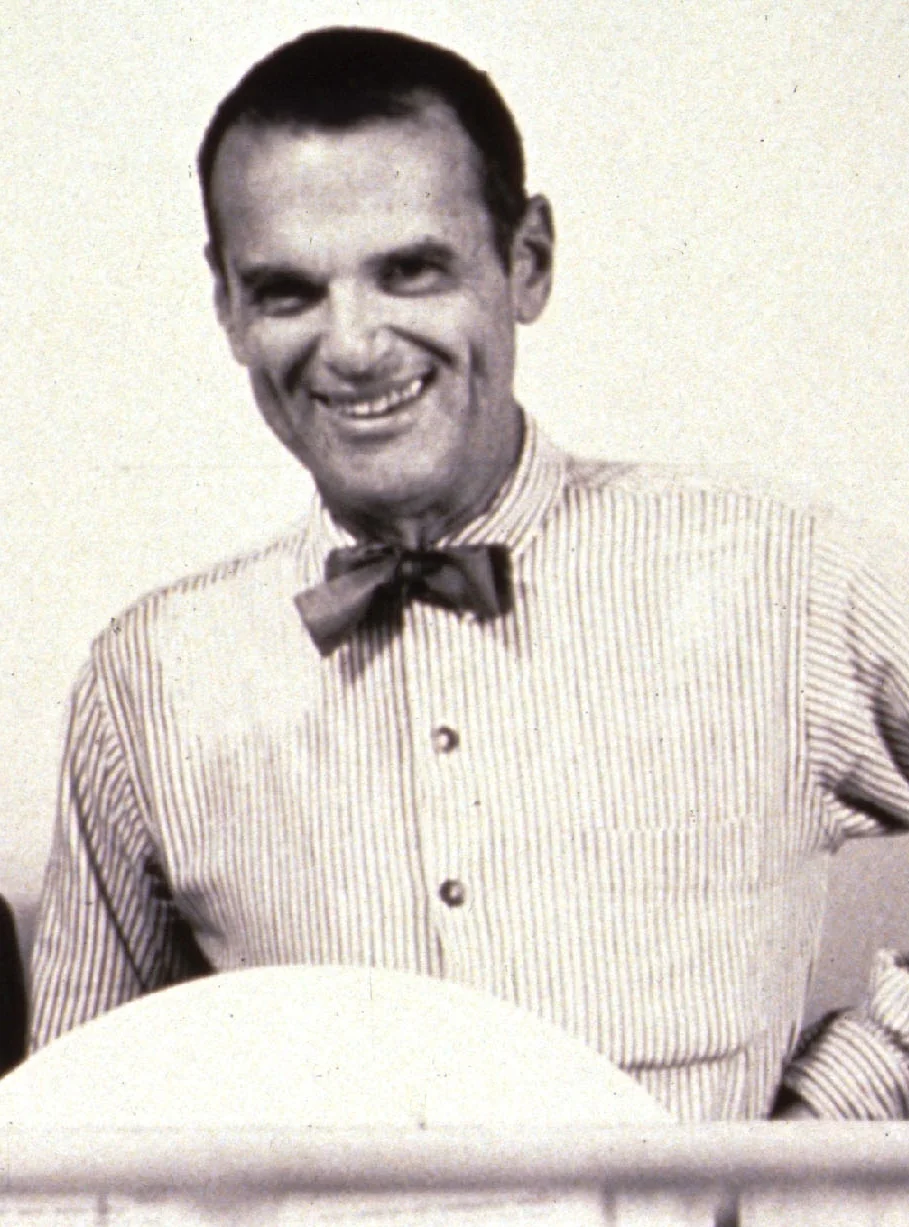
| 16 Quotes | |
| Born as | Charles Ormond Eames, Jr |
| Occup. | Designer |
| From | USA |
| Born | June 17, 1907 St. Louis, Missouri |
| Died | August 21, 1978 |
| Aged | 71 years |
| Cite | |
Citation Formats
APA Style (7th ed.)
Charles eames biography, facts and quotes. (2026, February 1). FixQuotes. https://fixquotes.com/authors/charles-eames/
Chicago Style
"Charles Eames biography, facts and quotes." FixQuotes. February 1, 2026. https://fixquotes.com/authors/charles-eames/.
MLA Style (9th ed.)
"Charles Eames biography, facts and quotes." FixQuotes, 1 Feb. 2026, https://fixquotes.com/authors/charles-eames/. Accessed 6 Mar. 2026.
Early Life and Background
Charles Ormond Eames, Jr. was born on June 17, 1907, in St. Louis, Missouri, a river-and-rail city where manufacturing, advertising, and architecture offered a daily lesson in how objects entered modern life. His father worked in railroad-related sales, and the young Eames absorbed the pragmatic poetry of American industry - the way steel, wood, and labor were translated into systems, schedules, and usable forms. Even as a boy he gravitated toward drawing and model-making, but he was not a romantic loner; his temperament leaned toward collaboration and iteration, the habit of improving a thing by touching it again.The St. Louis of his youth was close enough to the afterglow of the 1904 World's Fair to still feel its promise of progress, and close enough to the Great Depression to feel progress falter. That tension helped shape Eames's inner life: an optimism about what design could do, paired with a hard skepticism about waste and ornament for its own sake. He began early to treat taste not as status but as responsibility, an attitude that later made his work feel both warm and unsentimental.
Education and Formative Influences
Eames studied architecture at Washington University in St. Louis but left in 1928 after conflicts with the program's Beaux-Arts emphasis; he wanted a new architecture of purpose, closer to the machine age and the social realities gathering outside the studio. He worked in local offices, traveled to Mexico, and increasingly oriented himself toward modernism. By the mid-1930s he was in the orbit of Eliel Saarinen at Cranbrook Academy of Art in Michigan, where the school treated making as a whole culture - furniture, graphics, exhibitions, and architecture as one continuous problem of human use.Career, Major Works, and Turning Points
At Cranbrook, Eames formed the partnership that defined his life and work: first with Eero Saarinen on molded plywood experiments (their 1940 MoMA "Organic Design in Home Furnishings" win), then with Ray Kaiser, whom he married in 1941. They moved to Los Angeles and turned a small studio into a research-driven practice that treated materials as hypotheses. During World War II they perfected molded plywood techniques for U.S. Navy leg splints and aircraft parts, learning how constraint can sharpen invention. After the war, their breakthrough furniture for Herman Miller - the molded plywood chair (1946), wire chairs (1951), and the molded fiberglass shell chair (introduced 1950) - married mass production to humane comfort. Their Los Angeles home, the Eames House (Case Study House No. 8, completed 1949 in Pacific Palisades), became a manifesto in lived form, while films and exhibitions such as "Powers of Ten" (1977) and the IBM pavilions translated complex knowledge into approachable experience.Philosophy, Style, and Themes
Eames was not a stylist who imposed a signature; he was a systems thinker who believed design began with attention. He defined it plainly: “Design is a plan for arranging elements in such a way as best to accomplish a particular purpose”. The sentence sounds managerial, but psychologically it reveals his core discipline - an insistence that beauty should arrive as a consequence of clarity, not as decoration. In his studio, play was not the opposite of rigor; it was a method for staying awake to possibility, a way to keep the maker from becoming a bureaucrat of form.That seriousness did not erase delight. He resisted the puritan idea that function must look severe: “Who ever said that pleasure wasn't functional?” Pleasure, for Eames, was evidence that a product had met the body and the mind honestly. Yet he also knew where the soul of an object really lives: “The details are not the details. They make the design”. The line exposes his quiet perfectionism and his empathy for users - the curve that meets a shoulder, the edge that does not bite the hand, the joint that stays tight after years. His interiors and exhibitions, dense with toys, folk objects, textiles, and photographs, were not clutter but a worldview: the belief that learning is cumulative, that a chair and a film and a diagram can all be instruments for making connections.
Legacy and Influence
When Eames died on August 21, 1978, in Los Angeles, he left more than iconic furniture; he left a model of the designer as educator, engineer, and humane generalist. The continuing production of Eames designs by Herman Miller and Vitra keeps the work in daily circulation, but his deeper influence is methodological: prototype relentlessly, honor constraints, and communicate ideas as clearly as you solve them. In a culture that often treats design as image, Eames endures as proof that modernism can be warm, playful, and profoundly serviceable - a standard still used to judge whether an object truly deserves its place in the world.Our collection contains 16 quotes written by Charles, under the main topics: Motivational - Ethics & Morality - Wisdom - Art - Learning.
Source / external links