
Christina Rossetti Biography Quotes 12 Report mistakes
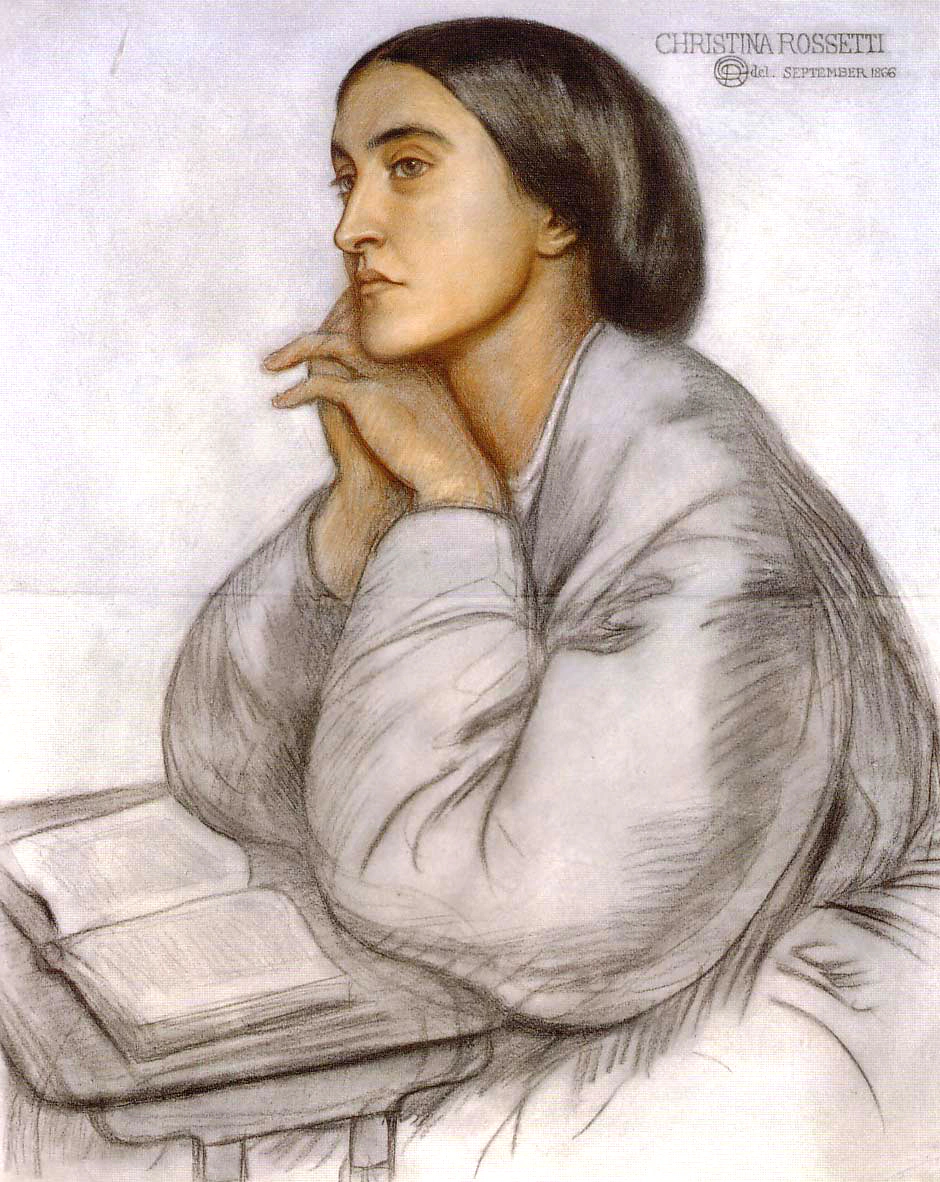
Attr: Dante Gabriel Rossetti
| 12 Quotes | |
| Born as | Christina Georgina Rossetti |
| Occup. | Poet |
| From | United Kingdom |
| Born | December 5, 1830 London, England, United Kingdom |
| Died | December 29, 1894 London, England, United Kingdom |
| Cause | Uterine Cancer |
| Aged | 64 years |
| Cite | |
Citation Formats
APA Style (7th ed.)
Christina rossetti biography, facts and quotes. (2026, February 11). FixQuotes. https://fixquotes.com/authors/christina-rossetti/
Chicago Style
"Christina Rossetti biography, facts and quotes." FixQuotes. February 11, 2026. https://fixquotes.com/authors/christina-rossetti/.
MLA Style (9th ed.)
"Christina Rossetti biography, facts and quotes." FixQuotes, 11 Feb. 2026, https://fixquotes.com/authors/christina-rossetti/. Accessed 5 Mar. 2026.
Early Life and Background
Christina Georgina Rossetti was born on 5 December 1830 in London, into a household where art and exile met. Her father, Gabriele Rossetti, was an Italian patriot and scholar who had fled to England; her mother, Frances Polidori Rossetti, came from an Anglo-Italian family of letters. The Rossetti home was cramped at times and often strained by money and illness, yet saturated with reading, translation, and talk of poetry and painting. That blend of continental intensity and English respectability gave Christina both a cosmopolitan ear and an acute sense of constraint.She grew up alongside siblings who would become cultural forces: Dante Gabriel Rossetti, painter-poet and founder of the Pre-Raphaelite Brotherhood; William Michael Rossetti, critic and editor; and Maria Francesca Rossetti, scholar and devotional writer. Christina was physically fragile from youth and periodically withdrawn by ill health, conditions that intensified her inwardness rather than diminishing her ambition. The family also lived under the shadow of her father's decline, and the pressures of caregiving helped form the severe compassion that later marks her writing: tenderness without sentimentality, and moral intensity without theatrical display.
Education and Formative Influences
Rossetti's education was largely domestic and self-directed, shaped by her mother's disciplined teaching, the household's bilingual culture, and a deep immersion in scripture and Anglican devotional prose. She read widely - from the Bible and the Church Fathers in translation to Dante and the English lyric tradition - while absorbing the aesthetic daring of her brother's circle. From the 1840s onward, the Oxford Movement's revival of high-church spirituality also pressed upon her imagination, encouraging an ethics of renunciation and a sacramental attention to ordinary things. The result was a young poet trained not in salons but in the hard schools of prayer, illness, and close observation.Career, Major Works, and Turning Points
Rossetti began publishing in the 1840s and early 1850s, including contributions to Pre-Raphaelite outlets, but her public breakthrough came with Goblin Market and Other Poems (1862), whose title narrative fused fairy-tale vividness with adult moral psychology. Later volumes such as The Prince's Progress and Other Poems (1866) and A Pageant and Other Poems (1881) consolidated her reputation as a major Victorian lyric poet, while her devotional prose - including The Face of the Deep (1892), a meditation on Revelation - revealed the theological rigor behind her art. Her life was outwardly quiet: she never married, worked for periods at the St. Mary Magdalene penitentiary in Highgate, and endured recurring illness (including what was diagnosed as Graves' disease). Yet the turning points were inward: the hardening of religious conviction, the steady refinement of voice, and the late-life synthesis of poetry and exegesis before her death in London on 29 December 1894.Philosophy, Style, and Themes
Rossetti's writing is often described as devotional, but its engine is psychological truth: she studies desire as something simultaneously holy and perilous, a force that can redeem or devour depending on what it is turned toward. She is fascinated by the mind's rehearsals - memory, longing, and the way love persists beyond reason. “I dream of you to wake; would that I might Dream of you and not wake but slumber on”. The sentence is not merely romantic; it admits the temptation to prefer inner fantasy to the costs of lived fidelity, a temptation she treats with startling candor. Her poems repeatedly stage a self that must wake up - to duty, to faith, to loss - and yet cannot stop longing for the sweetness of sleep.At the same time, Rossetti mistrusted easy persuasion and the vanity of "proof" when the will is resistant. "I might show facts as plain as day: but, since your eyes are blind, you'd say, "Where? What?“ and turn away”. That recognition of moral opacity helps explain her style: plain diction sharpened to a point, musical restraint, and allegory that does not solve itself but presses the reader into self-examination. Her ethic is not grim so much as bracingly realistic about the costs of attachment, which is why mercy in her work can sound like release rather than reward: “Better by far you should forget and smile that you should remember and be sad”. Even when she blesses love, she places it under a covenantal discipline, returning again and again to waiting, obedience, and the hope that trembles but does not break.
Legacy and Influence
Rossetti endured as one of the central poets of the Victorian era because her work crosses boundaries that usually separate reputations: she is at once a Pre-Raphaelite contemporary and a singular lyric voice, a children's poet and an adult moralist, a writer of sensuous imagery who also anatomizes renunciation. Later critics and poets have returned to her for the way she threads eros, faith, and female agency through forms that look simple but are engineered with near-metronomic control. Goblin Market in particular has proven inexhaustible - read as Christian allegory, a parable of addiction, a critique of commodity desire, and a story of sisterly salvation - while her short lyrics continue to model how emotional extremity can be held in a narrow, ringing line. In an age that often demanded certainty, Rossetti left a more difficult inheritance: sincerity without exhibitionism, and spiritual seriousness that never forgets the body's hunger.Our collection contains 12 quotes written by Christina, under the main topics: Truth - Love - Hope - Poetry - Faith.
Other people related to Christina: William Allingham (Poet), Gerald Finzi (Composer), Jean Ingelow (Poet), Laurence Housman (Playwright)
Christina Rossetti Famous Works
- 1881 A Pageant and Other Poems (Poetry Collection)
- 1872 Sing-Song: A Nursery Rhyme Book (Poetry Collection)
- 1870 Commonplace and Other Short Stories (Short Story Collection)
- 1866 The Prince's Progress and Other Poems (Poetry Collection)
- 1862 Goblin Market (Poem)
Source / external links