
Chuck Yeager Biography Quotes 9 Report mistakes
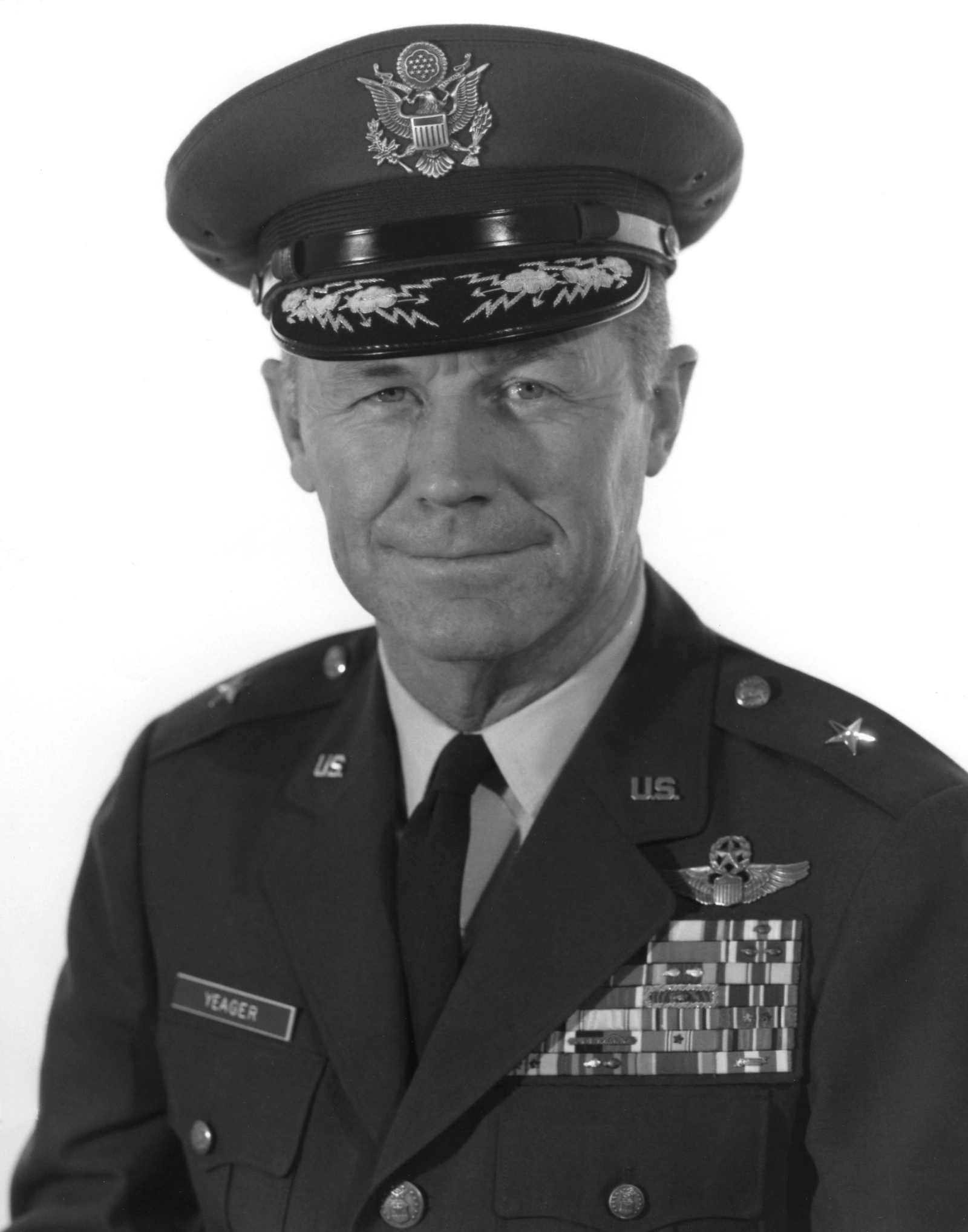
| 9 Quotes | |
| Occup. | Aviator |
| From | USA |
| Born | February 13, 1923 |
| Age | 103 years |
| Cite | |
Citation Formats
APA Style (7th ed.)
Chuck yeager biography, facts and quotes. (2026, February 11). FixQuotes. https://fixquotes.com/authors/chuck-yeager/
Chicago Style
"Chuck Yeager biography, facts and quotes." FixQuotes. February 11, 2026. https://fixquotes.com/authors/chuck-yeager/.
MLA Style (9th ed.)
"Chuck Yeager biography, facts and quotes." FixQuotes, 11 Feb. 2026, https://fixquotes.com/authors/chuck-yeager/. Accessed 27 Mar. 2026.
Early Life and Background
Charles Elwood "Chuck" Yeager was born on February 13, 1923, in Myra, a small West Virginia community in the coal-and-river country of the Appalachian frontier. He grew up in Hamlin, Lincoln County, in a culture that prized self-reliance, hunting skill, and mechanical common sense - traits that later read as calm under pressure rather than romance about the sky. The Great Depression framed his boyhood; money was tight, and competence mattered more than credentials.Yeager carried that rural pragmatism into adulthood. He was not a child prodigy pointed toward flight by family status or elite schooling. Instead, he was formed by work, tools, and a physical familiarity with risk: woods, weather, and machines that could fail. That background helped produce the quality colleagues later noticed in him - a quiet, unshowy confidence that could look like fearlessness but was closer to disciplined attention.
Education and Formative Influences
He graduated from Hamlin High School and enlisted in the U.S. Army Air Corps in September 1941 as an aircraft mechanic, entering military life just before Pearl Harbor transformed American aviation into an industrial and human pipeline. The war years gave him the decisive education: instruction by necessity, peer learning on flight lines, and a meritocratic proving ground where performance could outrank polish. Selected for pilot training, he learned in the cockpit what his upbringing had taught on the ground - that mastery comes from repetition, repair, and respect for limits.Career, Major Works, and Turning Points
Commissioned in 1943, Yeager became a P-51 Mustang fighter pilot in the European theater; after being shot down over France in 1944 he evaded capture with French Resistance help, returned to duty, and finished the war with ace status. Postwar, he stayed in uniform and moved into the experimental world at Muroc Army Air Field (later Edwards AFB), where on October 14, 1947 he flew the Bell X-1 "Glamorous Glennis" past Mach 1, becoming the first person to break the sound barrier in level flight - a milestone of the Cold War research state as much as a personal triumph. He later set records in the X-1 line and other aircraft, commanded fighter units including in the Vietnam era, and became a public symbol of the test pilot as national archetype, an image amplified decades later by Tom Wolfe's The Right Stuff and by Yeager's own memoir, Yeager: An Autobiography.Philosophy, Style, and Themes
Yeager's inner life was anchored in a paradox: a hard-eyed realism about danger paired with a refusal to let danger dominate attention. He insisted, “I was always afraid of dying. Always. It was my fear that made me learn everything I could about my airplane and my emergency equipment, and kept me flying respectful of my machine and always alert in the cockpit”. That sentence explains the source of his reputed coolness - not numbness, but fear converted into preparation. In his world, courage was procedural: checklists, systems knowledge, and the humility to assume something would go wrong.His style - both as aviator and as personality - was laconic, competitive, and anti-theatrical. He spoke in the grammar of judgment, not bravado: “If you want to grow old as a pilot, you've got to know when to push it, and when to back off”. That philosophy sits at the core of flight test culture, where success is not the absence of mishap but the management of unknowns. After the famous Mach 1 flight, he also warned against turning "barriers" into myths: “Later, I realized that the mission had to end in a let-down because the real barrier wasn't in the sky but in our knowledge and experience of supersonic flight”. The theme is epistemic - progress as learning, not conquest - and it reveals the self-discipline beneath his legend: he wanted results, but he wanted understanding even more.
Legacy and Influence
Yeager died in 2020, but his influence persists wherever pilots talk about craft rather than glamour: in the norms of test flying, the insistence on systems mastery, and the idea that a working-class mechanic can become the benchmark for an elite technical profession. In the early Cold War, his Mach 1 flight condensed national anxieties and ambitions into one clean data point; afterward, his career embodied the longer truth that aviation advances through methodical accumulation of knowledge. In popular memory he remains a face of "the right stuff", yet his deeper legacy is a ethic of competence - fear acknowledged, risk studied, limits tested carefully, and achievement treated as the byproduct of preparation.Our collection contains 9 quotes written by Chuck, under the main topics: Motivational - Never Give Up - Freedom - Learning - Training & Practice.
Other people related to Chuck: Philip Kaufman (Director)
Source / external links